Accounting vs Bookkeeping: What's the Difference?
Every business needs accurate financial records.
Whether you're running a small retail shop, a service business, a startup or a growing company, transactions happen every day — sales are made, purchases are recorded, expenses are paid, invoices are issued and customers and suppliers need to be tracked.
Two terms appear repeatedly when talking about these activities:
Bookkeeping and accounting.
They're often used interchangeably, but they don't mean exactly the same thing.
A simple way to remember the difference is:
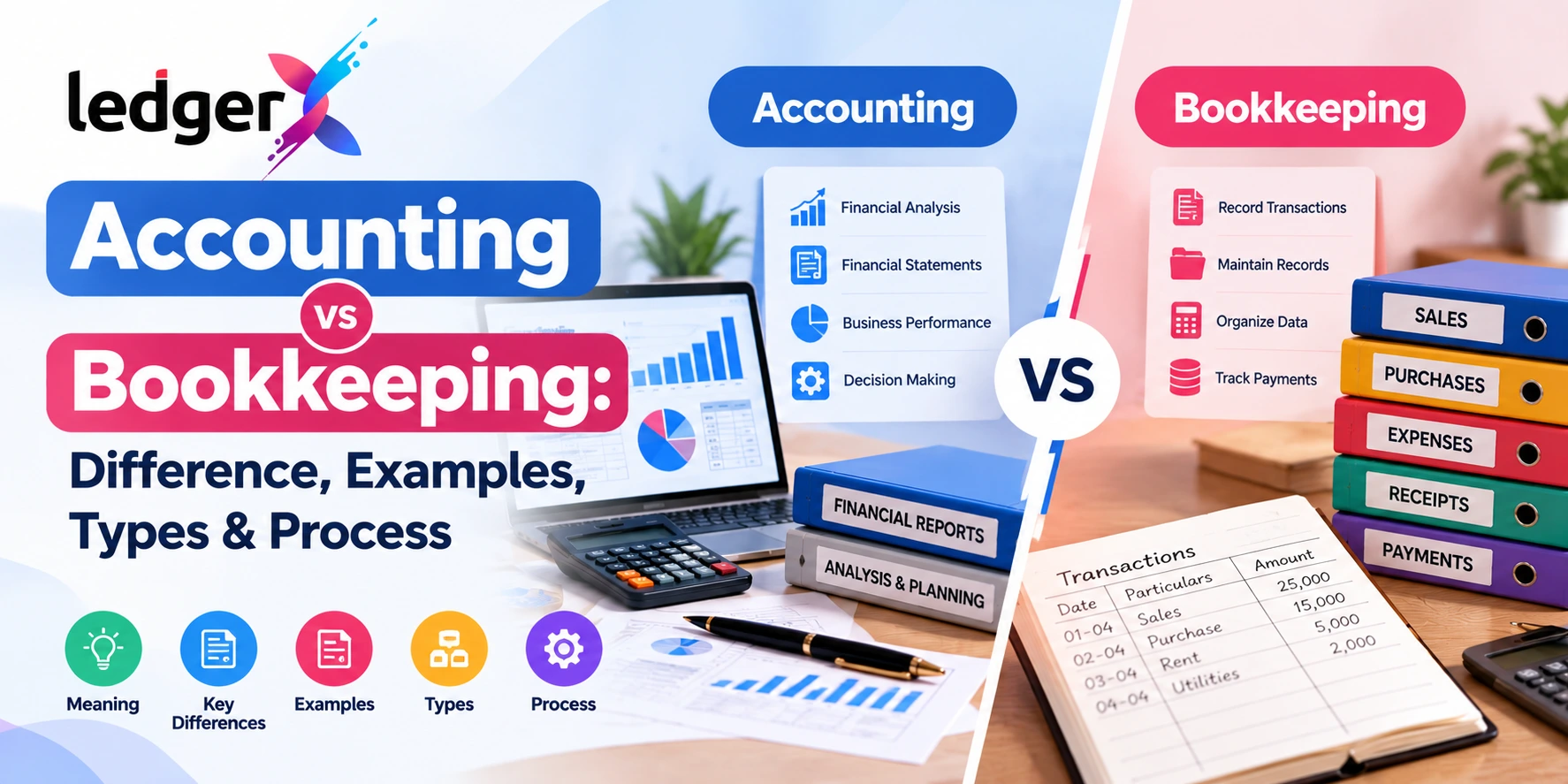
Bookkeeping records the financial transactions. Accounting turns those records into useful financial information.
Let's look at what each means, how they work together and why the distinction matters for a business.
What Is Bookkeeping?
Bookkeeping is the process of recording and organizing a business's financial transactions.
It focuses primarily on making sure transactions are recorded accurately and systematically.
For example, a business might record:
- A ₹25,000 cash sale
- A ₹50,000 credit sale
- A ₹15,000 supplier purchase
- A ₹5,000 electricity expense
- A ₹10,000 customer payment
- A ₹20,000 supplier payment
These transactions form part of the business's accounting records.
In simple terms:
Bookkeeping = Recording financial transactions
What Is Accounting?
Accounting is the broader process of organizing, analyzing, interpreting and reporting financial information.
Accounting uses information generated through bookkeeping to help answer questions such as:
- Is the business profitable?
- How much does the business owe?
- How much do customers owe?
- What assets does the business have?
- How much working capital is available?
- How has the business performed over time?
- What does the Balance Sheet show?
Accounting can therefore move beyond recording transactions to understanding what the financial information means.
In simple terms:
Accounting = Recording + organizing + analyzing + reporting financial information
Accounting vs Bookkeeping: The Main Difference
The easiest way to understand the difference is by looking at their roles.
| Bookkeeping | Accounting |
|---|---|
| Records financial transactions | Uses financial records for analysis and reporting |
| Focuses on transaction entry | Focuses on financial information |
| Maintains books and records | Prepares and interprets financial statements |
| More focused on day-to-day transactions | Broader financial process |
| Produces organized transaction data | Turns data into useful financial information |
| Includes recording sales, purchases and expenses | Includes P&L, Balance Sheet and financial analysis |
| Supports the accounting process | Uses bookkeeping information |
The two aren't competing functions.
Bookkeeping is an important part of accounting.
A Simple Example
Imagine a small clothing store.
During one day, the store:
- Sells ₹40,000 worth of products
- Purchases ₹15,000 of inventory
- Pays ₹3,000 for electricity
- Receives ₹10,000 from a previous credit customer
- Pays a supplier ₹8,000
Bookkeeping
The transactions are recorded:
Sales → ₹40,000
Purchase → ₹15,000
Electricity expense → ₹3,000
Customer payment → ₹10,000
Supplier payment → ₹8,000
That's bookkeeping.
Accounting
The recorded information can then be used to prepare reports and analyze:
- Revenue
- Expenses
- Profit
- Customer receivables
- Supplier payables
- Inventory
- Cash and bank balances
- Financial position
That's where accounting comes in.
Bookkeeping Process
A typical bookkeeping process may include the following steps.
1. Identify transactions
Determine which business transactions have occurred.
Examples:
- Sales
- Purchases
- Expenses
- Receipts
- Payments
- Loans
- Asset purchases
2. Collect supporting documents
These may include:
- Invoices
- Receipts
- Bills
- Bank statements
- Payment records
- Purchase documents
3. Record transactions
Transactions are entered into the appropriate accounts.
4. Classify transactions
Transactions are assigned to relevant categories or accounts.
5. Reconcile records
Bank and other records can be compared with the accounting records to identify differences.
6. Maintain ledgers
Transactions are organized into appropriate ledger accounts.
7. Prepare a trial balance
The balances of accounts can be summarized in a trial balance as part of the accounting process.
Accounting Process
Accounting generally goes beyond simply recording transactions.
A simplified accounting process can look like:
Transactions
↓
Bookkeeping
↓
Ledgers
↓
Trial Balance
↓
Adjustments
↓
Financial Statements
↓
Analysis & Interpretation
Depending on the business and accounting requirements, the process can involve additional steps.
Types of Bookkeeping
Bookkeeping can be performed using different approaches.
Single-Entry Bookkeeping
Single-entry bookkeeping records certain financial transactions in a relatively simple manner.
It may be used for basic record keeping in some very small businesses, but it does not provide the same level of financial information as a full double-entry accounting system.
Double-Entry Bookkeeping
Double-entry bookkeeping records transactions using corresponding debit and credit entries.
The basic principle is:
Every transaction affects at least two accounts.
For example, if a business receives ₹20,000 in cash from a customer:
Cash increases
and
the corresponding customer receivable decreases, depending on the transaction being recorded.
Double-entry bookkeeping forms the foundation of most modern accounting systems.
Types of Accounting
Accounting is a broad field with different areas of specialization.
Some commonly discussed types include:
Financial Accounting
Focuses on preparing financial information and statements for external and internal users.
Management Accounting
Provides financial information that can support management planning and decision-making.
Tax Accounting
Focuses on tax-related records, calculations and compliance.
Cost Accounting
Focuses on understanding and analyzing costs associated with products, services or operations.
Auditing
Involves examining financial information and records according to the relevant scope and requirements.
The exact roles and responsibilities can vary depending on the organization and professional context.
Bookkeeping vs Accounting Example for a Small Business
Consider a small wholesale business.
During the month, it records:
- ₹8,00,000 sales
- ₹5,00,000 purchases
- ₹75,000 operating expenses
- ₹2,00,000 customer collections
- ₹1,50,000 supplier payments
Bookkeeping records:
- Sales transactions
- Purchase transactions
- Expense transactions
- Customer receipts
- Supplier payments
Accounting uses those records to understand:
- Revenue
- Expenses
- Gross or net profitability
- Receivables
- Payables
- Inventory
- Cash position
- Assets and liabilities
The difference becomes clear:
Bookkeeping creates and maintains the financial records.
Accounting uses those records to produce and understand financial information.
Is Bookkeeping Part of Accounting?
Yes.
Bookkeeping is generally considered an important component of the broader accounting process.
Think of it like this:
Bookkeeping
"What happened?"
A sale was made.
A purchase was recorded.
An expense was paid.
A customer paid an invoice.
Accounting
"What do these numbers tell us?"
Revenue increased.
Expenses increased.
Customer receivables are rising.
Inventory is tied up.
Profit changed.
The business's financial position has changed.
This distinction is useful because accurate accounting depends heavily on accurate underlying records.
Why Bookkeeping Is Important
Good bookkeeping provides the foundation for reliable financial information.
1. Keeps transactions organized
Businesses can maintain a record of sales, purchases, expenses and payments.
2. Makes financial reporting easier
Accurate transaction records support the preparation of financial statements.
3. Helps track money
Businesses can monitor cash, bank balances, receivables and payables.
4. Supports tax-related work
Well-maintained records can make tax and GST-related processes more organized, subject to applicable requirements.
5. Helps identify errors
Regular reconciliation and review can help identify inconsistencies.
Why Accounting Is Important
Accounting helps turn financial records into information that can support business decisions.
It can help business owners understand:
- Profitability
- Financial position
- Working capital
- Customer receivables
- Supplier obligations
- Expenses
- Assets
- Liabilities
- Business performance
For example, two businesses could have similar sales but very different levels of debt, receivables and expenses.
Accounting helps reveal those differences.
Bookkeeping vs Accounting for Small Businesses
For a small business, the distinction doesn't necessarily mean that you need two separate people.
A small business owner may record transactions themselves, use accounting software, work with a bookkeeper or engage an accountant depending on their needs.
The important thing is that the underlying financial records are:
- Accurate
- Complete
- Organized
- Up to date
- Properly classified
The accounting and reporting process can then build on those records.
Can Accounting Software Handle Bookkeeping?
Yes.
Modern accounting software can automate or simplify many routine bookkeeping tasks.
Depending on the software, this can include:
- Recording sales
- Creating invoices
- Recording purchases
- Tracking expenses
- Managing customers
- Managing suppliers
- Recording receipts and payments
- Managing inventory
- Maintaining ledgers
- Bank reconciliation
- Generating reports
This means businesses don't necessarily have to maintain every transaction manually in separate spreadsheets.
Bookkeeping and Accounting With LedgerX
LedgerX combines day-to-day transaction management with broader accounting and reporting features.
Businesses can manage:
- GST invoices
- Sales
- Purchases
- Expenses
- Customers
- Suppliers
- Inventory
- Receipts and payments
- Ledgers
- Profit & Loss
- Balance Sheet
- Business reports
This creates a connection between daily bookkeeping activities and financial reporting.
For example:
Record a sale
↓
Customer balance updates
↓
Transaction enters accounting records
↓
Financial reports reflect the transaction
Instead of maintaining separate systems for billing, transactions and reports, businesses can manage these activities within one accounting platform.
Explore LedgerX: https://ledgerx.biz/
Bookkeeping vs Accounting: Which One Does a Business Need?
The answer is usually both functions, even if they are handled by the same person or software.
A business needs reliable bookkeeping to maintain accurate financial records.
It also needs accounting processes to turn those records into meaningful financial information.
As a business grows, the volume and complexity of transactions can increase. This may make professional accounting support more important, especially for tax, compliance, financial reporting and other specialized requirements.
Common Misconceptions About Bookkeeping and Accounting
"Bookkeeping and accounting are exactly the same."
They are closely connected but have different scopes.
"Bookkeeping is only about writing numbers in a notebook."
Modern bookkeeping can involve accounting software, digital invoices, bank transactions, reconciliations and automated data entry.
"Accounting only means calculating profit."
Accounting covers a much broader range of financial recording, reporting and analysis.
"Small businesses don't need proper bookkeeping."
Even a small business needs reliable records to understand sales, expenses, cash, receivables, payables and financial performance.
A Simple Way to Remember the Difference
Think of a business as collecting thousands of pieces of financial information.
Bookkeeping
Collects and organizes the pieces.
Accounting
Uses those pieces to create the bigger picture.
For example:
Invoice → Transaction → Ledger → Trial Balance → Financial Statements → Business Analysis
Bookkeeping plays a major role in getting the transaction into the system correctly.
Accounting takes that information further.
Frequently Asked Questions
What is the difference between accounting and bookkeeping?
Bookkeeping primarily focuses on recording and organizing financial transactions, while accounting is a broader process involving financial reporting, analysis and interpretation.
Is bookkeeping part of accounting?
Yes. Bookkeeping is generally considered an important part of the broader accounting process.
Is bookkeeping easier than accounting?
They require different skills and responsibilities. Bookkeeping focuses heavily on accurate transaction recording and organization, while accounting can involve more extensive financial reporting, analysis and interpretation.
Can an accountant do bookkeeping?
Yes. Depending on their role and responsibilities, an accountant may also perform or oversee bookkeeping activities.
Can a bookkeeper prepare financial statements?
A bookkeeper maintains the underlying financial records used to prepare financial statements. The exact responsibilities can vary based on their role, qualifications and the business's requirements.
Is accounting software useful for bookkeeping?
Yes. Accounting software can automate or simplify tasks such as invoicing, transaction recording, expense tracking, customer and supplier management, reconciliation and financial reporting.
What comes first, bookkeeping or accounting?
Generally, bookkeeping provides the underlying transaction records that feed into the broader accounting process.
Do small businesses need both bookkeeping and accounting?
Small businesses need accurate financial records and appropriate accounting processes. These may be handled by the owner, bookkeeping staff, accountants, accounting software or a combination of them.
Final Takeaway
The difference between bookkeeping and accounting becomes much easier when you think about their purpose.
Bookkeeping records what happened.
Accounting helps explain what those records mean.
A sale, purchase, expense or payment needs to be recorded correctly before it can become useful financial information.
That is why good accounting starts with good bookkeeping.
For a growing business, combining accurate transaction records with accounting software can make it easier to move from individual invoices and payments to a clear view of profit, assets, liabilities, receivables, payables and overall financial position.
The goal isn't simply to record more numbers.
It's to turn those numbers into information that helps you understand the business.