
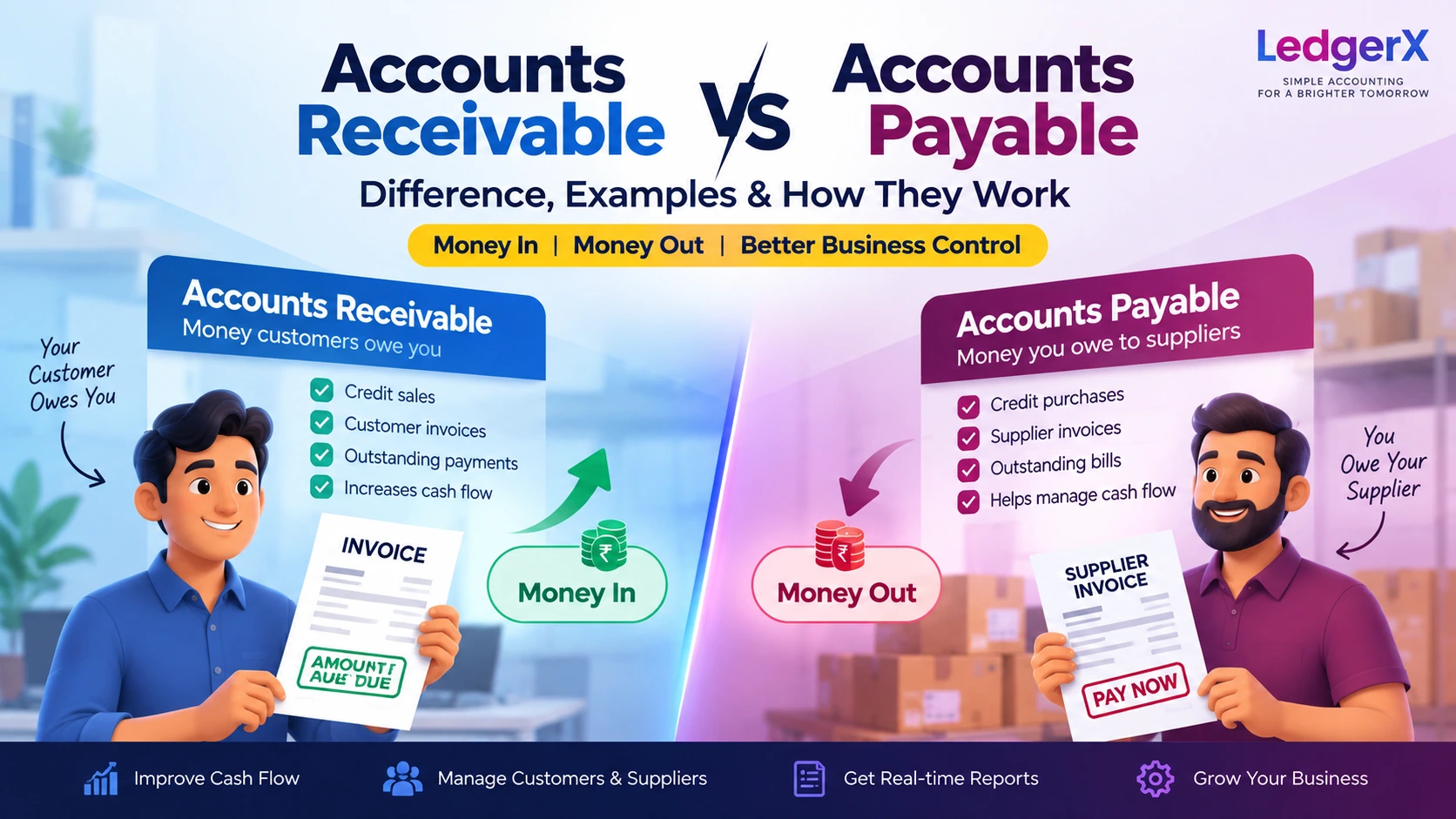
Accounts Receivable vs Accounts Payable: Difference, Examples & How They Work
Running a business often means buying goods from suppliers and selling products or services to customers. Some transactions are paid immediately, while others are completed on credit.
This is where accounts receivable (AR) and accounts payable (AP) become important.
Accounts receivable represents money that customers owe your business, while accounts payable represents money that your business owes suppliers or other vendors.
Although both are important parts of accounting, they have opposite roles in a business.
In this guide, we'll explain accounts receivable vs accounts payable, their differences, examples, accounting treatment, processes, and how businesses can manage them effectively.
What Is Accounts Receivable?
Accounts receivable (AR) is the money a business expects to receive from customers for products or services that have already been sold on credit.
When you make a credit sale, you record the amount as a receivable because the customer has not paid yet.
Simple example
Suppose a business sells goods worth ₹50,000 to a customer on credit.
The customer agrees to pay within 30 days.
The business has:
₹50,000 Accounts Receivable
The customer owes the business ₹50,000, so this amount is recorded as an asset.
Accounts receivable in simple terms
Accounts Receivable = Money customers owe your business
Examples include:
- Credit sales
- Unpaid customer invoices
- Outstanding service bills
- Amounts due from customers
- Short-term customer balances
What Is Accounts Payable?
Accounts payable (AP) is the money a business owes to suppliers, vendors, or other parties for goods or services purchased on credit.
When a business receives goods or services but hasn't paid the supplier yet, the amount becomes a payable.
Simple example
Suppose a retailer purchases inventory worth ₹80,000 from a supplier on credit.
The supplier gives the retailer 30 days to make the payment.
The retailer records:
₹80,000 Accounts Payable
The business owes ₹80,000 to the supplier, so this amount is recorded as a liability.
Accounts payable in simple terms
Accounts Payable = Money your business owes to others
Examples include:
- Supplier invoices
- Purchases made on credit
- Outstanding vendor bills
- Unpaid service expenses
- Amounts due to suppliers
Accounts Receivable vs Accounts Payable
The simplest way to understand the difference is:
| Accounts Receivable | Accounts Payable |
|---|---|
| Money owed to your business | Money your business owes |
| Comes mainly from credit sales | Comes mainly from credit purchases |
| Represents an asset | Represents a liability |
| You collect the money | You pay the money |
| Related mainly to customers | Related mainly to suppliers/vendors |
| Increases when credit sales are made | Increases when credit purchases are made |
| Decreases when customers pay | Decreases when your business pays suppliers |
The easiest way to remember
Accounts Receivable → Receive money
Accounts Payable → Pay money
Key Difference Between Accounts Receivable and Accounts Payable
The fundamental difference is the direction of the money.
Accounts Receivable
Your customer owes you money.
Business → sells → Customer
The customer has to pay your business.
Accounts Payable
You owe your supplier money.
Supplier → sells → Business
Your business has to pay the supplier.
So:
Receivable = Money coming into the business
Payable = Money going out of the business
Accounts Receivable Example
Consider a small electronics store.
The store sells a laptop to a business customer for ₹75,000 on 30-day credit.
The customer doesn't pay immediately.
The accounting records include:
Sales: ₹75,000
Accounts Receivable: ₹75,000
The ₹75,000 becomes an asset until the customer pays.
When the customer pays
After 30 days, the customer transfers ₹75,000 to the business.
The receivable is settled.
Accounts Receivable → decreases
Cash/Bank → increases
The business no longer has ₹75,000 outstanding from that customer.
Accounts Payable Example
Now consider the same electronics store purchasing inventory.
The store purchases laptops worth ₹2,00,000 from a distributor on credit.
The supplier allows 30 days for payment.
The business records:
Purchase/Inventory: ₹2,00,000
Accounts Payable: ₹2,00,000
The ₹2,00,000 is a liability because the business needs to pay the supplier.
When the supplier is paid
After 30 days, the business pays ₹2,00,000.
The result is:
Accounts Payable → decreases
Cash/Bank → decreases
The outstanding supplier balance becomes zero.
Accounts Receivable Process
Managing receivables involves more than simply recording unpaid invoices.
A typical accounts receivable process looks like this:
1. Make a sale
The business sells products or services to a customer.
2. Create an invoice
An invoice is issued with details such as:
- Customer name
- Invoice number
- Products/services
- Quantity
- Price
- Applicable taxes
- Total amount
- Payment terms
- Due date
3. Record the receivable
If the sale is on credit, the outstanding amount becomes accounts receivable.
4. Monitor the due date
The business tracks when the payment is expected.
5. Send reminders
Customers with overdue invoices can be contacted for payment.
6. Receive payment
The customer pays the outstanding amount.
7. Reconcile the transaction
The payment is recorded against the appropriate invoice.
This process helps businesses understand how much money they are expected to receive and when.
Accounts Payable Process
The accounts payable process works in the opposite direction.
1. Purchase goods or services
The business purchases goods or services from a supplier.
2. Receive the supplier invoice
The supplier provides an invoice containing the transaction details.
3. Verify the invoice
The business checks:
- Supplier details
- Invoice number
- Products/services
- Quantity
- Price
- Taxes
- Total amount
- Due date
4. Record the payable
If the purchase is made on credit, the amount becomes accounts payable.
5. Track the due date
The business monitors when payment must be made.
6. Make the payment
The supplier is paid according to the agreed payment terms.
7. Record and reconcile the payment
The payment is matched with the relevant supplier invoice.
AR vs AP: Accounting Treatment
Accounts receivable and accounts payable appear on different sides of the balance sheet.
Accounts Receivable
Accounts receivable is generally classified as a current asset when the business expects to collect the amount within the normal operating cycle or within the applicable short-term period.
It represents an economic benefit expected to come into the business.
Accounts Payable
Accounts payable is generally classified as a current liability when the business expects to settle the amount in the short term.
It represents an obligation that the business needs to pay.
In simple terms
AR → Asset
AP → Liability
Accounts Receivable Journal Entry Example
Suppose a business sells goods worth ₹40,000 on credit.
A simplified journal entry would be:
Accounts Receivable Dr. ₹40,000 To Sales ₹40,000
This records the customer's outstanding amount.
When the customer pays:
Bank/Cash Dr. ₹40,000 To Accounts Receivable ₹40,000
The receivable is now settled.
Accounts Payable Journal Entry Example
Suppose a business purchases goods worth ₹60,000 on credit.
A simplified entry would be:
Purchases/Inventory Dr. ₹60,000 To Accounts Payable ₹60,000
When the supplier is paid:
Accounts Payable Dr. ₹60,000 To Bank/Cash ₹60,000
The outstanding payable is cleared.
Actual accounting entries can vary depending on the nature of the transaction, inventory accounting method, taxes, discounts, and other circumstances.
Why Accounts Receivable Is Important
Accounts receivable tells a business how much money is currently outstanding from customers.
Effective AR management can help businesses:
Improve cash flow visibility
Knowing when customer payments are due helps businesses plan upcoming expenses.
Reduce overdue invoices
Tracking outstanding invoices makes it easier to identify overdue payments.
Monitor customer payment behaviour
Businesses can identify customers who regularly pay late.
Improve working capital management
Faster collection of receivables can help reduce pressure on working capital.
Reduce bad-debt risk
Regular monitoring can help businesses identify potentially problematic outstanding balances earlier.
Why Accounts Payable Is Important
Accounts payable is equally important because suppliers and vendors need to be paid on time.
Good AP management can help businesses:
Avoid missed payments
Tracking supplier invoices helps businesses avoid accidentally overlooking due dates.
Maintain supplier relationships
Consistent and timely payments can support healthy supplier relationships.
Plan cash requirements
Knowing upcoming obligations helps businesses plan available cash.
Avoid unnecessary penalties
Businesses can track payment deadlines and applicable terms.
Understand short-term liabilities
AP provides visibility into amounts the business needs to pay.
Accounts Receivable and Accounts Payable Example
Consider a small wholesale business.
During the month:
- Credit sales: ₹5,00,000
- Customer collections: ₹3,50,000
- Credit purchases: ₹3,00,000
- Supplier payments: ₹2,00,000
Assume there were no other changes to opening balances.
The business generated ₹5,00,000 in credit sales, but only ₹3,50,000 has been collected.
Therefore, the period's increase in receivables from these transactions is:
₹5,00,000 − ₹3,50,000 = ₹1,50,000
Similarly, the business made ₹3,00,000 of credit purchases but paid suppliers ₹2,00,000.
The period's increase in payables from these transactions is:
₹3,00,000 − ₹2,00,000 = ₹1,00,000
This example shows why a business can have significant sales and purchases while still having substantial outstanding receivables and payables.
Accounts Receivable vs Accounts Payable and Cash Flow
AR and AP have an important relationship with cash flow.
Suppose your business records ₹10 lakh in sales during a month.
That does not necessarily mean ₹10 lakh has been received in cash.
If ₹4 lakh remains unpaid by customers, the business has:
₹4 lakh outstanding Accounts Receivable
Similarly, if the business purchases ₹6 lakh worth of goods on credit and hasn't paid ₹2 lakh yet, it has:
₹2 lakh outstanding Accounts Payable
Therefore, businesses should monitor:
- Sales
- Customer collections
- Receivables
- Purchases
- Supplier payments
- Payables
- Available cash
Looking only at sales or profit does not provide the complete picture of short-term cash requirements.
What Is the Difference Between Receivables and Payables?
The distinction can be summarized in one sentence:
Receivables are amounts the business expects to receive, while payables are amounts the business is obligated to pay.
For example:
Customer owes your business ₹1,00,000 → Receivable
Your business owes supplier ₹80,000 → Payable
Both need to be tracked because they affect the business's financial position and cash planning.
Accounts Receivable vs Accounts Payable: Which Is an Asset?
Accounts receivable is an asset.
It represents money that customers owe the business and that the business expects to collect.
Accounts payable is a liability.
It represents money the business owes to suppliers or other parties.
Quick reference
| Account | Classification |
|---|---|
| Accounts Receivable | Asset |
| Accounts Payable | Liability |
| Customer outstanding invoice | Receivable |
| Supplier outstanding invoice | Payable |
| Money expected from customers | Receivable |
| Money owed to suppliers | Payable |
How to Manage Accounts Receivable Effectively
Businesses can improve receivables management by:
1. Set clear payment terms
Clearly communicate whether customers have 7, 15, 30 or another agreed number of days to pay.
2. Issue invoices promptly
Delayed invoices can delay collections.
3. Track outstanding invoices
Maintain a clear list of unpaid and overdue invoices.
4. Follow up on overdue payments
Send payment reminders before and after due dates where appropriate.
5. Review customer balances
Regularly check how much each customer owes.
6. Monitor ageing
Group receivables according to how long they have remained outstanding.
For example:
- Current
- 1–30 days overdue
- 31–60 days
- 61–90 days
- 90+ days
This makes overdue balances easier to identify.
How to Manage Accounts Payable Effectively
Businesses can improve AP management by:
1. Record supplier invoices immediately
Avoid keeping supplier invoices unrecorded.
2. Track payment due dates
Maintain visibility into upcoming supplier payments.
3. Verify invoices
Check the invoice before making payment.
4. Avoid duplicate payments
Maintain organized supplier records and invoice references.
5. Prioritize upcoming obligations
Review which payments are due soon.
6. Reconcile supplier accounts
Regular reconciliation helps identify differences between your records and supplier statements.
What Is an Accounts Receivable Ageing Report?
An accounts receivable ageing report organizes outstanding customer balances according to how long they have been unpaid.
For example:
| Customer | Current | 1–30 Days | 31–60 Days | 60+ Days | Total |
|---|---|---|---|---|---|
| Customer A | ₹20,000 | ₹10,000 | ₹0 | ₹0 | ₹30,000 |
| Customer B | ₹15,000 | ₹0 | ₹12,000 | ₹5,000 | ₹32,000 |
| Customer C | ₹8,000 | ₹4,000 | ₹0 | ₹3,000 | ₹15,000 |
This report helps businesses identify:
- Total outstanding customer balances
- Overdue invoices
- Customers with older balances
- Collection priorities
- Changes in receivables over time
Common Mistakes in Managing AR and AP
Businesses can run into problems when receivables and payables are not properly maintained.
Common mistakes include:
Not recording credit transactions
Unrecorded invoices can make financial reports inaccurate.
Forgetting payment due dates
This can result in delayed collections or missed supplier payments.
Mixing customer and supplier balances
Receivables and payables should be clearly separated.
Not reconciling payments
Payments should be matched with the appropriate invoices.
Maintaining everything manually
Large numbers of spreadsheets, invoices and payment records can become difficult to manage.
Not reviewing outstanding balances
Businesses should regularly check what they are owed and what they owe.
Can Accounting Software Help Manage AR and AP?
Yes. Accounting software can make receivables and payables management more organized by bringing transactions, invoices, customers, suppliers and reports together.
Depending on the software, businesses can use features such as:
- Customer management
- Supplier management
- Sales invoices
- Purchase records
- Expense tracking
- Receivables tracking
- Payables tracking
- Payment records
- Outstanding reports
- Ageing reports
- Financial reports
- Profit & Loss
- Balance Sheet
Instead of maintaining separate spreadsheets for sales, purchases, customers and payments, businesses can manage these records within a centralized accounting system.
Managing AR and AP With LedgerX
For businesses using LedgerX, customer and supplier transactions can be managed alongside billing, purchases, expenses and financial reporting.
LedgerX brings business accounting activities into one platform, helping businesses manage areas such as:
- GST billing and invoices
- Sales transactions
- Purchase transactions
- Customer records
- Supplier records
- Expenses
- Inventory
- Receivables and payables
- Profit & Loss
- Balance Sheet
- Business reports
This can make it easier to connect day-to-day transactions with the financial information needed to understand the business.
Explore LedgerX's accounting and billing features
AR vs AP: A Simple Comparison
| Feature | Accounts Receivable | Accounts Payable |
|---|---|---|
| Meaning | Money customers owe you | Money you owe suppliers |
| Related party | Customer | Supplier/vendor |
| Type | Asset | Liability |
| Created by | Credit sales | Credit purchases |
| Cash movement | Money expected in | Money expected out |
| Main activity | Collection | Payment |
| Example | ₹50,000 customer invoice | ₹30,000 supplier invoice |
| Main report | AR ageing | AP/outstanding report |
| Goal | Collect on time | Pay on time |
How AR and AP Affect Working Capital
Working capital is commonly calculated as:
Working Capital = Current Assets − Current Liabilities
Accounts receivable is generally included among current assets, while accounts payable is generally included among current liabilities.
Therefore, changes in AR and AP can affect working capital.
For example:
If customer receivables increase significantly because customers are taking longer to pay, more money can remain tied up in outstanding invoices.
On the other hand, supplier credit can allow a business to defer some payments, subject to agreed payment terms.
This is why businesses should monitor both sides rather than looking only at sales or profit.
AR and AP Best Practices for Small Businesses
Here is a practical checklist:
For Accounts Receivable
- Create invoices promptly
- Set clear payment terms
- Track due dates
- Follow up on overdue invoices
- Review customer balances regularly
- Monitor receivable ageing
- Reconcile customer payments
For Accounts Payable
- Record supplier invoices promptly
- Verify bills before payment
- Track payment due dates
- Reconcile supplier accounts
- Avoid duplicate payments
- Maintain organized supplier records
- Plan upcoming payments
Frequently Asked Questions
What is the main difference between accounts receivable and accounts payable?
Accounts receivable is money customers owe your business, while accounts payable is money your business owes suppliers or other vendors.
Is accounts receivable an asset or liability?
Accounts receivable is generally a current asset because it represents amounts the business expects to collect from customers.
Is accounts payable an asset or liability?
Accounts payable is generally a current liability because it represents amounts the business owes and expects to pay.
Is AR debit or credit?
Accounts receivable normally has a debit balance. When a credit sale is recorded, accounts receivable is debited. When the customer pays, the receivable is credited.
Is AP debit or credit?
Accounts payable normally has a credit balance. When a credit purchase or payable is recorded, accounts payable is credited. When the business makes the payment, the payable is debited.
Is accounts receivable the same as sales?
No. Sales represent revenue generated from selling goods or services. Accounts receivable represents the portion of those sales that customers still owe when the sale was made on credit.
Is accounts payable the same as expenses?
No. Accounts payable represents amounts owed. An underlying transaction may relate to inventory, expenses, assets or other purchases. The accounting treatment depends on the nature of the transaction.
Why are accounts receivable and accounts payable important?
They help businesses understand money expected from customers and money owed to suppliers. Monitoring both can improve financial visibility and cash planning.
How can small businesses manage AR and AP?
Businesses can use organized invoicing, payment tracking, customer and supplier records, ageing reports, reconciliation and accounting software to manage receivables and payables more efficiently.
Final Takeaway
Accounts receivable and accounts payable are two sides of everyday business transactions.
Accounts Receivable = Money customers owe your business.
Accounts Payable = Money your business owes others.
Understanding the difference is important because both affect a company's assets, liabilities, cash flow and working capital.
For small businesses, manually tracking every invoice, purchase, payment and outstanding balance can become difficult as transaction volumes increase. A centralized accounting system can help connect billing, purchases, expenses, customers, suppliers and financial reports in one place.
The key is not simply to track how much your business sells or spends, but also to understand when money is expected to come in and when it needs to go out.