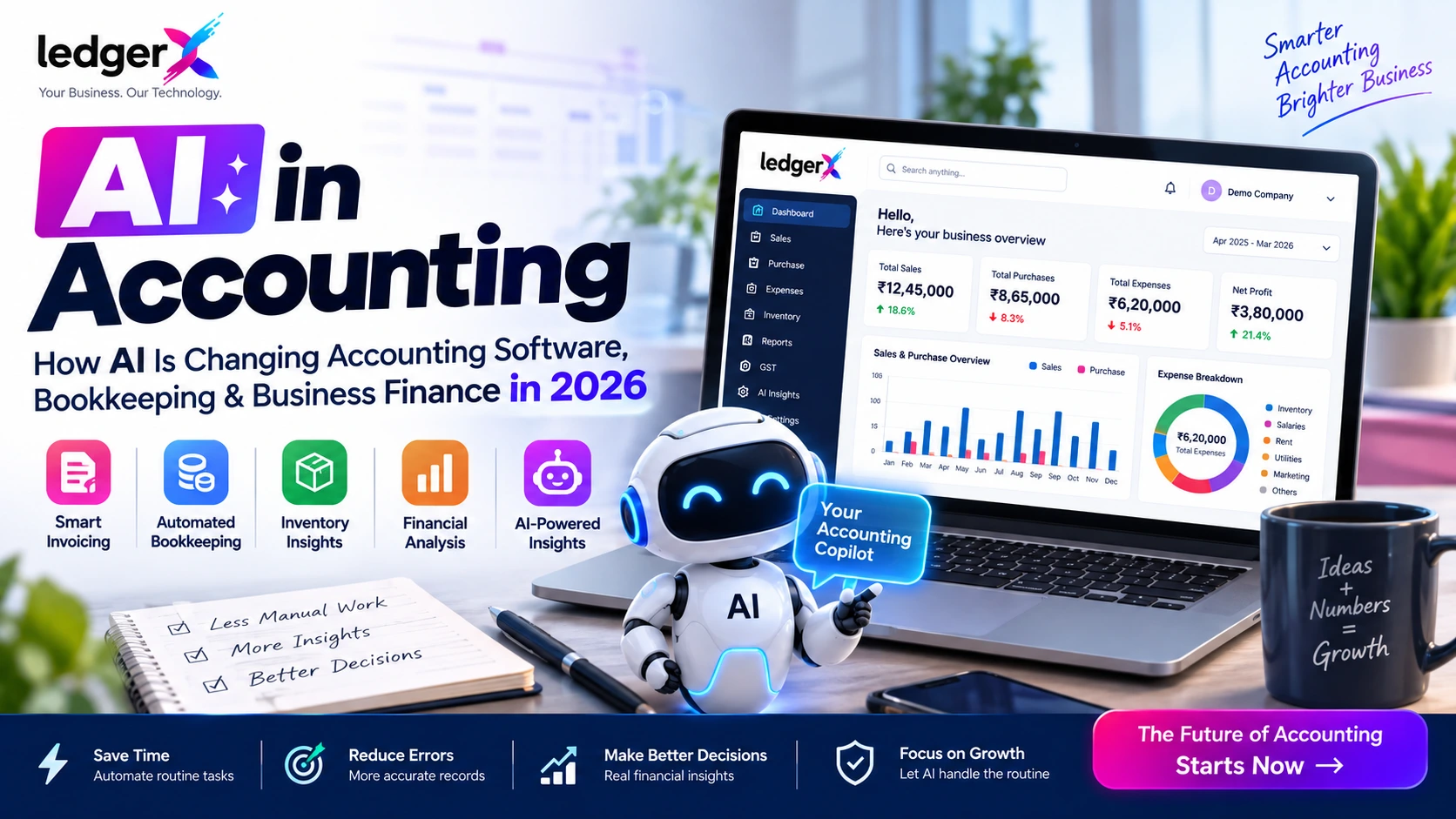
AI in Accounting: How AI Is Changing Accounting Software, Bookkeeping & Business Finance in 2026
Accounting has traditionally involved large amounts of repetitive work: recording transactions, entering invoices, categorizing expenses, reconciling accounts, preparing reports and reviewing financial data.
Artificial intelligence is changing how many of these processes are performed.
Modern accounting software can use AI to process information, identify patterns, automate repetitive workflows and generate financial insights. At the same time, a newer category known as agentic AI is emerging, where AI systems can execute multiple steps within a workflow with defined human controls and approvals.
The result is a gradual shift from accounting software that simply stores financial data to systems that can increasingly process, analyze and assist with financial work.
What Is AI in Accounting?
AI in accounting refers to the use of artificial intelligence and related technologies to assist with accounting, bookkeeping, financial analysis, reporting and finance workflows.
Depending on the software, AI can be used for activities such as:
- Transaction categorization
- Invoice and document processing
- Expense analysis
- Bank reconciliation
- Accounts payable and receivable workflows
- Financial reporting
- Anomaly detection
- Forecasting
- Data analysis
- Business insights
- Accounting-related queries
Accounting automation can combine several technologies, including AI, machine learning, optical character recognition (OCR), robotic process automation and intelligent data processing.
The important distinction is that AI does not necessarily mean completely autonomous accounting. In many real-world systems, AI assists with processing and recommendations while people remain responsible for reviewing important financial information and decisions.
How Is AI Changing Accounting Software in 2026?
Traditional accounting software primarily focused on recording transactions and generating reports.
AI-powered accounting software is increasingly designed to help businesses process and understand those transactions.
Here are some of the major areas changing in 2026.
1. Automated Transaction Categorization
Businesses can have hundreds or thousands of financial transactions every month.
Manually categorizing every transaction can consume significant time.
AI can analyze transaction information and help identify appropriate categories based on available data and previous patterns.
For example:
Transaction:
₹2,500 – ABC Internet Services
AI-assisted accounting software may recognize the transaction as a business internet or communication expense.
The accountant or business owner can then review the suggested classification instead of starting from scratch.
This approach can reduce repetitive data-entry work while keeping human review in the workflow.
2. AI-Powered Bookkeeping
Bookkeeping involves recording and organizing financial transactions so that businesses can maintain accurate financial records.
AI is increasingly being used to assist with parts of this process.
AI-powered bookkeeping can potentially help with:
- Transaction classification
- Expense categorization
- Invoice data extraction
- Matching transactions
- Identifying unusual entries
- Preparing accounting information
- Generating summaries
- Organizing financial data
However, AI-generated accounting information should still be reviewed according to the importance of the transaction and the controls used by the business.
This is particularly important when financial information is used for tax filings, statutory reporting or important business decisions.
3. AI for Invoice and Expense Processing
Invoices and expense documents contain information such as:
- Supplier details
- Invoice numbers
- Dates
- Amounts
- Tax information
- Product or service details
- Payment information
AI-powered systems can extract and process information from documents, reducing the amount of manual data entry required.
For businesses processing large numbers of invoices, this can make accounts payable and expense management more efficient.
Accounting automation technologies such as OCR and intelligent data processing are already being used alongside AI to automate document and transaction workflows.
4. AI-Assisted Bank Reconciliation
Bank reconciliation is another area where automation can reduce repetitive accounting work.
The basic process involves comparing:
Business accounting records ↔ Bank transactions
An AI-enabled system can help identify matching transactions and highlight items that require attention.
For example, it may help identify:
- Matching payments
- Matching receipts
- Duplicate transactions
- Unusual transactions
- Missing entries
- Transactions requiring review
Instead of manually checking every transaction, users can focus more attention on exceptions.
5. AI-Powered Financial Reports
Accounting software already generates reports such as:
- Profit & Loss
- Balance Sheet
- Cash flow information
- Sales reports
- Purchase reports
- Expense reports
- Receivables
- Payables
- Inventory reports
AI adds another layer by helping users interpret the information.
For example, instead of only showing:
Sales increased by 18%.
an AI-powered system could help identify:
Sales increased compared with the previous period, while expenses also changed during the same period.
The objective is to turn raw accounting data into information that is easier for business owners to understand.
6. AI for Business Insights
One of the important developments in accounting software is the movement from reporting what happened toward helping users understand what the numbers may indicate.
AI can analyze financial data to identify patterns such as:
- Changes in expenses
- Sales trends
- Unusual transactions
- Changes in profitability
- Receivable patterns
- Business performance changes
For small businesses without a dedicated finance team, this type of analysis can make financial information easier to interpret.
LedgerX also includes AI-powered business insights alongside accounting, billing, inventory and financial reporting features.
Explore LedgerX Accounting Software
7. AI in Accounts Receivable and Payable
Accounts receivable and accounts payable involve tracking money that businesses need to receive or pay.
AI-assisted systems can help businesses analyze:
Accounts Receivable
- Outstanding invoices
- Customer payment patterns
- Overdue amounts
- Receivable ageing
- Payment trends
Accounts Payable
- Supplier invoices
- Outstanding payments
- Payment schedules
- Invoice matching
- Unusual or duplicate entries
This can help businesses spend less time searching through financial records and more time addressing transactions that actually require attention.
8. AI-Powered Forecasting and Financial Planning
Historical accounting data can also be used for financial analysis and forecasting.
AI-based systems can analyze previous information to help businesses examine:
- Revenue trends
- Expense patterns
- Cash requirements
- Seasonal changes
- Profitability trends
- Potential financial scenarios
However, forecasts are not guarantees.
Business conditions can change because of market conditions, customer behavior, costs, regulations and many other factors. AI-generated forecasts should therefore be treated as analytical inputs rather than certain predictions.
What Is Agentic Accounting?
One of the newer concepts appearing in accounting technology in 2026 is agentic accounting.
Traditional software generally follows predefined workflows:
User → Software → Result
AI-assisted software can add suggestions:
User → AI assistance → User reviews → Result
Agentic accounting aims to go further:
Goal → AI plans tasks → AI executes workflow → Exceptions go to human → Result
Agentic AI systems are designed to plan and execute multiple steps within a workflow rather than simply answer individual questions. Accounting-industry sources are increasingly discussing applications such as reconciliation, invoice matching, journal preparation and close-related workflows.
For example, an agentic accounting workflow could potentially:
- Receive an invoice
- Extract relevant information
- Match it against existing records
- Identify the appropriate transaction
- Check for exceptions
- Prepare an accounting entry
- Request human approval where required
- Update the accounting system
The exact capabilities depend on the software and its integrations.
AI Accounting vs Agentic Accounting
| Traditional Accounting Software | AI-Assisted Accounting | Agentic Accounting |
|---|---|---|
| Records transactions | Analyzes transactions | Can execute multi-step workflows |
| Generates reports | Helps interpret reports | Can prepare workflow outputs |
| User performs most actions | AI assists users | AI can perform defined actions |
| Rule-based workflows | AI + rules | AI agents + workflows |
| Mostly reactive | More analytical | More autonomous |
| Human performs execution | Human + AI collaboration | Human supervises exceptions and approvals |
The distinction is still evolving, and not every product marketed as “agentic” necessarily provides the same level of autonomy. Wolters Kluwer specifically notes that some tools described as agentic may be closer to scripted automation than full agentic orchestration.
Benefits of AI in Accounting
Faster Routine Work
AI can reduce repetitive work involved in processing transactions, documents and financial information.
Less Manual Data Entry
Automated extraction and transaction processing can reduce the need to manually enter information repeatedly.
Faster Access to Financial Information
When transactions and reports are processed efficiently, business owners can access financial information more quickly.
Better Financial Visibility
AI-powered analysis can help identify patterns and changes that may not be immediately obvious from raw transaction lists.
Scalable Accounting Processes
Automation can help businesses manage growing transaction volumes without increasing every manual process at the same rate.
More Time for Higher-Value Work
The goal of automation is not simply to eliminate accounting work. It can shift human attention toward review, controls, financial planning, analysis and business decisions.
IFAC describes AI and intelligent automation as technologies that can help accountants spend more time on higher-value activities and decision support while also creating new requirements around governance and controls.
What Are the Risks of AI in Accounting?
AI can improve accounting workflows, but financial data requires a higher level of control than many ordinary business applications.
1. Incorrect Information
AI systems can make incorrect classifications, interpretations or recommendations.
2. Data Privacy
Accounting systems contain sensitive business and financial information. Businesses need to understand how data is stored, processed and protected.
3. Lack of Human Review
Important financial transactions should not automatically be trusted simply because an AI system produced the result.
4. Incorrect Automation
An automated workflow can repeat an error at scale if its rules, data or AI output are incorrect.
5. Auditability
Businesses need appropriate records of how financial information was processed, particularly when automated systems are involved.
6. AI Hallucinations
Generative AI can produce plausible but incorrect information. This is particularly important when AI is used for accounting, tax or compliance-related questions.
The accounting profession is therefore placing significant emphasis on AI governance, controls, confidentiality and professional judgment. IFAC maintains dedicated resources covering AI use, governance, risks and emerging agentic AI in accounting.
Does AI Replace Accountants?
AI changes accounting work, but that does not mean every accounting task can or should be handed over to AI.
Accounting professionals still provide important functions such as:
- Professional judgment
- Financial review
- Tax interpretation
- Compliance oversight
- Internal controls
- Audit
- Financial planning
- Business advisory
- Decision support
A more realistic model is:
AI handles repetitive processing → humans review important outputs → professionals handle judgment and decisions.
This human-review model remains important for agentic AI as well. A 2026 Journal of Accountancy report on agentic AI cited survey findings showing that CFOs continue to view human oversight as important for accuracy in finance processes.
How Small Businesses Can Use AI in Accounting
AI is not only relevant to large corporations.
Small businesses can use AI-enabled accounting software to simplify everyday activities such as:
Billing
Create and manage invoices and GST bills.
Expense Management
Record and organize business expenses.
Inventory
Track stock and product information.
Financial Reports
Review Profit & Loss, Balance Sheet and other reports.
Business Analysis
Understand changes in sales, expenses and profitability.
Accounting Automation
Reduce repetitive manual accounting tasks where the software supports automation.
For a small business, the biggest benefit may not be having the most advanced AI system. It may simply be having billing, accounting, inventory and financial information connected in one place.
What Should You Look for in AI Accounting Software?
If you are evaluating an AI-powered accounting platform, look beyond the word "AI".
Consider whether the software provides:
Core Accounting
- Ledgers
- Income and expense tracking
- Profit & Loss
- Balance Sheet
- Trial Balance
Billing
- GST invoices
- Sales invoices
- Purchase management
- Customer management
- Supplier management
Inventory
- Stock tracking
- Product management
- Stock reports
Reporting
- Financial reports
- GST reports
- Receivable reports
- Payable reports
- Business performance reports
AI Capabilities
- AI-powered insights
- Transaction analysis
- Automated categorization
- Anomaly detection
- Financial analysis
Security & Controls
- User permissions
- Data protection
- Audit trails
- Human review controls
- Export and backup options
The most useful AI feature is not necessarily the one with the most impressive description. It is the one that solves a real accounting problem while providing sufficient visibility and control.
The Future of AI in Accounting
The development of AI accounting software is likely to continue moving through several stages.
Stage 1: Digital Accounting
Businesses move from paper-based accounting to software.
Stage 2: Cloud Accounting
Accounting data becomes accessible across devices and locations.
Stage 3: Automated Accounting
Software automates repetitive workflows.
Stage 4: AI-Assisted Accounting
AI helps analyze transactions, documents and financial information.
Stage 5: Agentic Accounting
AI agents increasingly execute multi-step workflows under defined controls and human supervision.
The accounting industry is already discussing this transition. In 2026, professional accounting organizations and technology publications are treating agentic AI as an emerging area rather than a purely theoretical concept.
AI Accounting Is Becoming More Than Automation
The biggest change may not be that accounting software becomes capable of doing more tasks.
It is that accounting software is increasingly becoming a financial intelligence layer for businesses.
Instead of:
Enter → Record → Report
the workflow is gradually moving toward:
Capture → Automate → Analyze → Understand → Act
AI can help connect these stages.
For business owners, this can mean spending less time searching through financial records and more time understanding what those records mean.
How LedgerX Fits Into AI-Powered Accounting
LedgerX is designed to bring accounting, GST billing, expenses, inventory and financial reporting together for Indian businesses.
Businesses can use LedgerX to manage:
- GST billing
- Sales and purchases
- Expenses
- Inventory
- Profit & Loss
- Balance Sheet
- Financial reports
- GSTR-related reports
- TDS/TCS-related reporting
- Business insights
- AI-powered insights
The combination of accounting data and AI-powered insights can help businesses move beyond simply recording transactions toward understanding their financial performance.
Frequently Asked Questions
What is AI in accounting?
AI in accounting refers to using artificial intelligence to assist with accounting tasks such as transaction analysis, bookkeeping, document processing, reconciliation, reporting and financial insights.
What is AI accounting software?
AI accounting software combines traditional accounting functionality with artificial intelligence to automate, analyze or assist with accounting and financial workflows.
How is AI used in bookkeeping?
AI can assist with transaction categorization, document processing, invoice data extraction, reconciliation, expense analysis and financial information processing, depending on the software.
What is agentic accounting?
Agentic accounting refers to accounting systems that use AI agents to plan and execute multiple steps within accounting workflows, with human review or approval where appropriate.
Will AI replace accountants?
AI can automate and assist with many repetitive accounting tasks, but professional judgment, review, compliance oversight, controls and business advisory remain important parts of accounting work.
Is AI accounting suitable for small businesses?
Yes. AI-enabled accounting software can help small businesses manage billing, expenses, inventory, financial reports and other accounting activities, depending on the platform's capabilities.
Is AI-generated accounting information always accurate?
No. AI outputs can contain errors. Financial information should be reviewed using appropriate accounting controls, particularly before tax filings, statutory reporting or important financial decisions.
Conclusion
AI in accounting is moving from simple automation toward intelligent, increasingly autonomous financial workflows.
In 2026, businesses can already find AI-powered accounting applications for bookkeeping, invoice processing, reconciliation, reporting, financial analysis and business insights. At the same time, agentic accounting is emerging as the next stage, where AI systems can execute multiple steps within defined workflows.
The future of accounting is therefore unlikely to be simply humans versus AI.
It is more likely to be accounting professionals and business owners working with increasingly capable software, while humans continue to provide judgment, oversight and accountability.
For Indian businesses, the practical goal is straightforward: use technology to reduce repetitive accounting work, gain clearer financial information and make business management easier.