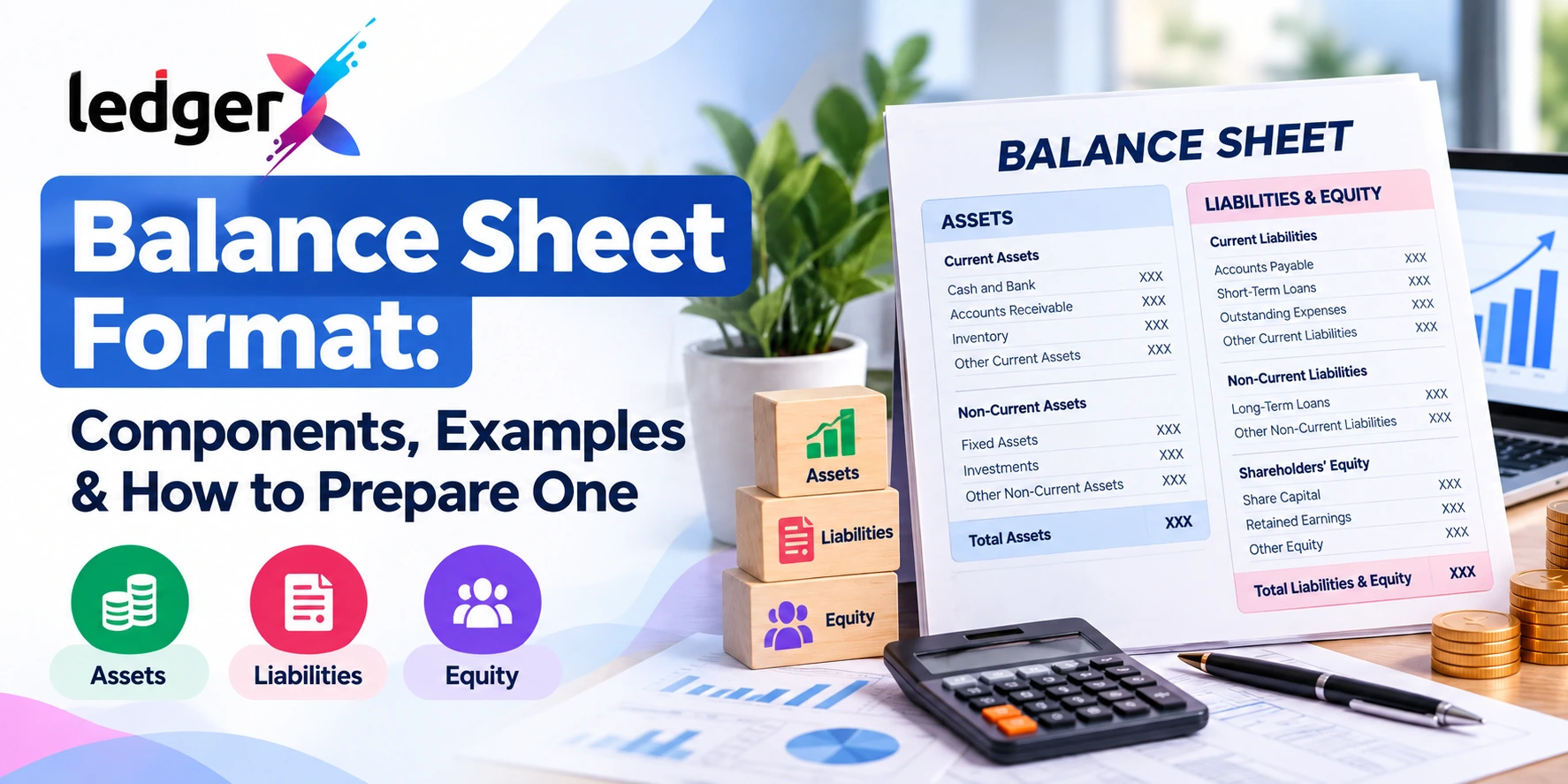
Balance Sheet Format: Components, Examples & How to Prepare One
If you want to understand the financial position of a business, one of the first reports you should look at is the Balance Sheet.
A Profit & Loss statement tells you how much a business earned or spent during a period. A Balance Sheet answers a different question:
What does the business own, what does it owe, and what is left for the owners?
This makes the Balance Sheet useful for business owners, accountants, lenders, investors and anyone trying to understand the financial position of a company.
In this guide, we'll explain the balance sheet format, its main components, a practical example, and the basic process of preparing one.
What Is a Balance Sheet?
A Balance Sheet is a financial statement that presents a business's assets, liabilities and equity at a specific date.
It is based on the fundamental accounting equation:
Assets = Liabilities + Equity
This equation is the foundation of the Balance Sheet.
For example, if a business has:
- Assets: ₹10,00,000
- Liabilities: ₹4,00,000
- Equity: ₹6,00,000
Then:
₹10,00,000 = ₹4,00,000 + ₹6,00,000
The two sides balance.
Simple Balance Sheet Format
A basic Balance Sheet can be structured like this:
| Particulars | Amount |
|---|---|
| Assets | |
| Non-Current Assets | ₹XX |
| Current Assets | ₹XX |
| Total Assets | ₹XX |
| Equity & Liabilities | |
| Owner's Equity / Shareholders' Equity | ₹XX |
| Non-Current Liabilities | ₹XX |
| Current Liabilities | ₹XX |
| Total Equity & Liabilities | ₹XX |
The exact presentation can vary depending on the type of business and applicable accounting requirements.
The key principle remains:
Total Assets = Total Equity + Total Liabilities
Main Components of a Balance Sheet
A Balance Sheet primarily contains three categories:
- Assets
- Liabilities
- Equity
Let's understand each one.
1. Assets
Assets are resources controlled by a business that have economic value.
Examples include:
- Cash
- Bank balances
- Inventory
- Accounts receivable
- Machinery
- Buildings
- Vehicles
- Computers
- Investments
- Other business resources
Assets are commonly divided into current assets and non-current assets.
Current Assets
Current assets are assets expected to be realized, sold, consumed or converted into cash within the normal operating cycle or within the relevant short-term period.
Common examples include:
Cash and Bank
Money held as cash or in business bank accounts.
Accounts Receivable
Amounts customers owe the business from credit transactions.
Inventory
Goods and materials held for sale or use in the business.
Short-Term Investments
Investments that meet the applicable criteria for short-term classification.
Other Current Assets
Other assets expected to be realized or used within the relevant period.
2. Non-Current Assets
Non-current assets are resources held for longer-term use in the business.
Examples include:
- Land
- Buildings
- Machinery
- Vehicles
- Office equipment
- Computers
- Long-term investments
- Certain intangible assets
For example, if a manufacturing business purchases machinery for ₹8,00,000 to use in production, the machinery is generally treated as a long-term business asset rather than an ordinary day-to-day expense.
3. Liabilities
Liabilities represent amounts that a business owes to other parties.
Examples include:
- Accounts payable
- Bills payable
- Loans
- Outstanding expenses
- Taxes payable
- Other financial obligations
Like assets, liabilities are commonly separated into current and non-current liabilities.
Current Liabilities
Current liabilities are obligations expected to be settled within the normal operating cycle or relevant short-term period.
Examples include:
Accounts Payable
Amounts owed to suppliers and vendors.
Bills Payable
Formal payment obligations due in the future.
Outstanding Expenses
Expenses incurred but not yet paid.
Taxes Payable
Tax obligations that remain payable.
Short-Term Borrowings
Borrowings that are due within the relevant short-term period.
Non-Current Liabilities
Non-current liabilities generally represent obligations that are not expected to be settled within the short term.
Examples may include:
- Long-term loans
- Certain long-term lease obligations
- Other long-term financial liabilities
The classification depends on the applicable accounting framework and the terms of the obligation.
4. Equity
Equity represents the owner's or shareholders' residual interest in the assets of the business after deducting liabilities.
In simple terms:
Equity = Assets − Liabilities
For a sole proprietorship, equity may include:
- Owner's capital
- Additional capital introduced
- Retained profits
- Less drawings
For companies, equity can include items such as:
- Share capital
- Retained earnings
- Other reserves
The exact structure depends on the type of entity.
Balance Sheet Format Example
Let's take a simple example of a small trading business.
Suppose the business has:
Assets
- Cash: ₹1,00,000
- Bank: ₹2,00,000
- Accounts Receivable: ₹2,50,000
- Inventory: ₹3,00,000
- Equipment: ₹1,50,000
Total assets:
₹10,00,000
The business also has:
Liabilities
- Accounts Payable: ₹2,00,000
- Business Loan: ₹2,00,000
Total liabilities:
₹4,00,000
Therefore:
Equity = ₹10,00,000 − ₹4,00,000
Equity = ₹6,00,000
The Balance Sheet would look like this:
| Assets | Amount |
|---|---|
| Cash | ₹1,00,000 |
| Bank | ₹2,00,000 |
| Accounts Receivable | ₹2,50,000 |
| Inventory | ₹3,00,000 |
| Equipment | ₹1,50,000 |
| Total Assets | ₹10,00,000 |
| Equity & Liabilities | Amount |
|---|---|
| Owner's Equity | ₹6,00,000 |
| Accounts Payable | ₹2,00,000 |
| Business Loan | ₹2,00,000 |
| Total Equity & Liabilities | ₹10,00,000 |
Both sides are equal:
₹10,00,000 = ₹10,00,000
That's why it is called a Balance Sheet.
How to Prepare a Balance Sheet
Preparing a Balance Sheet doesn't start with simply writing down numbers.
The underlying accounting records need to be organized first.
A basic process is:
Step 1: Record business transactions
Record sales, purchases, expenses, payments, receipts and other transactions.
Step 2: Maintain accounting records
Transactions are classified into appropriate accounts and ledgers.
Step 3: Prepare a trial balance
A trial balance helps summarize ledger balances and identify certain recording errors before financial statements are prepared.
Step 4: Make necessary adjustments
Depending on the accounting system and reporting requirements, adjustments may be needed for items such as:
- Depreciation
- Accrued expenses
- Prepaid expenses
- Closing inventory
- Provisions
- Other adjustments
Step 5: Prepare the financial statements
Relevant balances are classified into assets, liabilities and equity.
Step 6: Check the accounting equation
Finally:
Total Assets = Total Liabilities + Equity
If the Balance Sheet does not balance, the underlying records and calculations need to be reviewed.
Balance Sheet Format for a Small Business
A small business does not necessarily need an extremely complicated Balance Sheet.
A simplified format could be:
Assets
Current Assets
- Cash
- Bank
- Accounts Receivable
- Inventory
- Other Current Assets
Non-Current Assets
- Machinery
- Furniture
- Vehicles
- Equipment
- Other Long-Term Assets
Equity & Liabilities
Owner's Equity
- Capital
- Retained Profit
- Less: Drawings
Current Liabilities
- Accounts Payable
- Bills Payable
- Outstanding Expenses
- Taxes Payable
Non-Current Liabilities
- Long-Term Loans
- Other Long-Term Obligations
This provides a practical overview of the business's financial position.
Balance Sheet vs Profit & Loss Statement
These two reports are often confused because both are important financial statements, but they answer different questions.
| Balance Sheet | Profit & Loss Statement |
|---|---|
| Shows financial position | Shows financial performance |
| Prepared as at a specific date | Covers a period |
| Shows assets | Shows revenue |
| Shows liabilities | Shows expenses |
| Shows equity | Shows profit or loss |
| Helps understand what the business owns and owes | Helps understand whether the business generated profit or loss |
Simple example
A business might have generated:
₹20 lakh revenue
during the year and earned:
₹3 lakh profit.
The Balance Sheet, however, might show:
- ₹8 lakh assets
- ₹3 lakh liabilities
- ₹5 lakh equity
The two statements provide different information about the same business.
Balance Sheet vs Trial Balance
A trial balance and a Balance Sheet are also different.
Trial Balance
A trial balance lists the debit and credit balances of accounts at a particular point in time.
It is primarily an accounting working statement used in the preparation and checking of financial statements.
Balance Sheet
A Balance Sheet presents classified assets, liabilities and equity to show the financial position of the business.
In simple terms:
Trial Balance → Accounting records
Balance Sheet → Financial position
You can read more about the distinction in our guide on Trial Balance vs Balance Sheet.
Why Is a Balance Sheet Important?
A Balance Sheet gives business owners a snapshot of financial position.
It can help answer questions such as:
- How much does the business own?
- How much does it owe?
- How much money is tied up in inventory?
- How much do customers owe?
- How much is owed to suppliers?
- How much debt does the business have?
- How much equity remains in the business?
This information can be useful when planning investments, managing working capital, evaluating financing needs or reviewing business performance.
What Does a Balance Sheet Tell a Business Owner?
Consider two businesses that each generated ₹50 lakh in annual sales.
Looking only at revenue doesn't tell you everything.
Business A
- Assets: ₹30 lakh
- Liabilities: ₹5 lakh
- Equity: ₹25 lakh
Business B
- Assets: ₹30 lakh
- Liabilities: ₹20 lakh
- Equity: ₹10 lakh
Both businesses have the same asset value in this simplified example, but their financing structures are very different.
This is one reason financial position matters alongside revenue and profit.
Common Balance Sheet Mistakes
Small businesses can make several mistakes when preparing or maintaining Balance Sheet records.
Mixing personal and business transactions
Personal transactions can make business financial records difficult to interpret.
Not recording all liabilities
Loans, supplier balances, taxes and outstanding expenses should be properly accounted for.
Incorrect inventory values
Inventory is an important component for many trading and manufacturing businesses.
Ignoring depreciation
Long-term assets may need appropriate depreciation or other adjustments depending on the accounting requirements.
Not reconciling bank balances
Bank records should be reconciled with the accounting records.
Treating revenue as cash
A credit sale may increase revenue and receivables without immediately increasing cash.
Not reviewing the Balance Sheet regularly
A Balance Sheet becomes more useful when business owners actually review the numbers and understand what is changing.
Can Accounting Software Prepare a Balance Sheet?
Yes. Accounting software can generate Balance Sheet reports from recorded transactions, provided the underlying records and accounting setup are correct.
A typical accounting system may connect:
Sales → Receivables → Cash/Bank
Purchases → Payables → Inventory
Expenses → Profit & Loss
Transactions → Ledgers → Financial Reports
This reduces the need to manually compile every figure whenever a financial report is required.
However, the quality of the Balance Sheet still depends on the accuracy and completeness of the underlying accounting records.
Create and View Financial Reports With LedgerX
LedgerX brings day-to-day business transactions and financial reporting together in one accounting platform.
Businesses can manage:
- Sales
- Purchases
- GST invoices
- Expenses
- Customers
- Suppliers
- Inventory
- Payments and receipts
- Ledgers
- Profit & Loss
- Balance Sheet
- Other business reports
Instead of manually collecting figures from different spreadsheets, businesses can use their recorded transactions to generate financial reports within the accounting system.
Explore LedgerX: https://ledgerx.biz/
Balance Sheet Checklist
Before finalizing a Balance Sheet, review:
- Cash balance recorded correctly
- Bank balances reconciled
- Customer receivables checked
- Inventory accounted for
- Fixed assets recorded
- Depreciation considered where applicable
- Supplier payables recorded
- Loans and borrowings recorded
- Outstanding expenses considered
- Tax liabilities considered
- Capital/equity updated
- Total Assets = Total Liabilities + Equity
Frequently Asked Questions
What is a Balance Sheet?
A Balance Sheet is a financial statement that shows a business's assets, liabilities and equity at a specific date.
What is the basic Balance Sheet formula?
The fundamental accounting equation is:
Assets = Liabilities + Equity
What are the three main components of a Balance Sheet?
The three main components are assets, liabilities and equity.
Is cash an asset on the Balance Sheet?
Yes. Cash is generally classified as a current asset.
Is inventory an asset or liability?
Inventory is generally classified as a current asset for businesses that hold goods for sale or use in production.
Are accounts payable shown on the Balance Sheet?
Yes. Accounts payable is generally presented as a liability.
Are accounts receivable shown on the Balance Sheet?
Yes. Accounts receivable is generally presented as an asset when it represents amounts due from customers.
How often should a business prepare a Balance Sheet?
The appropriate frequency depends on the business and its reporting requirements. Businesses may prepare and review Balance Sheets monthly, quarterly, annually or at other intervals for management and reporting purposes.
Can a small business prepare its own Balance Sheet?
Yes, provided its accounting records are properly maintained and the business understands the applicable accounting and reporting requirements. For more complex businesses or statutory reporting, professional accounting advice may be appropriate.
Final Takeaway
A Balance Sheet gives you a snapshot of where your business stands financially.
Remember the basic relationship:
Assets = Liabilities + Equity
Assets show what the business controls or owns. Liabilities show what it owes. Equity represents the residual interest after liabilities are deducted from assets.
For a small business, regularly reviewing these numbers can reveal things that revenue and profit alone may not show — such as increasing customer receivables, growing supplier obligations, excessive inventory or rising debt.
Once your day-to-day transactions are recorded properly, accounting software can make it much easier to turn those transactions into useful financial reports.
The goal of a Balance Sheet isn't simply to make the numbers balance. It's to understand what those numbers are telling you about the business.