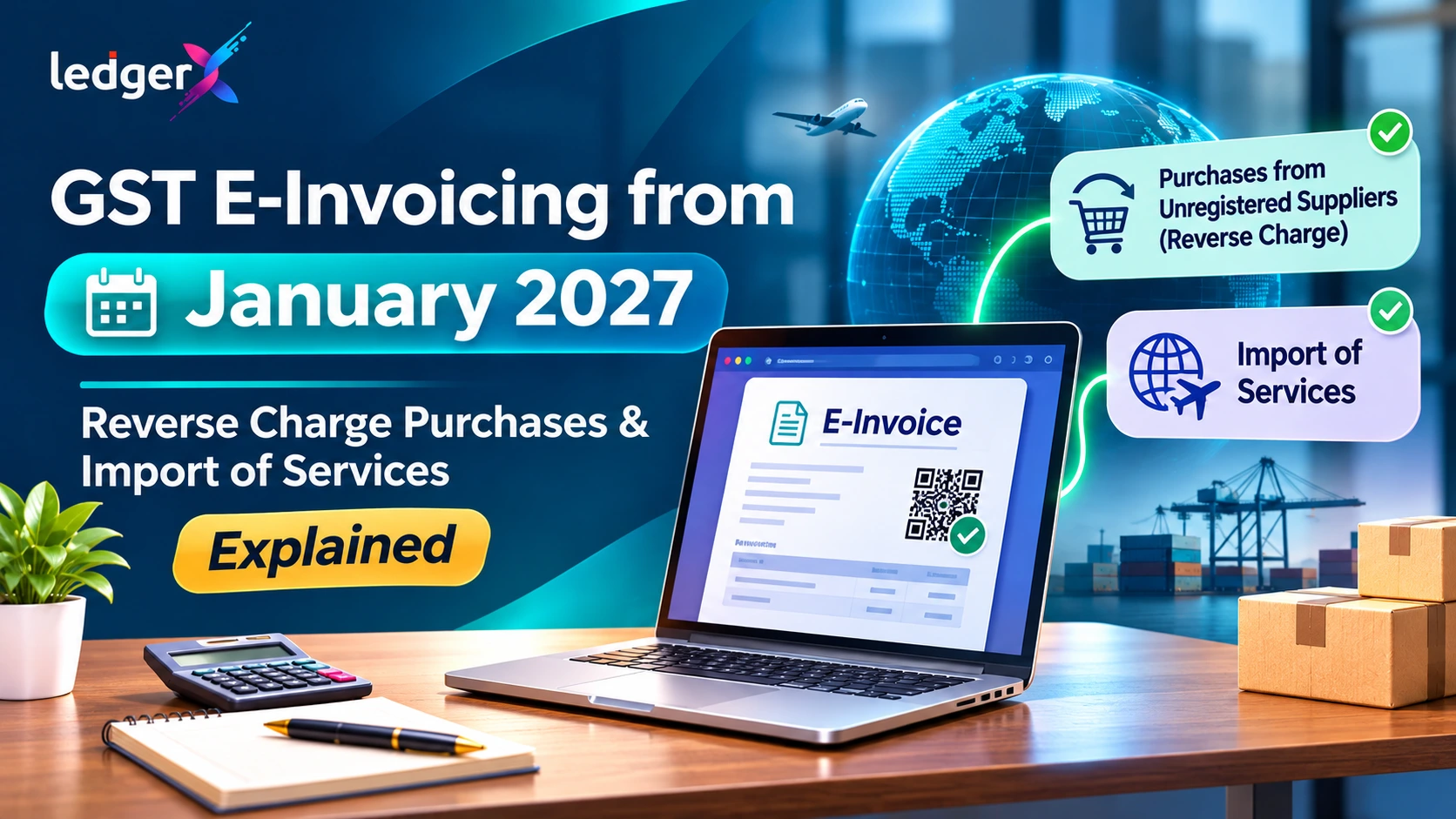
GST E-Invoicing from January 2027: Reverse Charge Purchases and Import of Services Explained
GST e-invoicing in India is set to cover additional types of transactions from 1 January 2027. Under the amended provisions, the specified e-invoicing framework will extend to certain inward supplies received from unregistered suppliers where the recipient is liable to pay GST under the Reverse Charge Mechanism (RCM), as well as imports of services.
The change has been introduced through Notification No. 04/2026–Central Tax dated 26 October 2026, which amends the existing e-invoicing notification issued under Rule 48(4) of the Central Goods and Services Tax (CGST) Rules, 2017.
For businesses already covered by e-invoicing, this means their compliance processes may need to account for additional inward transactions—not just invoices issued for outward sales.
This guide explains the January 2027 change, how it relates to reverse charge and import of services, and what businesses should review before the new provisions take effect.
1. What Is Changing in GST E-Invoicing from January 2027?
Until now, the specified e-invoicing categories under the existing notification have covered supplies made to registered persons and supplies made for exports.
From 1 January 2027, the notified categories will also include:
- Supplies of goods or services received from an unregistered person where the recipient is liable to pay tax under reverse charge.
- Import of services.
The amendment retains the existing categories and adds these two inward transaction categories.
| Transaction category | Position under the amended notification from 1 January 2027 |
|---|---|
| Supplies made to registered persons | Covered |
| Supplies made for exports | Covered |
| Specified purchases from unregistered suppliers under RCM | Added |
| Import of services | Added |
The change is relevant to businesses that fall within the existing e-invoicing applicability framework and are not covered by an applicable exemption.
Important: This is not a blanket requirement for every GST-registered business. The existing turnover-based applicability conditions and notified exemptions must still be considered.
2. What Is E-Invoicing Under GST?
GST e-invoicing is a system in which specified invoice details are reported to an authorised Invoice Registration Portal (IRP). The portal validates the information and generates an Invoice Reference Number (IRN) and a signed QR code for the document.
E-invoicing does not mean that businesses must prepare every invoice directly on a government website. Businesses can continue preparing invoices through compatible accounting or ERP software and report the required information to the IRP.
The IRN and QR code help identify and authenticate the reported invoice.
E-invoicing is different from simply creating a PDF invoice or sending an invoice by email. A document does not become a GST e-invoice merely because it is generated electronically.
3. E-Invoicing for Purchases from Unregistered Suppliers Under RCM
One of the important changes from January 2027 concerns inward supplies received from unregistered suppliers where the recipient is liable to pay GST under reverse charge.
What is the Reverse Charge Mechanism?
Under the Reverse Charge Mechanism, the responsibility to pay GST shifts from the supplier to the recipient for specified categories of supplies.
Under the normal forward-charge arrangement, the supplier generally collects GST from the customer and pays it to the government.
Under reverse charge, the recipient is responsible for paying the applicable GST, subject to the relevant provisions.
What changes from January 2027?
When a covered business receives a specified supply from an unregistered supplier and is liable to pay GST under RCM, the transaction will fall within the expanded e-invoicing framework.
This is important because the recipient may need to create the relevant self-invoice or other prescribed document and report it through the IRP, in accordance with the applicable GST provisions and technical requirements.
Example
Suppose a business covered by e-invoicing receives a taxable service from an unregistered supplier.
Assume the following:
- Value of service: ₹50,000
- Applicable GST rate: 18%
- GST payable under RCM: ₹9,000
The recipient is responsible for paying ₹9,000 as GST under reverse charge, subject to the applicable provisions.
From 1 January 2027, the specified transaction will also fall within the expanded e-invoicing categories for businesses covered by the mandate.
The business should maintain the supplier details, nature of service, taxable value, applicable tax rate, tax amount and the prescribed invoice or document details.
Note: The example is illustrative. RCM applicability depends on the nature of the supply and the relevant GST provisions. Not every purchase from an unregistered supplier attracts reverse charge.
4. E-Invoicing for Import of Services
The second major addition is the inclusion of imports of services in the expanded e-invoicing categories.
An import of services generally refers to a supply of services where the supplier is located outside India, the recipient is located in India, and the place of supply is in India, subject to the statutory definition and applicable conditions.
Examples of services that Indian businesses may purchase from overseas providers include:
- Cloud hosting and software subscriptions
- Online advertising and digital marketing services
- Professional and consultancy services
- Software development and technology services
- Certain international subscription services
Whether GST is payable under reverse charge depends on the nature of the service and the applicable provisions. Businesses should not assume that every payment to an overseas supplier automatically has the same GST treatment.
Example
An Indian business purchases a cloud software subscription from an overseas service provider.
Assume:
- Subscription value: ₹1,00,000
- Applicable IGST rate for the example: 18%
- IGST payable under RCM: ₹18,000
If the transaction qualifies as an import of services and the recipient is liable to pay IGST under reverse charge, the business must account for the tax under the applicable rules.
From 1 January 2027, import of services is expressly included in the expanded e-invoicing categories. Businesses covered by the mandate should review how these transactions will be documented and reported through the IRP.
The actual tax treatment and documentation requirements depend on the transaction and applicable GST provisions.
5. Does the ₹5 Crore E-Invoicing Threshold Change?
The January 2027 amendment expands the categories of transactions covered by the e-invoicing notification. It does not, by itself, change the existing general turnover threshold.
Under the existing framework, e-invoicing generally applies to registered persons whose aggregate turnover exceeded ₹5 crore in any financial year from 2017–18 onwards, subject to specified exclusions and exemptions.
Businesses should check:
- Their aggregate turnover across relevant financial years.
- Whether they fall within the notified categories.
- Whether any exemption applies to their business.
- Whether the new inward transaction categories are relevant to their operations.
A business should not conclude that it is covered—or exempt—based only on its current year's turnover.
6. What Is the Difference Between RCM, Self-Invoicing and E-Invoicing?
These terms are related, but they do not mean the same thing.
| Term | Meaning |
|---|---|
| Reverse Charge Mechanism | A GST arrangement where the recipient is liable to pay tax instead of the supplier. |
| Self-invoice | An invoice required to be issued by the recipient in specified cases involving purchases from unregistered suppliers under RCM. |
| E-invoicing | Reporting specified invoice details to the IRP to obtain an IRN and signed QR code. |
| Invoice Reference Number (IRN) | A unique reference generated by the IRP for a successfully registered document. |
A self-invoice and an e-invoice are not interchangeable terms. Where the law requires a self-invoice and the transaction falls within the e-invoicing mandate, the applicable reporting requirements must also be followed.
Businesses should ensure that their accounting process distinguishes between supplier invoices, self-invoices, RCM records and documents requiring IRP registration.
7. Which Businesses Should Review Their Processes?
The expanded provisions may be particularly relevant to businesses that:
- Already fall within the GST e-invoicing mandate.
- Purchase specified goods or services from unregistered suppliers under RCM.
- Buy services from overseas providers.
- Use foreign software, cloud platforms or professional service providers.
- Maintain multiple inward transaction records across branches or departments.
- Use accounting or ERP software to manage GST documentation.
For example, an eligible business paying for overseas software subscriptions should review whether the transaction qualifies as an import of services and whether it attracts IGST under reverse charge.
Similarly, a business receiving specified services from an unregistered domestic supplier should review whether RCM applies and whether the transaction will require the relevant e-invoice documentation from January 2027.
8. What Should Businesses Do Before 1 January 2027?
Businesses should use the time before the effective date to review their transaction records and accounting systems.
Step 1: Check e-invoicing applicability
Review aggregate turnover across the relevant financial years and confirm whether the business is covered by the existing e-invoicing provisions.
Step 2: Identify RCM purchases
Prepare a list of purchases from unregistered suppliers. Identify which transactions attract reverse charge and distinguish them from ordinary purchases.
Step 3: Review overseas service payments
Identify payments made to overseas software providers, cloud platforms, consultants and other service providers.
Check whether the services qualify as imports of services and whether GST is payable under reverse charge.
Step 4: Review self-invoice and document processes
Check how your business currently records RCM transactions and creates the documents required under GST law.
Review whether the process can support the additional e-invoicing requirements.
Step 5: Speak to your accounting software provider
Confirm whether your accounting or ERP software will support the required document types, data fields and IRP reporting process for the new provisions.
Do not assume that an existing e-invoicing integration will automatically support every newly covered transaction type.
Step 6: Train the accounting team
Ensure that the people handling purchases, expenses, accounts payable and GST compliance understand how to identify and record these transactions.
9. Common Mistakes Businesses Should Avoid
The expanded e-invoicing framework may create confusion if businesses do not distinguish between different transaction types.
Avoid these common mistakes:
Assuming every purchase from an unregistered supplier attracts RCM
Reverse charge applies only to specified supplies under the relevant provisions. The supplier's registration status alone does not make every purchase subject to RCM.
Treating every overseas payment as an import of services
The GST treatment depends on the statutory definition, place-of-supply rules and other applicable conditions.
Confusing self-invoicing with ordinary purchase invoices
A self-invoice is required in specified circumstances. It should be recorded separately from a regular supplier-issued invoice.
Assuming every GST-registered business must generate e-invoices
The existing applicability conditions and notified exemptions continue to matter.
Waiting until January to update accounting processes
Businesses should review their transaction categories and software readiness before the effective date.
10. How Accounting Software Can Help with GST Compliance
As GST documentation requirements expand, maintaining accurate purchase records and tax information becomes increasingly important.
A suitable accounting system can help businesses organise:
- Purchase invoices and supplier records
- Domestic and overseas service expenses
- RCM-related transactions
- Taxable values and GST amounts
- Sales and purchase registers
- GST reports and accounting records
- Financial statements and business reports
LedgerX is a cloud-based accounting and GST billing platform for Indian businesses. It supports billing, purchases, expenses, inventory, customer and supplier records, GST reports and financial statements.
Businesses can use a centralised accounting system to maintain more organised records and review their financial information.
Before relying on any software for the January 2027 changes, confirm that its e-invoicing integration supports the specific new document categories and reporting requirements applicable to your business.
11. Frequently Asked Questions
1. When will the new GST e-invoicing provisions take effect?
The expanded e-invoicing categories under Notification No. 04/2026–Central Tax will take effect from 1 January 2027.
2. What new transactions are included in GST e-invoicing from January 2027?
The amendment adds specified supplies received from unregistered persons where the recipient pays GST under reverse charge, and imports of services.
3. Will e-invoicing apply to all GST-registered businesses from January 2027?
No. The amendment does not make e-invoicing compulsory for every GST-registered business. Existing applicability conditions and notified exemptions must still be considered.
4. Will purchases from every unregistered supplier require an e-invoice?
No. The new category concerns supplies received from an unregistered person where the recipient is liable to pay tax under reverse charge. Ordinary purchases from unregistered suppliers are not automatically covered merely because the supplier is unregistered.
5. Does the new rule cover imports of goods?
The amendment specifically adds imports of services. It should not be read as adding imports of goods to this new category.
6. Does the ₹5 crore e-invoicing threshold change from January 2027?
Notification No. 04/2026–Central Tax expands the specified transaction categories. It does not itself change the existing general ₹5 crore turnover threshold. Businesses should also check the applicable exclusions and exemptions.
7. What is the difference between a self-invoice and an e-invoice?
A self-invoice is a document the recipient must issue in specified cases under GST law. E-invoicing is the process of reporting specified document details to the IRP to obtain an IRN and signed QR code. A transaction may require both the prescribed self-invoice and e-invoice reporting where the applicable provisions require it.
8. Should businesses update their accounting software before January 2027?
Businesses covered by the e-invoicing mandate should check with their software provider about support for the new transaction categories, document requirements and IRP reporting process before the effective date.
9. Does the January 2027 change alter the GST rate on RCM purchases?
The amendment expands the e-invoicing categories. It does not, by itself, change the applicable GST rates for reverse charge transactions. The rate depends on the relevant supply and GST classification.
10. Does the new e-invoicing rule change how RCM tax is paid?
The notification expands the specified e-invoicing categories. It does not, by itself, replace the existing provisions governing the calculation and payment of RCM tax. Businesses should continue to follow the applicable GST payment and return requirements.
Conclusion
The GST e-invoicing changes effective from 1 January 2027 expand the specified transaction categories to include certain inward supplies received from unregistered suppliers under reverse charge and imports of services.
Businesses already covered by e-invoicing should review their RCM purchases, overseas service payments, document-generation processes and accounting software readiness before the effective date.
Maintaining organised purchase records, correctly identifying reverse charge transactions and preparing accounting systems in advance can help businesses manage the expanded requirements more effectively.
Manage your business billing, purchases, expenses and GST records in one place with LedgerX