GST Return Filing Guide: The Complete Guide for Businesses in India
Filing GST returns is one of the most important compliance requirements for every GST-registered business in India. Whether you're a startup, freelancer, retailer, wholesaler, manufacturer, service provider, or accountant, timely and accurate GST return filing helps you remain compliant with tax laws, claim Input Tax Credit (ITC), and avoid penalties.
Many business owners assume that GST return filing is complicated. However, once you understand the different return types, due dates, and filing procedures, the process becomes much easier.
This comprehensive guide explains everything from the basics of GST returns to the online filing process, helping businesses understand their GST obligations with confidence.
Table of Contents
- What is GST Return?
- Why is GST Return Filing Important?
- Who Should File GST Returns?
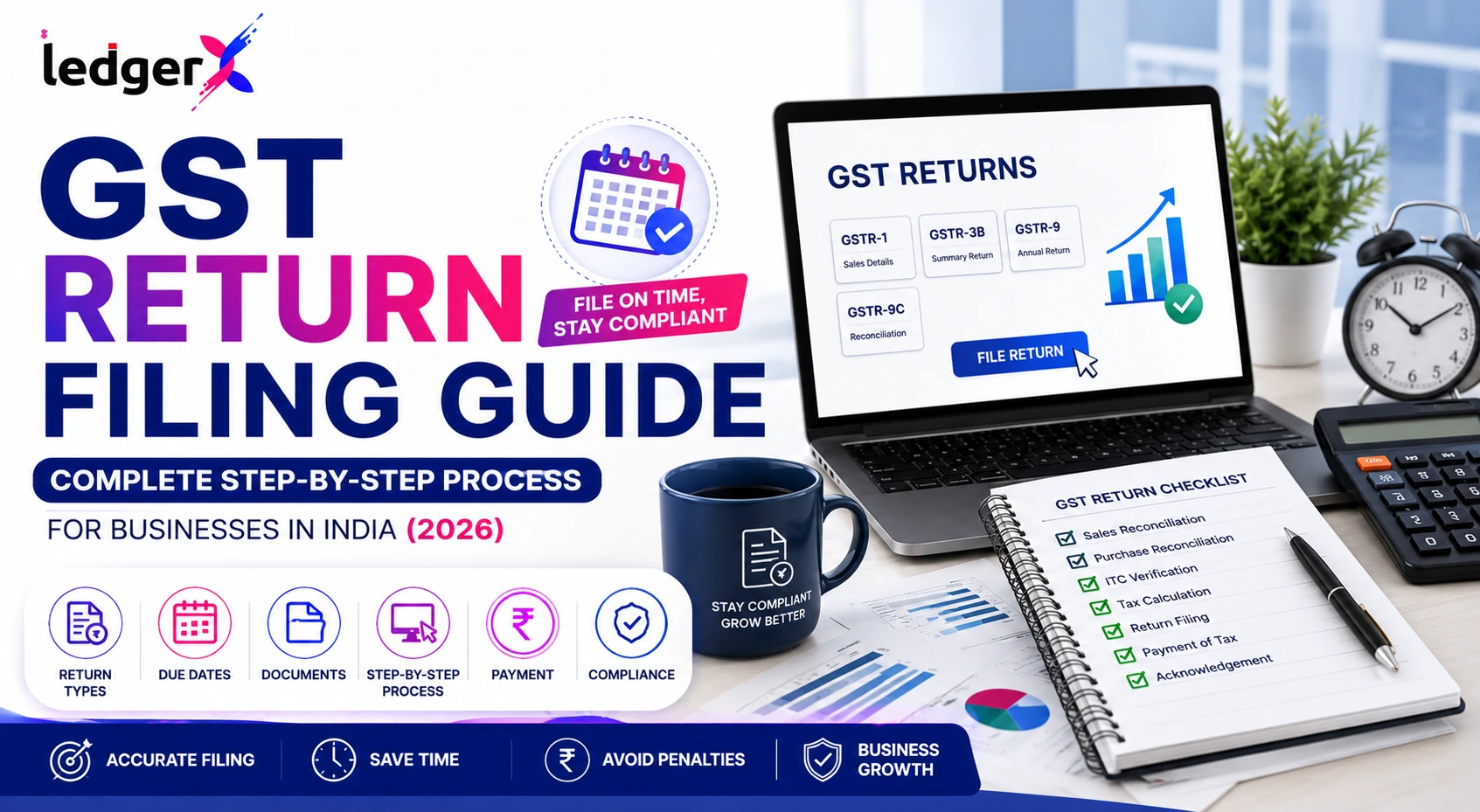
- Types of GST Returns
- GST Return Filing Due Dates
- Information Required Before Filing
- Documents Required
- Step-by-Step GST Return Filing Process
- How to File GST Returns Online
- Common Filing Mistakes
- FAQs
- Conclusion
What is a GST Return?
A GST Return is a document submitted by a registered taxpayer to the tax authorities containing details of:
- Sales (Outward Supplies)
- Purchases (Inward Supplies)
- GST Collected
- GST Paid
- Input Tax Credit (ITC)
- Tax Liability
- Tax Payments
Based on the information submitted, the government calculates the taxpayer's GST liability and verifies compliance.
GST returns must be filed electronically through the official GST portal within the prescribed due dates.
Why is GST Return Filing Important?
Regular GST return filing offers several benefits.
Legal Compliance
Filing returns on time helps businesses comply with GST regulations and avoid legal issues.
Claim Input Tax Credit (ITC)
Businesses can claim eligible GST paid on purchases only after complying with applicable GST return requirements.
Avoid Late Fees and Interest
Delayed filing may attract statutory late fees and interest on outstanding tax liabilities.
Maintain Business Credibility
Timely compliance improves credibility with customers, suppliers, banks, and government agencies.
Better Financial Management
Accurate GST returns help maintain organized accounting records and simplify financial reporting.
Who Should File GST Returns?
GST return filing is generally required for:
- Sole Proprietorships
- Partnership Firms
- LLPs
- Private Limited Companies
- Public Limited Companies
- One Person Companies (OPCs)
- Freelancers registered under GST
- Consultants
- Contractors
- Retailers
- Wholesalers
- Manufacturers
- Service Providers
- Importers
- Exporters
- E-commerce Sellers
- Composition Scheme taxpayers (through applicable returns)
The type of return depends on the nature of the business and the GST registration category.
Types of GST Returns
Different taxpayers are required to file different GST returns.
GSTR-1
GSTR-1 contains details of all outward supplies (sales).
It includes:
- B2B Sales
- B2C Sales
- Credit Notes
- Debit Notes
- Export Sales
- Nil-rated Supplies
GSTR-3B
GSTR-3B is a summary return that includes:
- Outward Supplies
- Input Tax Credit
- Tax Liability
- GST Payment
Most regular taxpayers file this return periodically.
GSTR-4
Applicable to eligible taxpayers registered under the Composition Scheme.
GSTR-5
Filed by Non-Resident Taxable Persons.
GSTR-6
Filed by Input Service Distributors (ISD).
GSTR-7
Filed by entities required to deduct Tax Deducted at Source (TDS) under GST.
GSTR-8
Filed by notified e-commerce operators collecting Tax Collected at Source (TCS).
GSTR-9
Annual Return filed by eligible regular taxpayers.
GSTR-9C
Reconciliation Statement applicable to specified taxpayers under applicable GST provisions.
GSTR-10
Final Return filed after cancellation of GST registration where applicable.
GSTR-11
Filed by notified persons eligible to claim refunds under GST.
GST Return Filing Due Dates
Different GST returns have different due dates.
Businesses should regularly verify the latest due dates through official GST notifications, as timelines may change based on government announcements.
Missing due dates can result in:
- Late Fees
- Interest on Tax Liability
- Notice from Tax Authorities
- Delayed Input Tax Credit
- Compliance Issues
Maintaining a GST filing calendar helps businesses avoid unnecessary penalties.
Information Required Before Filing GST Returns
Before filing your GST return, keep the following information ready:
- GSTIN
- Sales Register
- Purchase Register
- Tax Invoices
- Debit Notes
- Credit Notes
- Export Details (if applicable)
- Import Details
- Input Tax Credit Details
- GST Payment Records
- Electronic Cash Ledger Balance
- Electronic Credit Ledger Balance
- Previous GST Returns
Having complete and accurate records reduces filing errors.
Documents Required for GST Return Filing
Businesses should maintain:
- Sales Invoices
- Purchase Invoices
- GST Payment Challans
- Bank Statements
- E-Way Bills (where applicable)
- Debit Notes
- Credit Notes
- Import Documents
- Export Documents
- Vendor GST Details
- Customer GST Details
Maintaining digital copies of these documents makes filing easier and improves audit readiness.
Step-by-Step GST Return Filing Process
Step 1: Collect Sales and Purchase Data
Compile all transactions for the tax period.
Verify:
- Sales
- Purchases
- Returns
- GST Amounts
- Credit Notes
- Debit Notes
Step 2: Reconcile Business Records
Compare your accounting records with supplier invoices and purchase data.
Ensure that:
- Sales match invoices.
- Purchases are correctly recorded.
- GST rates are accurate.
- Customer GSTINs are correct.
- Vendor GSTINs are valid.
Step 3: Calculate GST Liability
Calculate:
- Output GST
- Input Tax Credit
- Net GST Payable
Ensure eligible ITC has been claimed correctly under applicable GST provisions.
Step 4: Verify Input Tax Credit (ITC)
Check whether eligible purchase invoices support the ITC being claimed.
Review:
- Vendor details
- Invoice values
- GST amounts
- Purchase records
Accurate reconciliation helps reduce ITC-related disputes.
Step 5: Prepare the GST Return
Choose the applicable return based on your registration category.
Enter:
- Taxable Sales
- Exempt Supplies
- Nil-rated Supplies
- Export Sales
- Reverse Charge Transactions
- ITC Details
- Tax Liability
Step 6: Pay Outstanding GST
If tax is payable after adjusting Input Tax Credit, make the payment through the prescribed electronic payment methods before filing the return.
Step 7: Submit the GST Return
Review all entered information carefully.
Complete the filing using the applicable verification method available on the GST portal.
After successful submission, retain the acknowledgement for future reference.
How to File GST Returns Online
The online filing process generally includes:
- Log in to the GST portal.
- Select the relevant return.
- Choose the tax period.
- Enter sales details.
- Enter purchase details.
- Verify Input Tax Credit.
- Calculate GST liability.
- Pay tax if required.
- Preview the return.
- Submit and verify.
- Download the acknowledgement after successful filing.
Best Practices Before Filing GST Returns
To reduce errors and improve compliance:
- Record transactions daily.
- Maintain GST-compliant invoices.
- Verify customer GSTINs.
- Verify supplier GSTINs.
- Reconcile books every month.
- Review Input Tax Credit carefully.
- Keep digital backups of invoices.
- File returns before the due date.
- Maintain proper accounting records.
Common GST Return Filing Mistakes
Even experienced businesses make errors while filing GST returns. These mistakes can lead to notices, delayed Input Tax Credit (ITC), penalties, and additional compliance work.
Some of the most common mistakes include:
- Entering an incorrect GSTIN
- Reporting incorrect invoice numbers
- Selecting the wrong GST return type
- Claiming excess Input Tax Credit (ITC)
- Missing purchase invoices
- Forgetting to report credit notes or debit notes
- Filing returns after the due date
- Incorrect HSN or SAC codes
- Incorrect GST rates
- Duplicate invoice entries
- Failure to reconcile purchase and sales registers
- Not updating amendments in subsequent returns
Reviewing accounting records before filing significantly reduces the risk of errors.
Late Fees and Interest on GST Returns
If GST returns are not filed within the prescribed due dates, businesses may be liable to pay:
Late Fee
Late fees may apply for delayed filing of applicable GST returns. The amount depends on the return type and the applicable GST provisions.
Interest
If GST tax is payable but not paid within the due date, interest may be charged on the outstanding tax amount as per the GST Act.
Timely filing helps businesses avoid unnecessary financial costs and compliance issues.
What Happens If You Don't File GST Returns?
Failure to file GST returns can have several consequences, including:
- Late fees
- Interest on outstanding tax
- GST notices from tax authorities
- Suspension or cancellation of GST registration (in applicable cases)
- Difficulty claiming Input Tax Credit
- Compliance issues during audits
- Difficulty obtaining business loans
- Reduced business credibility
Regular filing ensures uninterrupted business operations and better financial management.
Can GST Returns Be Revised?
Unlike income tax returns, GST returns generally cannot be revised after submission.
If an error is discovered, it is usually corrected through amendments or adjustments in a subsequent return, subject to applicable GST provisions.
This is why businesses should verify every invoice, tax amount, and Input Tax Credit before filing.
How to Correct Errors in GST Returns
If errors are identified after filing, businesses should:
- Identify the incorrect transaction.
- Verify supporting documents.
- Determine the appropriate correction mechanism.
- Make the correction in the applicable subsequent GST return, where permitted.
- Maintain documentation explaining the correction.
Professional advice may be useful for complex GST corrections.
GST Return Filing Checklist
Use this checklist before filing every GST return.
✅ Verify GSTIN
✅ Match Sales Register
✅ Match Purchase Register
✅ Verify Input Tax Credit
✅ Check Credit Notes
✅ Check Debit Notes
✅ Verify GST Rates
✅ Review HSN/SAC Codes
✅ Verify Tax Liability
✅ Reconcile Bank Receipts
✅ Review Customer GSTIN
✅ Review Supplier GSTIN
✅ Check Reverse Charge Transactions
✅ Verify Export Details (if applicable)
✅ Verify Import Details (if applicable)
✅ Ensure GST Payment is Complete
A monthly checklist helps minimize filing errors.
Best Practices for GST Return Filing
Businesses can improve GST compliance by following these best practices:
Maintain Accurate Accounting Records
Record every purchase and sale promptly.
Reconcile Books Every Month
Monthly reconciliation helps identify discrepancies before filing returns.
Verify Supplier GST Details
Ensure suppliers have correctly uploaded invoices to support eligible ITC claims.
Issue GST-Compliant Invoices
Every invoice should contain mandatory GST information, including GSTIN, invoice number, tax rate, and taxable value.
Keep Digital Records
Store invoices, payment proofs, GST challans, and supporting documents securely for future reference.
File Returns Before the Due Date
Avoid last-minute filing to reduce the risk of portal issues and late fees.
Monitor Input Tax Credit
Track eligible ITC regularly to improve cash flow and ensure compliance.
Use Reliable Accounting Software
Automated accounting systems reduce manual errors and simplify GST return preparation.
Benefits of Filing GST Returns on Time
Timely GST filing provides several advantages:
- Avoids late fees
- Reduces interest costs
- Improves compliance
- Enables timely ITC claims
- Supports business credibility
- Simplifies audits
- Maintains accurate financial records
- Improves cash flow planning
- Reduces the risk of notices
Consistent compliance contributes to smoother business operations.
Frequently Asked Questions (FAQs)
What is a GST Return?
A GST Return is a document filed by a registered taxpayer containing details of sales, purchases, GST collected, GST paid, and tax liability for a specified period.
Who is required to file GST returns?
Every GST-registered taxpayer must file the applicable GST returns based on their registration category and business activities, even if there are no transactions during a particular period, where required under GST law.
What are the main types of GST returns?
Some of the most common GST returns include:
- GSTR-1
- GSTR-3B
- GSTR-4
- GSTR-5
- GSTR-6
- GSTR-7
- GSTR-8
- GSTR-9
- GSTR-9C
- GSTR-10
- GSTR-11
Can GST returns be filed online?
Yes. GST returns are filed electronically through the official GST portal using the applicable filing process.
What documents are required before filing GST returns?
Commonly required records include:
- Sales invoices
- Purchase invoices
- GST payment details
- Credit notes
- Debit notes
- Bank statements
- GSTIN details
- Input Tax Credit records
What happens if GST returns are filed late?
Late filing may result in late fees, interest on outstanding tax, delayed ITC claims, and other compliance consequences as prescribed under GST law.
Can GST returns be corrected after filing?
GST returns generally cannot be revised directly. Errors are usually corrected through subsequent returns where permitted under GST provisions.
How often should GST returns be filed?
The filing frequency depends on the taxpayer's registration type and the applicable GST return requirements.
Why is GST reconciliation important?
GST reconciliation ensures that purchase records, sales records, invoices, and Input Tax Credit match before filing returns, reducing errors and improving compliance.
How can accounting software help with GST return filing?
Accounting software helps businesses maintain organized financial records, generate GST-compliant reports, reconcile purchases and sales, calculate tax liabilities, and prepare accurate data for GST return filing.
Conclusion
GST return filing is a critical part of running a compliant business in India. Understanding the different return types, maintaining accurate accounting records, reconciling transactions regularly, and filing returns on time helps businesses avoid penalties, improve cash flow, and claim eligible Input Tax Credit efficiently.
As businesses grow, manually managing GST invoices, tax calculations, reconciliations, and return preparation can become increasingly time-consuming. LedgerX Accounting Software simplifies GST accounting by helping businesses generate GST-compliant invoices, maintain purchase and sales registers, manage Input and Output GST, reconcile accounts, prepare GST-ready reports, and organize financial records from one centralized platform.
Whether you're a startup, freelancer, retailer, wholesaler, manufacturer, service provider, or accountant, LedgerX Accounting Software helps streamline your bookkeeping and GST compliance, allowing you to focus more on growing your business and less on manual accounting.