How to Calculate Gross Profit: A Complete Guide for Businesses
Understanding your gross profit is one of the most important aspects of running a successful business. It helps you determine how efficiently your business generates profit from selling products or services before accounting for operating expenses, taxes, and other costs.
Whether you're a retailer, wholesaler, manufacturer, service provider, startup founder, or accountant, calculating gross profit regularly helps you monitor business performance, make better pricing decisions, and improve profitability.
While businesses can calculate gross profit manually using spreadsheets, modern accounting software like LedgerX Accounting Software automatically calculates gross profit from your sales and purchase records, saving time and reducing errors.
What is Gross Profit?
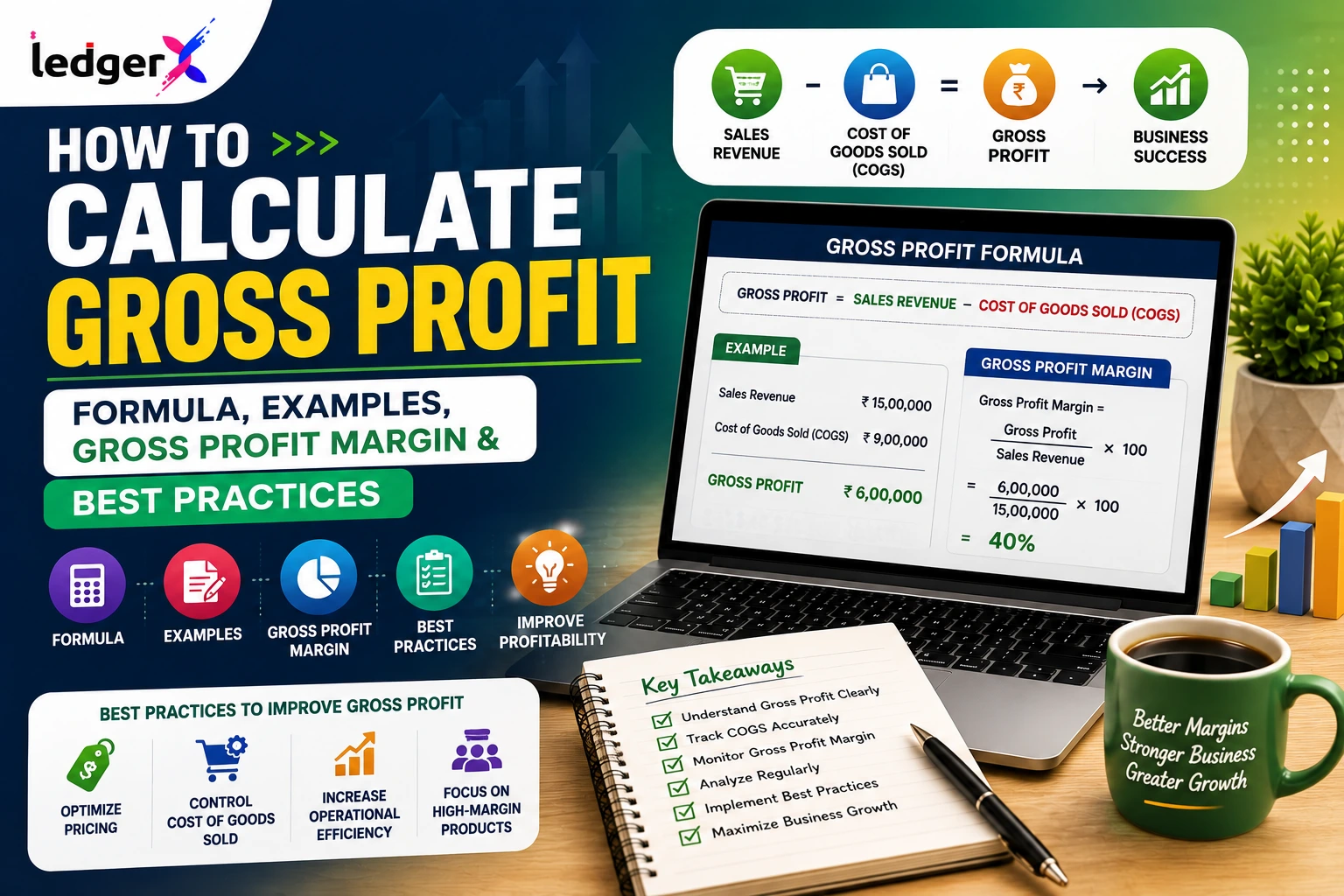
Gross Profit is the amount of money a business earns after deducting the Cost of Goods Sold (COGS) from total sales or revenue.
It represents the profit generated from the core business operations before deducting operating expenses such as rent, salaries, utilities, marketing, depreciation, and taxes.
Gross Profit is one of the key indicators used to evaluate a company's operational efficiency and pricing strategy.
Gross Profit Formula
The standard formula is:
Gross Profit = Net Sales – Cost of Goods Sold (COGS)
Where:
- Net Sales = Total Sales – Sales Returns – Sales Discounts
- Cost of Goods Sold (COGS) = Direct costs associated with producing or purchasing goods sold.
What is Included in Cost of Goods Sold (COGS)?
COGS generally includes:
- Purchase Cost
- Raw Materials
- Direct Labour
- Manufacturing Costs
- Factory Expenses
- Freight Inward
- Import Duties (where applicable)
- Packaging Costs directly related to production
COGS does not include operating expenses such as:
- Office Rent
- Salaries (Administrative Staff)
- Electricity (Office)
- Advertising
- Internet Bills
- Insurance
- Office Supplies
- Loan Interest
These are recorded separately in the Profit & Loss Statement.
Why is Gross Profit Important?
Gross Profit helps businesses:
- Measure operational efficiency
- Evaluate pricing strategies
- Control production costs
- Compare profitability over time
- Analyze business performance
- Support financial planning
- Attract investors
- Prepare financial statements
- Improve decision-making
A consistently healthy gross profit usually indicates that a business is pricing its products appropriately and controlling direct costs effectively.
Step-by-Step Guide to Calculate Gross Profit
Step 1: Calculate Total Sales
Determine the total revenue generated during the accounting period.
Example:
| Sales Source | Amount (₹) |
|---|---|
| Product Sales | 9,50,000 |
| Service Revenue | 50,000 |
| Total Sales | 10,00,000 |
Step 2: Calculate Net Sales
Subtract any sales returns or discounts.
Example:
Total Sales = ₹10,00,000
Sales Returns = ₹20,000
Sales Discounts = ₹10,000
Net Sales = ₹9,70,000
Step 3: Calculate Cost of Goods Sold
Example:
| Particular | Amount (₹) |
| Opening Inventory | 1,50,000 |
| Purchases | 5,00,000 |
| Freight Inward | 20,000 |
| Direct Labour | 80,000 |
| Less: Closing Inventory | (1,00,000) |
| COGS | 6,50,000 |
Formula:
COGS = Opening Inventory + Purchases + Direct Expenses – Closing Inventory
Step 4: Apply the Gross Profit Formula
Net Sales = ₹9,70,000
COGS = ₹6,50,000
Gross Profit = ₹9,70,000 – ₹6,50,000 = ₹3,20,000
This means the business earned ₹3,20,000 before deducting operating expenses.
Gross Profit Calculation Example
Suppose a business reports:
- Total Sales: ₹15,00,000
- Sales Returns: ₹50,000
- Sales Discounts: ₹25,000
- Cost of Goods Sold: ₹9,25,000
Calculation
Net Sales:
₹15,00,000 − ₹50,000 − ₹25,000 = ₹14,25,000
Gross Profit:
₹14,25,000 − ₹9,25,000 = ₹5,00,000
What is Gross Profit Margin?
Gross Profit Margin measures how much profit is earned from every rupee of sales.
Formula
Gross Profit Margin (%) = (Gross Profit ÷ Net Sales) × 100
Using the previous example:
Gross Profit = ₹5,00,000
Net Sales = ₹14,25,000
Gross Profit Margin =
(₹5,00,000 ÷ ₹14,25,000) × 100
= 35.09%
This means the business retains approximately ₹35 as gross profit for every ₹100 of sales before operating expenses.
Gross Profit vs Net Profit
| Gross Profit | Net Profit |
| Sales – Cost of Goods Sold | Gross Profit – All Operating Expenses |
| Measures production or trading profitability | Measures overall business profitability |
| Does not include rent, salaries, taxes | Includes all business expenses |
| Used to analyze pricing efficiency | Used to measure final earnings |
Both metrics are important, but Gross Profit focuses specifically on the profitability of core operations.
Common Mistakes When Calculating Gross Profit
Avoid these common errors:
- Ignoring sales returns
- Forgetting sales discounts
- Incorrect inventory valuation
- Omitting freight inward charges
- Including operating expenses in COGS
- Recording purchases incorrectly
- Duplicate inventory entries
- Not updating closing inventory
- Using outdated accounting records
Accurate bookkeeping is essential for reliable gross profit calculations.
Tips to Improve Gross Profit
Businesses can improve gross profit by:
- Negotiating better supplier prices
- Reducing production waste
- Increasing selling prices strategically
- Managing inventory efficiently
- Improving procurement processes
- Reducing direct labour costs through productivity
- Eliminating low-margin products
- Increasing high-margin sales
- Using accounting software to monitor profitability regularly
Manual Gross Profit Calculation vs LedgerX Accounting Software
| Manual Method | LedgerX Accounting Software |
| Spreadsheet calculations | Automatic calculations |
| Manual inventory updates | Real-time inventory tracking |
| Higher chance of errors | Accurate financial reports |
| Time-consuming | Instant Profit & Loss reports |
| Delayed profitability insights | Real-time business analytics |
| Manual reconciliation | Automated bookkeeping |
How LedgerX Accounting Software Helps Calculate Gross Profit
Calculating gross profit manually becomes more difficult as your business grows and transaction volumes increase.
With LedgerX Accounting Software, businesses can:
- Automatically calculate Gross Profit
- Track sales and purchases in real time
- Maintain inventory records
- Generate Profit & Loss Statements instantly
- Produce Trial Balance reports
- Create Balance Sheets automatically
- Record journal entries
- Track customer and supplier accounts
- Monitor business profitability through dashboards
- Generate financial reports from anywhere using cloud access
Instead of spending hours preparing spreadsheets, LedgerX calculates your gross profit automatically using recorded business transactions, allowing you to focus on improving business performance.
Best Practices for Accurate Gross Profit Calculation
To ensure reliable financial reporting:
- Record every sale promptly.
- Maintain accurate inventory records.
- Separate direct and indirect expenses.
- Update purchase records regularly.
- Perform inventory counts periodically.
- Reconcile supplier invoices.
- Verify sales returns and discounts.
- Generate monthly Profit & Loss Statements.
- Use accounting software for automation.
Frequently Asked Questions (FAQs)
What is Gross Profit?
Gross Profit is the amount remaining after deducting the Cost of Goods Sold (COGS) from Net Sales. It represents the profit earned from core business operations before operating expenses.
What is the formula for Gross Profit?
Gross Profit = Net Sales – Cost of Goods Sold (COGS)
What is Gross Profit Margin?
Gross Profit Margin is the percentage of sales revenue retained after covering direct costs.
Gross Profit Margin = (Gross Profit ÷ Net Sales) × 100
What is included in Cost of Goods Sold?
COGS generally includes purchases, raw materials, direct labour, freight inward, manufacturing costs, and opening/closing inventory adjustments.
Can accounting software calculate Gross Profit automatically?
Yes. LedgerX Accounting Software automatically calculates Gross Profit using recorded sales, purchases, and inventory transactions, helping businesses generate accurate financial reports with minimal effort.
Conclusion
Gross Profit is one of the most important financial metrics for measuring the efficiency and profitability of your core business operations. By understanding how to calculate Gross Profit accurately, businesses can make better pricing decisions, control direct costs, improve margins, and strengthen long-term financial performance.
Manual calculations can become complex as transaction volumes increase. LedgerX Accounting Software simplifies the process by automatically recording sales, purchases, inventory, and other financial transactions to generate accurate Gross Profit figures, Profit & Loss Statements, Trial Balances, and Balance Sheets in real time.
Whether you're a startup, retailer, wholesaler, manufacturer, service provider, or accountant, LedgerX Accounting Software provides the tools you need to monitor profitability, streamline bookkeeping, and make smarter business decisions.
Start using LedgerX Accounting Software today to automate your accounting, calculate Gross Profit instantly, and gain real-time insights into your business performance.