
How to Calculate Working Capital: A Complete Guide for Businesses
Working capital is one of the most important indicators of a company's short-term financial health. It measures whether a business has enough current assets to meet its short-term liabilities and continue operating smoothly.
Whether you're running a startup, retail shop, wholesale business, manufacturing company, or service-based business, understanding your working capital helps you manage cash flow, pay suppliers on time, maintain inventory, and plan future growth.
Although working capital can be calculated manually, modern accounting software like LedgerX Accounting Software automatically tracks current assets and liabilities, enabling businesses to monitor their financial position in real time.
What is Working Capital?
Working Capital is the difference between a company's Current Assets and Current Liabilities. It represents the funds available to finance daily business operations.
A business with positive working capital generally has sufficient resources to cover its short-term obligations, while negative working capital may indicate liquidity challenges.
Working Capital Formula
Working Capital = Current Assets − Current Liabilities
Why is Working Capital Important?
Working capital is essential because it helps businesses:
- Maintain healthy cash flow
- Pay suppliers and employees on time
- Meet short-term financial obligations
- Purchase inventory
- Handle unexpected expenses
- Improve business stability
- Support business growth
- Build lender and investor confidence
- Reduce the risk of cash shortages
Monitoring working capital regularly helps businesses make informed financial decisions.
What are Current Assets?
Current assets are assets expected to be converted into cash or used within one year.
Examples include:
- Cash in Hand
- Bank Balance
- Accounts Receivable (Debtors)
- Inventory
- Short-Term Investments
- GST Input Credit
- Prepaid Expenses
- Marketable Securities
What are Current Liabilities?
Current liabilities are obligations due within one year.
Examples include:
- Accounts Payable (Creditors)
- GST Payable
- Salaries Payable
- Outstanding Expenses
- Short-Term Loans
- Taxes Payable
- Bank Overdraft
- Interest Payable
Step-by-Step Guide to Calculate Working Capital
Step 1: Calculate Total Current Assets
List all current assets.
Example:
| Current Assets | Amount (₹) |
|---|---|
| Cash | 2,00,000 |
| Bank Balance | 4,50,000 |
| Accounts Receivable | 3,20,000 |
| Inventory | 5,80,000 |
| GST Input Credit | 50,000 |
| Total Current Assets | 16,00,000 |
Step 2: Calculate Total Current Liabilities
List all liabilities due within one year.
Example:
| Current Liabilities | Amount (₹) |
| Accounts Payable | 4,20,000 |
| GST Payable | 80,000 |
| Salaries Payable | 1,00,000 |
| Short-Term Loan | 2,50,000 |
| Outstanding Expenses | 50,000 |
| Total Current Liabilities | 9,00,000 |
Step 3: Apply the Working Capital Formula
Working Capital = Current Assets − Current Liabilities
₹16,00,000 − ₹9,00,000
= ₹7,00,000
The business has positive working capital, indicating that it has enough short-term assets to meet its short-term obligations.
Working Capital Calculation Example
Suppose a company reports:
Current Assets:
- Cash: ₹3,00,000
- Bank Balance: ₹2,00,000
- Inventory: ₹4,50,000
- Accounts Receivable: ₹2,50,000
Total Current Assets = ₹12,00,000
Current Liabilities:
- Creditors: ₹4,00,000
- GST Payable: ₹50,000
- Salaries Payable: ₹1,00,000
- Short-Term Loan: ₹2,00,000
Total Current Liabilities = ₹7,50,000
Working Capital
₹12,00,000 − ₹7,50,000
= ₹4,50,000
This indicates that the company has ₹4,50,000 available to support its day-to-day operations after covering short-term liabilities.
What is Working Capital Ratio?
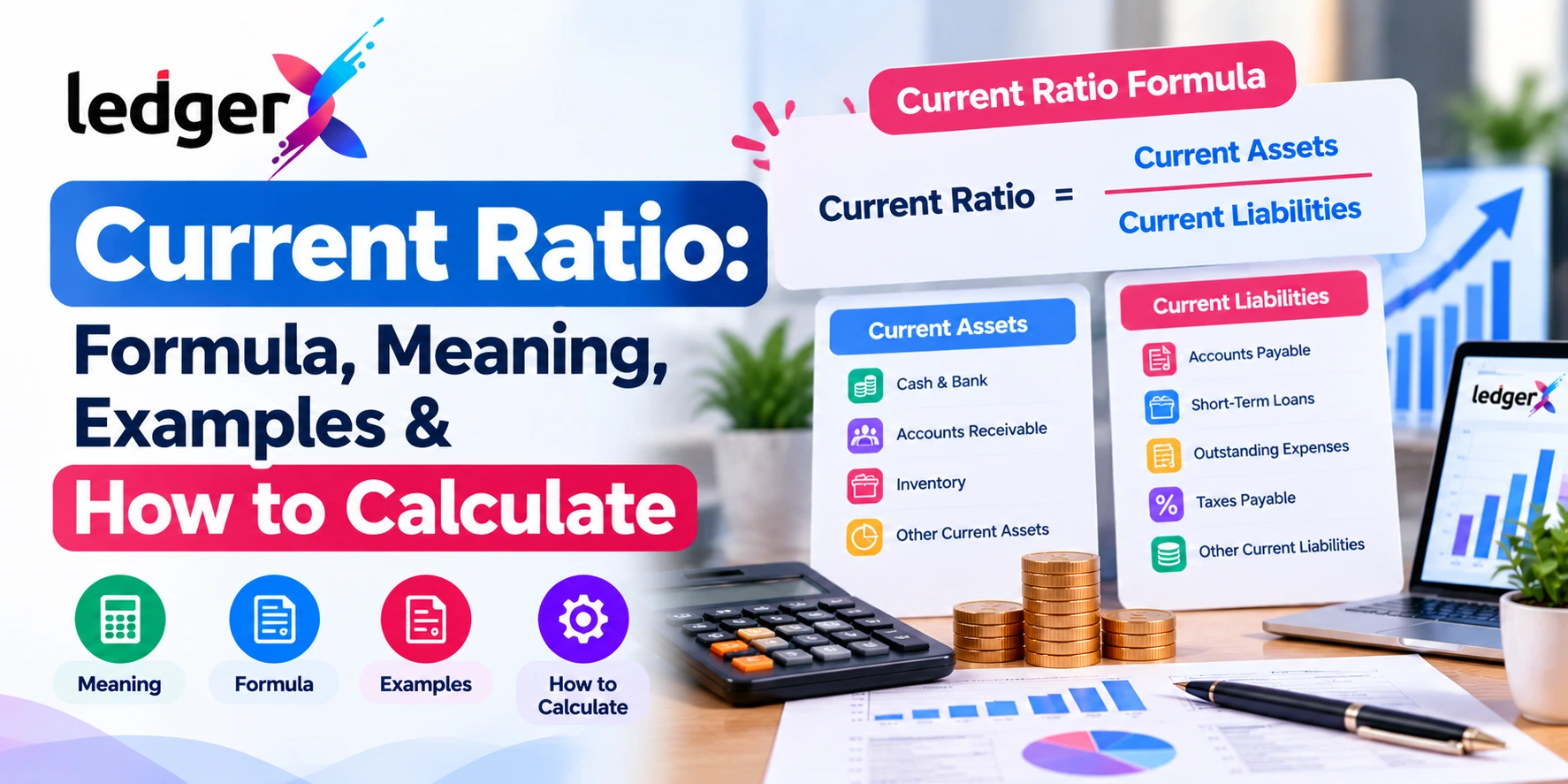
The Working Capital Ratio, also called the Current Ratio, measures a company's ability to pay its short-term obligations.
Formula
Working Capital Ratio = Current Assets ÷ Current Liabilities
Using the previous example:
Current Assets = ₹12,00,000
Current Liabilities = ₹7,50,000
Working Capital Ratio =
₹12,00,000 ÷ ₹7,50,000 = 1.6
A ratio greater than 1 generally indicates that a business can comfortably meet its short-term liabilities.
Interpreting Working Capital
Positive Working Capital
- Healthy cash flow
- Strong liquidity
- Ability to pay short-term debts
- Better operational flexibility
Negative Working Capital
- Cash flow issues
- Difficulty paying suppliers
- Higher financial risk
- Possible dependence on borrowing
Excessive Working Capital
While positive working capital is desirable, holding too much idle cash or inventory may indicate inefficient use of resources.
Factors That Affect Working Capital
Several factors influence working capital:
- Inventory levels
- Customer payment cycles
- Supplier credit terms
- Sales growth
- Seasonal demand
- Business expansion
- Credit policies
- Operating expenses
- Loan repayments
Monitoring these factors helps businesses maintain a healthy financial position.
Common Mistakes When Calculating Working Capital
Avoid these common errors:
- Including fixed assets as current assets
- Ignoring accrued liabilities
- Incorrect inventory valuation
- Outdated accounts receivable balances
- Excluding short-term loans
- Double-counting assets
- Mixing personal and business finances
- Failing to reconcile bank balances
Accurate bookkeeping ensures reliable working capital calculations.
How to Improve Working Capital
Businesses can improve working capital by:
- Collecting customer payments faster
- Reducing unnecessary inventory
- Negotiating longer payment terms with suppliers
- Managing expenses efficiently
- Increasing sales revenue
- Improving inventory turnover
- Refinancing short-term debt
- Monitoring cash flow regularly
- Using accounting software for real-time financial tracking
Working Capital vs Cash Flow
| Working Capital | Cash Flow |
| Measures short-term financial position | Measures movement of cash |
| Based on Current Assets and Liabilities | Based on cash inflows and outflows |
| Snapshot at a specific date | Covers a period of time |
| Indicates liquidity | Indicates cash availability |
Both metrics are essential for managing business finances effectively.
Manual Working Capital Calculation vs LedgerX Accounting Software
| Manual Method | LedgerX Accounting Software |
| Spreadsheet calculations | Automatic calculations |
| Manual asset tracking | Real-time asset management |
| Manual liability tracking | Automatic liability updates |
| Higher risk of errors | Accurate financial reports |
| Time-consuming | Instant business insights |
| Delayed reporting | Live dashboards and analytics |
How LedgerX Accounting Software Helps Manage Working Capital
Managing working capital manually becomes increasingly difficult as business operations expand.
With LedgerX Accounting Software, businesses can:
- Monitor Current Assets and Current Liabilities in real time
- Generate Balance Sheets automatically
- Track Accounts Receivable and Accounts Payable
- Manage inventory efficiently
- Generate Trial Balance reports
- Create Profit & Loss Statements
- Reconcile bank accounts
- Monitor cash flow
- Access financial reports securely from anywhere
- View business performance through intuitive dashboards
Instead of relying on spreadsheets, LedgerX automatically updates financial records and provides accurate working capital information whenever you need it.
Best Practices for Managing Working Capital
To maintain healthy working capital:
- Review receivables regularly.
- Monitor inventory levels.
- Pay suppliers on schedule.
- Avoid unnecessary borrowing.
- Prepare monthly financial reports.
- Reconcile bank accounts frequently.
- Forecast cash flow.
- Track short-term liabilities.
- Use accounting software for automation.
Frequently Asked Questions (FAQs)
What is Working Capital?
Working Capital is the difference between a company's Current Assets and Current Liabilities. It measures the funds available for day-to-day business operations.
What is the formula for Working Capital?
Working Capital = Current Assets − Current Liabilities
What is a good Working Capital Ratio?
A ratio above 1 generally indicates that a business has enough current assets to meet its short-term obligations. However, the ideal ratio varies by industry.
Why is Working Capital important?
Working Capital helps businesses manage cash flow, pay suppliers and employees, purchase inventory, and maintain smooth daily operations.
Can accounting software calculate Working Capital automatically?
Yes. LedgerX Accounting Software automatically tracks Current Assets and Current Liabilities, generates Balance Sheets, and provides real-time insights into your working capital and overall financial health.
Conclusion
Working Capital is a key indicator of a company's financial stability and operational efficiency. By calculating and monitoring working capital regularly, businesses can maintain healthy cash flow, meet short-term obligations, reduce financial risk, and make better strategic decisions.
While manual calculations are possible, they become increasingly complex as transaction volumes grow. LedgerX Accounting Software simplifies working capital management by automatically recording transactions, maintaining accurate financial records, generating Balance Sheets, Trial Balances, and Profit & Loss Statements, and providing real-time visibility into current assets and liabilities.
Whether you're a startup, retailer, wholesaler, manufacturer, service provider, or accountant, LedgerX Accounting Software helps you streamline accounting, improve liquidity management, and make data-driven financial decisions.
Start using LedgerX Accounting Software today to automate bookkeeping, monitor working capital in real time, and keep your business financially healthy and ready for growth.