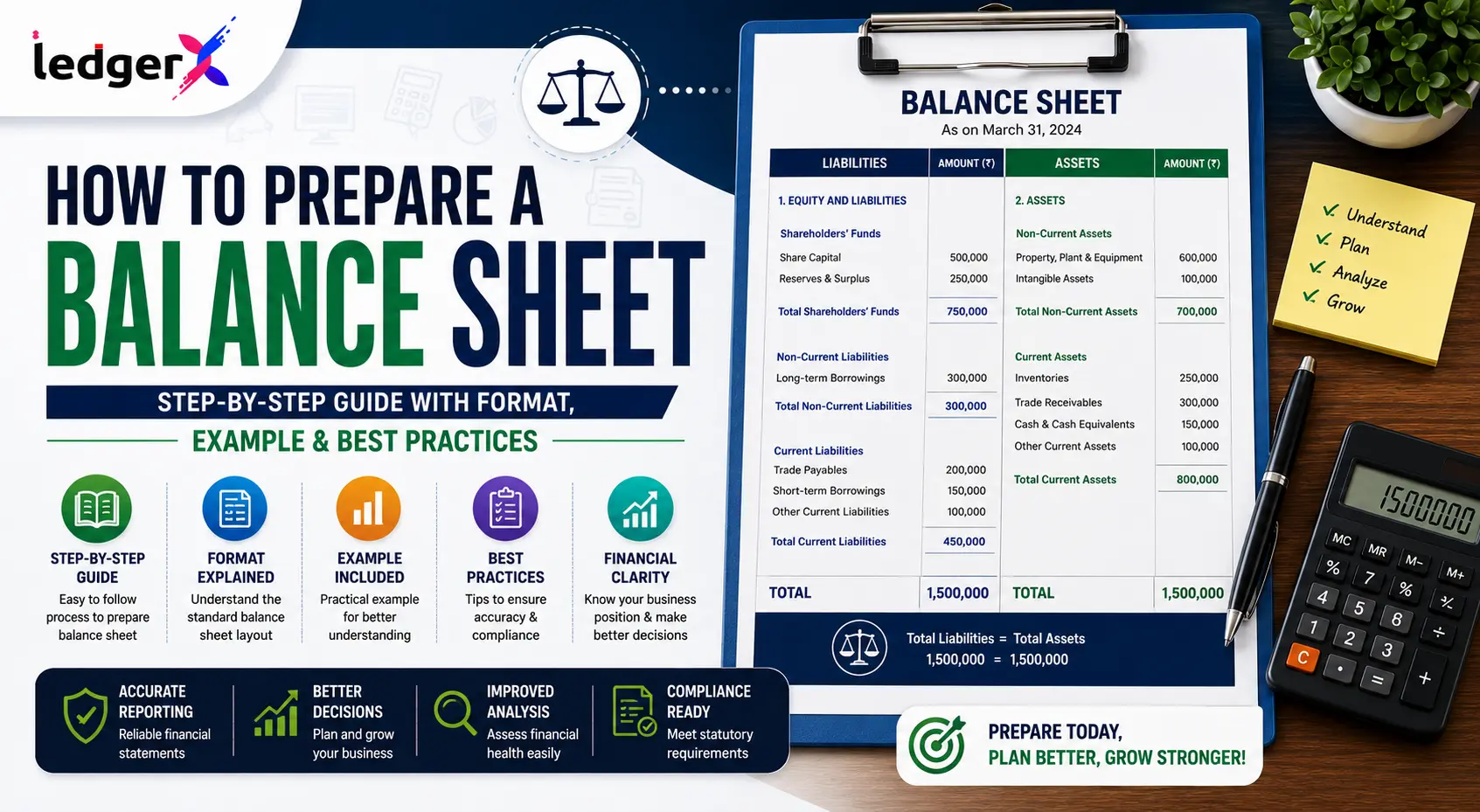
How to Prepare a Balance Sheet: A Complete Step-by-Step Guide
A balance sheet is one of the most important financial statements every business should prepare. It provides a snapshot of a company's financial position by showing what the business owns (assets), what it owes (liabilities), and the owner's equity at a specific point in time.
Whether you're a small business owner, startup founder, accountant, or finance student, knowing how to prepare a balance sheet is essential for understanding your company's financial health and making informed business decisions.
While balance sheets can be prepared manually, modern accounting software like LedgerX Accounting Software automates the entire process, helping businesses generate accurate balance sheets in seconds.
What is a Balance Sheet?
A balance sheet is a financial statement that summarizes a company's:
- Assets
- Liabilities
- Owner's Equity
It follows the fundamental accounting equation:
Assets = Liabilities + Owner's Equity
This equation ensures that every financial transaction is accurately recorded using the double-entry accounting system.
Unlike an income statement, which measures performance over a period, a balance sheet represents the financial position of a business on a specific date.
Why is a Balance Sheet Important?
A balance sheet helps businesses:
- Understand financial health
- Track assets and liabilities
- Measure business net worth
- Support loan applications
- Prepare tax filings
- Attract investors
- Make informed financial decisions
- Analyze liquidity and solvency
- Prepare annual financial statements
Banks, investors, auditors, and tax authorities frequently review balance sheets to assess a company's financial stability.
Components of a Balance Sheet
Every balance sheet consists of three primary sections.
1. Assets
Assets are resources owned by the business that have economic value.
Current Assets
These are assets expected to be converted into cash within one year.
Examples include:
- Cash
- Bank Balance
- Accounts Receivable
- Inventory
- GST Input Credit
- Short-Term Investments
- Prepaid Expenses
Non-Current Assets
These are long-term assets used to operate the business.
Examples include:
- Machinery
- Furniture
- Land
- Buildings
- Vehicles
- Computers
- Equipment
- Software Licenses
2. Liabilities
Liabilities are the financial obligations a business owes to others.
Current Liabilities
Obligations payable within one year.
Examples:
- Accounts Payable
- GST Payable
- Outstanding Expenses
- Short-Term Loans
- Salaries Payable
Long-Term Liabilities
Debts due after one year.
Examples:
- Bank Loans
- Business Loans
- Mortgage
- Vehicle Loan
3. Owner's Equity
Owner's equity represents the owner's investment in the business after deducting liabilities.
It generally includes:
- Capital
- Retained Earnings
- Current Year Profit
- Additional Capital Introduced
Balance Sheet Formula
Every balance sheet follows this equation:
Assets = Liabilities + Owner's Equity
Example:
Assets = ₹10,00,000
Liabilities = ₹4,00,000
Owner's Equity = ₹6,00,000
Since:
₹10,00,000 = ₹4,00,000 + ₹6,00,000
The balance sheet is accurate.
Information Required Before Preparing a Balance Sheet
Before creating a balance sheet, gather the following information:
- Trial Balance
- General Ledger
- Cash Book
- Bank Statements
- Inventory Records
- Fixed Asset Register
- Accounts Receivable
- Accounts Payable
- Loan Details
- Capital Account
- Profit & Loss Statement
Businesses using LedgerX Accounting Software can automatically generate these reports without maintaining multiple spreadsheets.
Step-by-Step Guide to Prepare a Balance Sheet
Step 1: Prepare the Trial Balance
The trial balance serves as the foundation for preparing a balance sheet.
Ensure:
- Debit equals Credit
- Ledger balances are accurate
- Errors are corrected
Without an accurate trial balance, the balance sheet may contain incorrect figures.
Step 2: Calculate Total Assets
List all current and non-current assets.
Example:
| Asset | Amount (₹) |
|---|---|
| Cash | 1,20,000 |
| Bank | 2,50,000 |
| Inventory | 3,00,000 |
| Furniture | 1,50,000 |
| Machinery | 4,80,000 |
| Total Assets | 13,00,000 |
Step 3: Calculate Total Liabilities
Include all outstanding obligations.
Example:
| Liability | Amount (₹) |
| Creditors | 1,20,000 |
| GST Payable | 80,000 |
| Bank Loan | 3,00,000 |
| Salaries Payable | 50,000 |
| Total Liabilities | 5,50,000 |
Step 4: Calculate Owner's Equity
Owner's Equity is calculated as:
Owner's Equity = Capital + Retained Earnings – Drawings
Example:
Capital = ₹6,50,000
Current Profit = ₹1,00,000
Drawings = ₹0
Owner's Equity = ₹7,50,000
Step 5: Verify the Accounting Equation
Ensure:
Assets = Liabilities + Owner's Equity
Example:
Assets = ₹13,00,000
Liabilities = ₹5,50,000
Owner's Equity = ₹7,50,000
Since both sides are equal, the balance sheet is balanced.
Balance Sheet Example
| Assets | ₹ | Liabilities & Equity | ₹ |
| Cash | 1,20,000 | Creditors | 1,20,000 |
| Bank | 2,50,000 | GST Payable | 80,000 |
| Inventory | 3,00,000 | Bank Loan | 3,00,000 |
| Furniture | 1,50,000 | Capital | 6,50,000 |
| Machinery | 4,80,000 | Current Profit | 1,00,000 |
| Total Assets | 13,00,000 | Total Liabilities & Equity | 13,00,000 |
Common Mistakes While Preparing a Balance Sheet
Avoid these common errors:
- Missing transactions
- Incorrect asset valuation
- Forgetting depreciation
- Misclassifying liabilities
- Incorrect inventory valuation
- Ignoring outstanding expenses
- Not reconciling bank balances
- Posting incorrect ledger balances
- Using outdated financial records
Using accounting software significantly reduces these errors.
Benefits of Using Accounting Software for Balance Sheets
Manual balance sheet preparation can become time-consuming as a business grows.
With LedgerX Accounting Software, businesses can:
- Generate balance sheets instantly
- Maintain automatic ledgers
- Track assets and liabilities
- Record transactions accurately
- Calculate depreciation
- Generate Trial Balance automatically
- View Profit & Loss reports
- Manage GST records
- Access financial reports from anywhere
- Reduce manual accounting errors
Instead of spending hours preparing reports, businesses can focus on strategic planning while LedgerX handles the calculations.
Manual Balance Sheet vs LedgerX Accounting Software
| Manual Method | LedgerX Accounting Software |
| Manual calculations | Automatic calculations |
| Higher risk of errors | Accurate financial reports |
| Spreadsheet dependency | Cloud-based access |
| Time-consuming | Instant report generation |
| Manual ledger maintenance | Automatic ledger updates |
| Difficult reconciliation | Easy financial tracking |
Best Practices for Preparing a Balance Sheet
To maintain accurate financial records:
- Record transactions daily.
- Reconcile bank accounts regularly.
- Update inventory records frequently.
- Verify ledger balances monthly.
- Record depreciation correctly.
- Maintain supporting documents.
- Review outstanding liabilities.
- Generate monthly financial reports.
- Use reliable accounting software.
Frequently Asked Questions (FAQs)
What is a balance sheet?
A balance sheet is a financial statement that shows a company's assets, liabilities, and owner's equity on a specific date.
Why is a balance sheet important?
It helps businesses understand their financial position, measure net worth, secure loans, prepare tax filings, and make informed business decisions.
What is the balance sheet formula?
Assets = Liabilities + Owner's Equity
How often should a balance sheet be prepared?
Most businesses prepare balance sheets monthly, quarterly, and annually, depending on reporting and compliance requirements.
Can accounting software prepare a balance sheet automatically?
Yes. Modern accounting software such as LedgerX Accounting Software can automatically generate balance sheets using recorded transactions, saving time and reducing errors.
Conclusion
A balance sheet is a vital financial statement that provides a clear picture of a business's financial health. By accurately recording assets, liabilities, and owner's equity, businesses can evaluate performance, improve financial planning, and make better strategic decisions.
Preparing a balance sheet manually can be challenging, especially as your business grows. That's why many businesses choose LedgerX Accounting Software to automate bookkeeping, generate accurate balance sheets, produce real-time financial reports, and simplify overall accounting.
Whether you're a startup, retailer, wholesaler, manufacturer, freelancer, or accountant, LedgerX Accounting Software helps you manage your finances with confidence.
Start using LedgerX today to automate your accounting, generate professional balance sheets instantly, and gain real-time insights into your business finances.