How to Prepare a Profit & Loss Statement: Format, Formula & Examples
A business can have hundreds of sales transactions, dozens of expenses and multiple bank accounts. But at the end of the month or year, one question usually matters:
Did the business actually make a profit?
A Profit & Loss statement, commonly called a P&L statement, helps answer that question.
It brings together a business's revenue and expenses for a particular period and shows the resulting profit or loss.
For a small business owner, the P&L can provide a much clearer picture than simply looking at the bank balance.
In this guide, we'll explain what a Profit & Loss statement is, its format, the basic formulas, a practical example and how businesses can prepare one.
What Is a Profit & Loss Statement?
A Profit & Loss statement is a financial statement that summarizes a business's income and expenses over a specific period to determine its profit or loss.
The period could be:
- A month
- A quarter
- Six months
- A financial year
- Another appropriate reporting period
The basic idea is simple:
Profit = Income − Expenses
If income is greater than expenses, the business has a profit.
If expenses are greater than income, the business has a loss.
Why Is a Profit & Loss Statement Important?
Revenue alone doesn't tell you whether a business is profitable.
Imagine a business generates:
₹50 lakh in sales
during a year.
That sounds substantial.
But suppose the business spends:
₹47 lakh
on inventory, salaries, rent, advertising, utilities and other expenses.
The resulting profit would be:
₹50 lakh − ₹47 lakh = ₹3 lakh
The P&L helps bring these numbers together so the business owner can see what happened financially during the period.
It can help answer questions such as:
- How much revenue did we generate?
- What did it cost to generate that revenue?
- How much gross profit did we make?
- What were our operating expenses?
- What was our net profit or loss?
- Which expenses increased?
- Is profitability improving?
Profit & Loss Statement Format
A simplified P&L statement can look like this:
| Particulars | Amount |
|---|---|
| Revenue / Sales | ₹10,00,000 |
| Less: Cost of Goods Sold | ₹6,00,000 |
| Gross Profit | ₹4,00,000 |
| Operating Expenses | ₹2,50,000 |
| Operating Profit | ₹1,50,000 |
| Other Income | ₹20,000 |
| Finance Costs / Other Expenses | ₹30,000 |
| Profit Before Tax | ₹1,40,000 |
| Tax Expense | ₹40,000 |
| Profit After Tax | ₹1,00,000 |
The exact presentation can vary depending on the type of business and applicable accounting requirements.
Main Components of a Profit & Loss Statement
A P&L generally includes several important components.
1. Revenue
Revenue is the income generated from the business's primary activities.
For example:
A retailer sells goods worth:
₹10,00,000
during the year.
The relevant sales revenue is included in the P&L, subject to the applicable accounting treatment.
Revenue may come from:
- Product sales
- Service income
- Subscription income
- Professional fees
- Other operating activities
2. Cost of Goods Sold
For businesses that sell products, the Cost of Goods Sold (COGS) represents the cost associated with the goods sold during the period.
A commonly used formula is:
COGS = Opening Inventory + Purchases + Direct Costs − Closing Inventory
For example:
- Opening inventory: ₹2,00,000
- Purchases: ₹6,00,000
- Direct costs: ₹50,000
- Closing inventory: ₹1,50,000
Then:
COGS = ₹2,00,000 + ₹6,00,000 + ₹50,000 − ₹1,50,000
COGS = ₹7,00,000
The exact calculation and treatment can vary depending on the accounting method and business circumstances.
3. Gross Profit
Gross profit shows what remains after deducting the cost directly associated with the goods or services sold from revenue.
Gross Profit = Revenue − COGS
Suppose:
Revenue = ₹10,00,000
COGS = ₹7,00,000
Then:
Gross Profit = ₹10,00,000 − ₹7,00,000
Gross Profit = ₹3,00,000
Gross profit is particularly useful for understanding the profitability of the core sale of goods or services before other operating expenses are considered.
4. Operating Expenses
Operating expenses are costs associated with running the business.
Depending on the business, these can include:
- Salaries
- Rent
- Electricity
- Advertising
- Office expenses
- Software subscriptions
- Transportation
- Telephone and internet
- Professional fees
- Repairs and maintenance
For example:
| Expense | Amount |
|---|---|
| Salaries | ₹1,00,000 |
| Rent | ₹50,000 |
| Electricity | ₹15,000 |
| Marketing | ₹20,000 |
| Office expenses | ₹15,000 |
| Total | ₹2,00,000 |
These expenses reduce the profit generated by the business.
5. Operating Profit
A simplified calculation is:
Operating Profit = Gross Profit − Operating Expenses
For example:
Gross Profit = ₹3,00,000
Operating Expenses = ₹2,00,000
Therefore:
Operating Profit = ₹1,00,000
This shows the result from the business's operating activities before considering certain other income and expenses.
6. Other Income and Expenses
Depending on the business, the P&L may also include items outside the main operating activity.
Examples can include:
- Interest income
- Certain investment income
- Finance costs
- Interest expense
- Other non-operating income
- Other applicable expenses
These items can affect the final profit.
7. Profit Before Tax
After considering relevant income and expenses, the business arrives at profit before tax.
For example:
Operating Profit = ₹1,00,000
Other Income = ₹20,000
Finance/Other Expenses = ₹10,000
Therefore:
Profit Before Tax = ₹1,10,000
The exact structure depends on the business and applicable reporting requirements.
8. Tax Expense
Applicable tax expenses are then considered to arrive at the final profit figure under the relevant accounting and tax treatment.
For example:
Profit Before Tax = ₹1,10,000
Tax Expense = ₹30,000
Profit After Tax = ₹80,000
Again, this is a simplified illustration rather than a universal tax calculation.
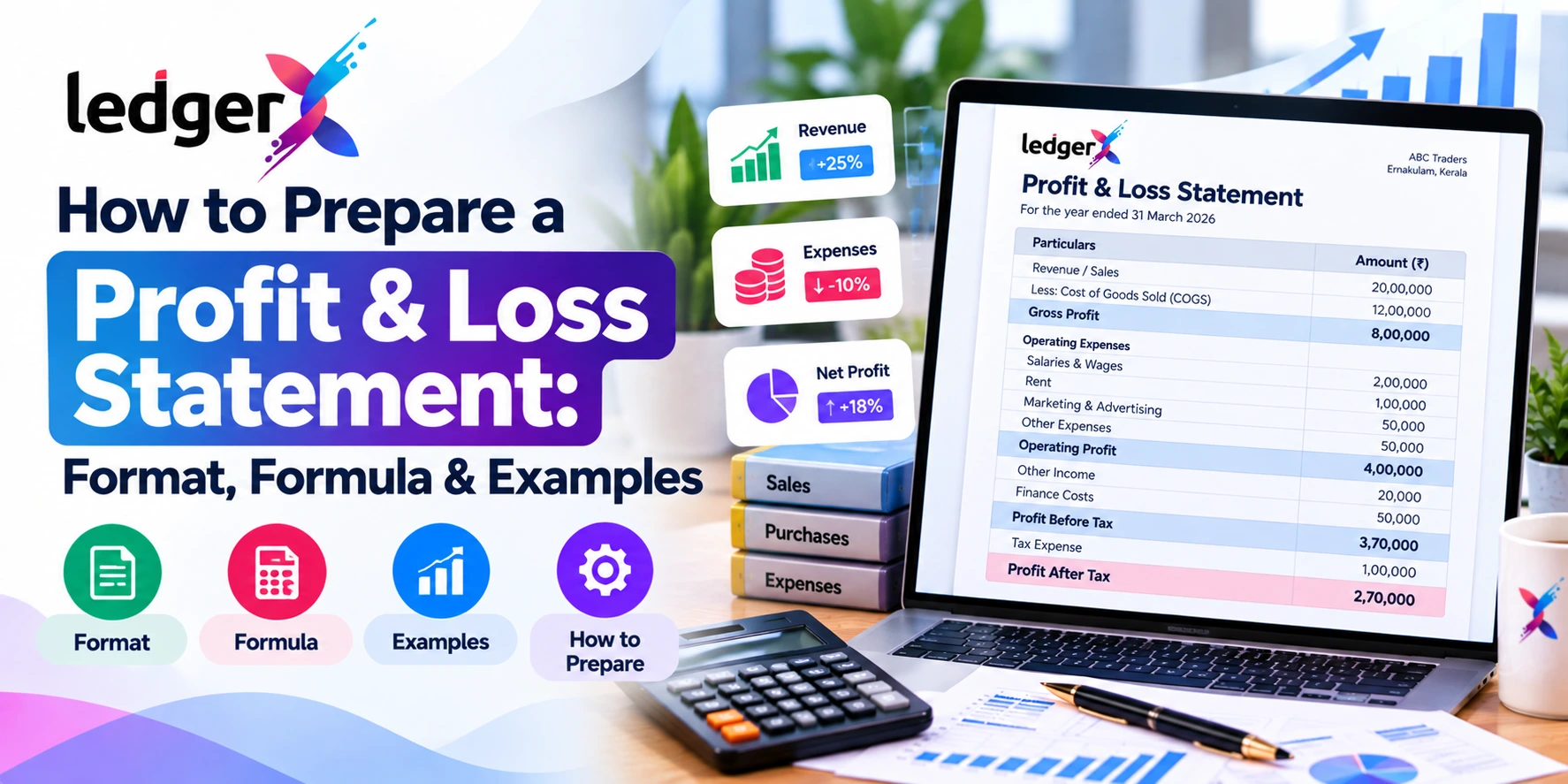
Profit & Loss Statement Example
Let's take a small retail business.
During the year:
Revenue
₹20,00,000
COGS
₹12,00,000
Therefore:
Gross Profit = ₹8,00,000
Now consider operating expenses:
- Salaries: ₹2,00,000
- Rent: ₹1,00,000
- Electricity: ₹30,000
- Marketing: ₹50,000
- Other expenses: ₹20,000
Total operating expenses:
₹4,00,000
Therefore:
Operating Profit = ₹8,00,000 − ₹4,00,000
₹4,00,000
Suppose other expenses total ₹50,000.
Then:
Profit Before Tax = ₹3,50,000
If the relevant tax expense is ₹1,00,000:
Profit After Tax = ₹2,50,000
A simplified P&L could therefore look like:
| Particulars | Amount |
|---|---|
| Revenue | ₹20,00,000 |
| COGS | ₹12,00,000 |
| Gross Profit | ₹8,00,000 |
| Operating Expenses | ₹4,00,000 |
| Operating Profit | ₹4,00,000 |
| Other Expenses | ₹50,000 |
| Profit Before Tax | ₹3,50,000 |
| Tax Expense | ₹1,00,000 |
| Profit After Tax | ₹2,50,000 |
How to Prepare a Profit & Loss Statement
Preparing a P&L starts with having accurate accounting records.
A simplified process is:
Step 1: Determine the reporting period
Decide whether you're preparing the statement for a month, quarter, year or another period.
Step 2: Collect revenue information
Compile relevant sales and other operating income.
Step 3: Calculate the applicable cost of sales
For businesses selling goods, determine COGS using the appropriate accounting method.
Step 4: Calculate gross profit
Revenue − COGS = Gross Profit
Step 5: Record operating expenses
Include relevant expenses such as rent, salaries, utilities, marketing and other operating costs.
Step 6: Consider other income and expenses
Include relevant non-operating items and finance costs.
Step 7: Calculate profit before tax
Determine the result before applicable tax expense.
Step 8: Consider tax expense
Apply the appropriate accounting treatment.
Step 9: Determine the final profit or loss
The resulting figure represents the profit or loss for the period under the relevant accounting framework.
Profit & Loss Formula
There isn't just one formula because a P&L contains several stages.
The simplest formula is:
Profit = Income − Expenses
For a product-based business, you can break it down further:
Gross Profit = Revenue − COGS
Then:
Operating Profit = Gross Profit − Operating Expenses
And, in a simplified presentation:
Profit Before Tax = Operating Profit + Other Income − Other Expenses
Finally:
Profit After Tax = Profit Before Tax − Tax Expense
The exact presentation can vary depending on the business and applicable accounting standards.
Gross Profit vs Net Profit
These two terms are frequently confused.
Gross Profit
Shows the amount left after deducting the cost of goods or services sold from revenue.
Gross Profit = Revenue − COGS
Net Profit
Represents the final profit after considering applicable operating and other expenses and taxes.
For example:
Revenue = ₹10 lakh
COGS = ₹6 lakh
Gross Profit = ₹4 lakh
After operating expenses and other applicable costs:
Net Profit = ₹1.5 lakh
So:
Gross Profit tells you about the profitability of sales before other expenses.
Net Profit shows the final result after the relevant expenses and tax effects.
Profit & Loss Statement vs Balance Sheet
Both are important, but they answer different questions.
| Profit & Loss | Balance Sheet |
|---|---|
| Measures financial performance | Shows financial position |
| Covers a period | Shows position at a specific date |
| Includes revenue | Includes assets |
| Includes expenses | Includes liabilities |
| Shows profit/loss | Shows equity |
| Helps evaluate profitability | Helps evaluate financial position |
For example:
A P&L might show:
Profit for the year = ₹5 lakh
The Balance Sheet might show:
Assets = ₹20 lakh
Liabilities = ₹8 lakh
Equity = ₹12 lakh
The two reports provide different perspectives on the business.
Profit & Loss Statement vs Cash Flow
Profit and cash are also not the same thing.
Suppose a business makes a credit sale of:
₹5,00,000
The sale may contribute to revenue and profit according to the applicable accounting treatment.
But if the customer hasn't paid yet, the business hasn't necessarily received ₹5 lakh in cash.
The amount may instead be recorded as a receivable.
This is why a profitable business can still experience cash-flow pressure.
Common P&L Mistakes
Recording personal expenses as business expenses
Business and personal transactions should be appropriately separated.
Forgetting expenses
Missing expenses can overstate reported profit.
Confusing sales with cash received
Credit sales may not immediately generate cash.
Incorrect inventory treatment
Closing inventory can affect COGS and therefore gross profit.
Ignoring outstanding expenses
Expenses incurred but not yet paid may still require appropriate accounting treatment.
Mixing different periods
Revenue and expenses should be accounted for in the appropriate reporting period according to the applicable accounting principles.
Not reviewing expense trends
A P&L becomes much more useful when businesses compare results over time.
How to Use a P&L to Understand Your Business
Don't simply look at the final profit number.
Look at the components.
For example:
Revenue increased
But did gross profit increase at the same rate?
Gross profit decreased
Did product costs increase?
Operating expenses increased
Which expense categories changed?
Net profit decreased
Was the change caused by lower revenue, higher costs, finance expenses or another factor?
This approach turns the P&L from a report you simply receive into a tool for understanding business performance.
P&L Analysis for Small Businesses
Suppose a business has:
| Metric | Last Year | This Year |
|---|---|---|
| Revenue | ₹20 lakh | ₹25 lakh |
| COGS | ₹12 lakh | ₹16 lakh |
| Gross Profit | ₹8 lakh | ₹9 lakh |
| Operating Expenses | ₹5 lakh | ₹6.5 lakh |
| Net Profit | ₹3 lakh | ₹2.5 lakh |
Revenue increased by ₹5 lakh.
That sounds positive.
But net profit decreased from ₹3 lakh to ₹2.5 lakh.
The P&L can help the business investigate why.
Possible areas to review include:
- Rising product costs
- Higher salaries
- Increased rent
- Marketing expenses
- Finance costs
- Other expenses
This is where financial reporting becomes useful for decision-making.
Can Accounting Software Generate a P&L?
Yes.
Accounting software can generate Profit & Loss reports based on recorded transactions.
When a business properly records:
- Sales
- Purchases
- Expenses
- Inventory
- Payments
- Receipts
- Other transactions
the accounting system can organize that information into financial reports.
This is much more efficient than manually adding numbers from separate invoices and spreadsheets every time a P&L is required.
Create Profit & Loss Reports With LedgerX
LedgerX connects day-to-day business accounting with financial reporting.
Businesses can manage:
- Sales
- Purchases
- Expenses
- Customers
- Suppliers
- Inventory
- Payments
- Receipts
- Ledgers
- Profit & Loss
- Balance Sheet
- Business reports
This means business transactions can flow into financial reports without requiring the owner to manually rebuild the P&L every time.
Explore LedgerX: https://ledgerx.biz/
P&L Statement Checklist
Before reviewing a Profit & Loss statement, check:
- Reporting period is correct
- Sales/revenue is recorded accurately
- Purchases are recorded
- COGS is calculated appropriately
- Closing inventory is considered
- Operating expenses are recorded
- Other income is included where applicable
- Finance costs are recorded
- Relevant adjustments are considered
- Tax expense is appropriately accounted for
- Profit/loss is calculated correctly
- Results are compared with previous periods
Frequently Asked Questions
What is a Profit & Loss statement?
A Profit & Loss statement is a financial statement that summarizes a business's income and expenses over a specific period to determine its profit or loss.
What is the formula for Profit & Loss?
A simple formula is:
Profit = Income − Expenses
For a trading business, gross profit is commonly calculated as:
Gross Profit = Revenue − COGS
What is the difference between gross profit and net profit?
Gross profit is revenue minus the cost of goods or services sold. Net profit is the final profit after considering relevant operating and other expenses and tax effects.
How often should a business prepare a P&L?
Businesses may prepare P&L statements monthly, quarterly, annually or at other intervals depending on their management and reporting requirements.
Is a Profit & Loss statement the same as an income statement?
The terms are commonly used interchangeably to refer to a statement showing income and expenses and the resulting profit or loss.
Does a P&L show cash in the bank?
Not necessarily. A P&L measures income and expenses under the applicable accounting basis. Cash balances are presented separately in financial position and cash-flow information.
Can a small business prepare its own P&L?
Yes, provided its accounting records are accurate and the business applies the appropriate accounting treatment. Professional advice may be appropriate for more complex or statutory reporting requirements.
Final Takeaway
A Profit & Loss statement turns a long list of sales and expenses into a much simpler question:
Did the business make money during the period?
The basic relationship is:
Revenue − Costs and Expenses = Profit or Loss
But the real value of a P&L goes beyond the final number.
It can show whether revenue is growing, whether product costs are increasing, whether expenses are eating into margins and whether profitability is improving or declining.
For a small business, regularly reviewing the P&L alongside the Balance Sheet, cash-flow information, receivables and payables gives a much clearer picture of what's happening financially.
Don't just ask how much your business sold. Ask how much it kept — and understand why.