Sales Invoice: Meaning, Format, Examples & How to Create One
Every time a business sells a product or service, there is more to the transaction than simply receiving money.
You need to know what was sold, to whom, for how much, what taxes apply, whether the customer has paid, and when the transaction took place.
A sales invoice brings these details together in one document.
For a small business, a good invoice is more than a piece of paper or a PDF. It becomes part of the business's accounting records and can help track sales, customer balances, taxes and payments.
In this guide, we'll look at what a sales invoice is, what it contains, a simple sales invoice format, examples, GST-related details and how to create one efficiently.
What Is a Sales Invoice?
A sales invoice is a document issued by a seller to a customer that records the details of a sale and the amount payable.
It commonly includes:
- Seller details
- Customer details
- Invoice number
- Invoice date
- Products or services sold
- Quantity
- Price
- Discounts, where applicable
- Taxes, where applicable
- Total amount
- Payment terms
In simple terms:
A sales invoice tells the customer what they purchased, how much it costs and how much they need to pay.
For businesses selling on credit, the invoice also becomes an important record for tracking the amount outstanding from the customer.
Why Is a Sales Invoice Important?
Imagine running a business that makes 50 sales every month.
If you only record the total amount received in your bank account, you won't have a clear record of:
- Which customer purchased what
- Which products were sold
- How much GST was charged
- Which invoices are unpaid
- When each sale happened
- Which invoices are overdue
A properly prepared sales invoice helps create that transaction-level record.
It can support:
Sales tracking
Businesses can maintain a record of individual sales rather than relying on memory or bank statements.
Customer management
Invoices can be associated with specific customers.
Payment tracking
Businesses can identify paid, partially paid and outstanding invoices.
Accounting
Sales invoices provide transaction information that can feed into accounting records.
Tax and GST records
Where applicable, invoices contain information relevant to GST and tax reporting.
Sales Invoice Format
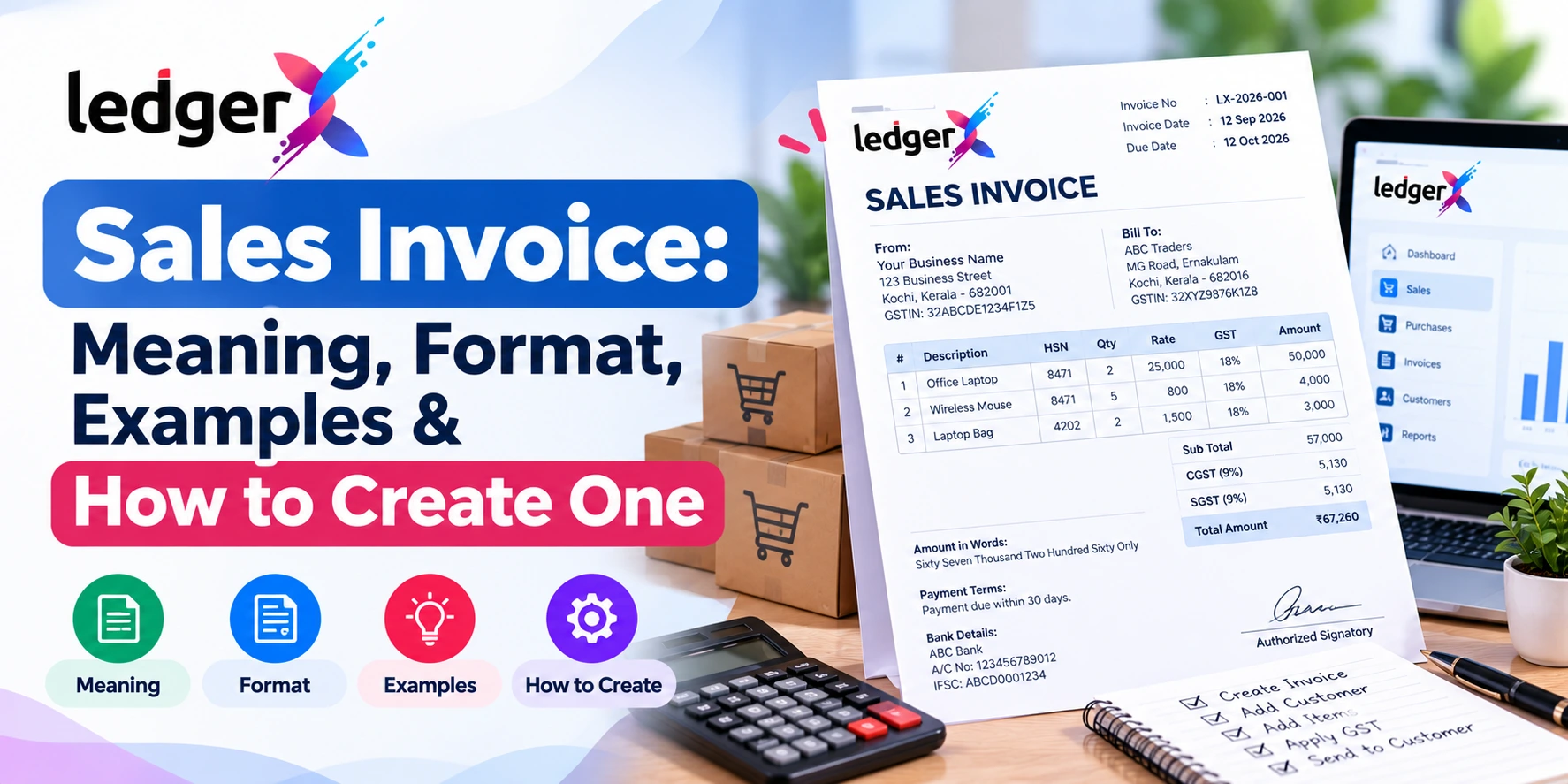
A basic sales invoice can follow a structure like this:
SALES INVOICE
Seller Details
- Business Name
- Address
- GSTIN, if applicable
- Contact details
Invoice Details
- Invoice Number
- Invoice Date
- Due Date
- Payment Terms
Customer Details
- Customer Name
- Billing Address
- GSTIN, if applicable
- Contact details
Products / Services
| Description | Qty | Rate | Taxable Value | GST | Amount |
|---|---|---|---|---|---|
| Product A | 2 | ₹1,000 | ₹2,000 | 18% | ₹2,360 |
| Product B | 1 | ₹2,000 | ₹2,000 | 18% | ₹2,360 |
Subtotal: ₹4,000
GST: ₹720
Total: ₹4,720
Payment Terms: 30 days
Payment Details: Bank/UPI details, if applicable
Authorized Signatory: __________
The actual format can vary depending on the business, transaction and applicable requirements.
What Should a Sales Invoice Contain?
The exact information required can depend on the type of transaction and applicable laws. For GST-registered businesses in India, invoices need to contain relevant prescribed particulars.
Some commonly important fields include:
1. Invoice Number
Each invoice should have a unique invoice number according to the applicable invoicing requirements.
For example:
INV-2026-00125
2. Invoice Date
The date on which the invoice is issued.
3. Seller Information
This may include:
- Legal/business name
- Address
- GSTIN, where applicable
- Contact details
4. Customer Information
Depending on the transaction, this can include:
- Customer name
- Address
- GSTIN, where applicable
- Place of supply, where relevant
5. Product or Service Details
The invoice should clearly identify what was sold.
For products, this may include:
- Product name
- HSN
- Quantity
- Unit price
For services, relevant service classification details may apply.
6. Tax Details
For a taxable GST transaction, the invoice should show the applicable tax information.
Depending on the transaction, this may include:
- CGST
- SGST
- IGST
- Tax rate
- Tax amount
7. Total Amount
The final amount payable by the customer.
8. Payment Terms
For credit sales, the invoice can specify when payment is expected.
Sales Invoice Example
Let's take a simple example.
A retailer sells a product for:
Product: Office Printer
Quantity: 1
Price: ₹20,000
GST: 18%
Tax calculation:
₹20,000 × 18% = ₹3,600
Therefore:
Taxable value: ₹20,000
GST: ₹3,600
Invoice total: ₹23,600
A simplified invoice could show:
| Particular | Amount |
|---|---|
| Product value | ₹20,000 |
| GST @ 18% | ₹3,600 |
| Total | ₹23,600 |
If the customer pays immediately, the transaction can be recorded as paid.
If the customer purchases on credit, the ₹23,600 may remain outstanding until payment is received.
Sales Invoice for GST-Registered Businesses
For businesses registered under GST, the invoice needs to comply with the applicable GST invoicing requirements.
A GST tax invoice can contain details such as:
- Supplier GSTIN
- Invoice number
- Invoice date
- Customer details
- Customer GSTIN, where applicable
- Description of goods/services
- HSN/SAC, as applicable
- Quantity, where relevant
- Taxable value
- GST rate
- Tax amount
- Place of supply, where applicable
- Total invoice value
- Other prescribed particulars
The exact requirements depend on the nature of the transaction.
Businesses should refer to current GST requirements for their specific situation.
GST Sales Invoice Example
Suppose a GST-registered business sells goods worth ₹50,000 in an applicable intra-state transaction.
Assume GST is charged at 18%.
The tax is split into:
CGST = 9%
SGST = 9%
Calculation:
CGST: ₹50,000 × 9% = ₹4,500
SGST: ₹50,000 × 9% = ₹4,500
Therefore:
| Particular | Amount |
|---|---|
| Taxable Value | ₹50,000 |
| CGST @ 9% | ₹4,500 |
| SGST @ 9% | ₹4,500 |
| Total Invoice Value | ₹59,000 |
For an applicable inter-state transaction, the tax treatment may instead involve IGST.
Sales Invoice vs Tax Invoice
These terms can sometimes be used loosely, but they should not automatically be treated as identical in every context.
A tax invoice is a specific GST document issued by a registered person for taxable supplies when the relevant GST requirements call for one.
A sales invoice is a broader business term used for a document recording a sale.
For a GST-registered business making a taxable supply, the sales invoice may function as the GST tax invoice when it meets the applicable requirements.
Sales Invoice vs Bill of Supply
A Bill of Supply is different from a tax invoice.
A registered person may issue a Bill of Supply in specified situations, such as certain exempt supplies or supplies by a composition taxpayer where a tax invoice is not issued.
Therefore, businesses should not simply use the same document for every transaction without considering the applicable GST treatment.
Sales Invoice vs Receipt
A sales invoice and receipt serve different purposes.
Sales Invoice
Primarily records the sale and amount payable.
Receipt
Generally confirms that payment has been received.
For example:
Invoice: ₹50,000
Customer pays: ₹50,000
The business can issue or record appropriate payment confirmation according to its process.
So:
Invoice = What the customer needs to pay
Receipt = Confirmation of payment received
Sales Invoice vs Quotation
A quotation is generally created before a sale is finalized.
An invoice is generally issued when the sale is made or the relevant invoicing requirement is triggered.
Quotation
"Here is the price we are offering."
Sales Invoice
"Here is the transaction and amount payable."
A typical sales process might therefore look like:
Customer enquiry
↓
Quotation
↓
Order
↓
Sale
↓
Invoice
↓
Payment
The exact workflow varies between businesses.
How to Create a Sales Invoice
Creating a sales invoice doesn't need to be complicated.
Step 1: Add your business details
Enter your business name, address and relevant tax information.
Step 2: Add customer details
Enter the customer's name and relevant address/GST information.
Step 3: Add invoice number and date
Use a consistent invoice numbering system.
Step 4: Add products or services
Enter:
- Product/service
- Quantity
- Rate
- Applicable discount
- Tax
Step 5: Calculate the total
The invoice should clearly show the taxable value, applicable taxes and final amount.
Step 6: Add payment terms
If the sale is on credit, mention the agreed payment terms or due date.
Step 7: Review the invoice
Check:
- Customer details
- Product details
- Quantity
- Price
- GST rate
- Tax amount
- Total
- Invoice number
Step 8: Send the invoice
The completed invoice can be shared through the appropriate channel, such as email or another business communication method.
How to Number Sales Invoices
A consistent invoice numbering system makes sales records easier to organize.
For example:
INV-001
INV-002
INV-003
Or:
LX-2026-0001
LX-2026-0002
The numbering approach should follow the applicable invoicing requirements and your business's record-keeping system.
Avoid creating confusing or duplicate invoice numbers.
What Happens After a Sales Invoice Is Created?
Creating the invoice is only one part of the sales cycle.
Once an invoice is issued, the business may need to:
- Track whether it has been paid
- Record the payment
- Update customer outstanding balances
- Update inventory where applicable
- Record GST/tax information
- Reconcile the payment
- Include the transaction in financial reports
This is where an invoice becomes part of the wider accounting system.
For example:
Sales Invoice
↓
Customer Receivable
↓
Customer Payment
↓
Bank/Cash
↓
Accounting Reports
Sales Invoice and Accounts Receivable
Credit sales create an important connection between invoices and accounts receivable.
Suppose you issue a sales invoice for:
₹75,000
but the customer has 30 days to pay.
Until the customer pays, the amount can remain outstanding as a receivable, subject to the accounting treatment applicable to the transaction.
This means your sales invoice can help answer:
- How much does the customer owe?
- When is payment due?
- Which invoices are overdue?
- How much total receivables are outstanding?
For businesses with many customers, this becomes difficult to manage manually.
Sales Invoice and Inventory
For businesses that sell physical products, a sales invoice can also be connected to inventory management.
For example:
A retailer has:
100 units of a product.
A customer buys:
10 units.
After the sale, the available stock should generally become:
90 units
depending on the business's inventory system and transaction processing.
When sales, invoicing and inventory are managed separately, businesses may end up with discrepancies.
A connected accounting and inventory system can help keep these records aligned.
Common Sales Invoice Mistakes
Even a simple invoice can create problems if important details are incorrect.
Incorrect customer details
A wrong GSTIN or address can cause issues.
Duplicate invoice numbers
Invoice numbers should be properly controlled.
Incorrect GST rate
The applicable tax treatment should be verified.
Incorrect quantity or price
Always review the line items before issuing the invoice.
Missing payment terms
Credit customers should know when payment is expected.
Not tracking unpaid invoices
Issuing an invoice doesn't mean the money has been collected.
Maintaining invoices in different places
Scattered PDFs, spreadsheets and paper records can make tracking difficult.
Can You Create Sales Invoices With Accounting Software?
Yes.
Modern accounting and billing software can simplify the entire invoicing process.
Depending on the software, businesses can:
- Create sales invoices
- Calculate applicable taxes
- Save customer information
- Track invoice status
- Record payments
- Manage receivables
- Update inventory
- Generate sales reports
- Export invoices
- Share invoices digitally
This can save time compared with creating every invoice manually.
Create GST Sales Invoices With LedgerX
LedgerX combines GST billing, sales, accounting and business reporting in one platform.
With LedgerX, businesses can manage areas such as:
- GST invoices
- Customer records
- Sales transactions
- Purchases
- Expenses
- Inventory
- Receivables
- Payments
- Profit & Loss
- Balance Sheet
- Business reports
Instead of creating an invoice in one system and then manually entering the same transaction into accounting records, businesses can manage the sales transaction within the accounting workflow.
Explore LedgerX: https://ledgerx.biz/
Sales Invoice Checklist
Before sending a sales invoice, check:
- Business name and address
- GSTIN, where applicable
- Customer name
- Customer GSTIN, where applicable
- Invoice number
- Invoice date
- Product/service description
- Quantity
- Price
- HSN/SAC, where applicable
- Taxable value
- Applicable GST
- Total invoice value
- Payment terms
- Due date, where applicable
- Payment details, if required
Frequently Asked Questions
What is a sales invoice?
A sales invoice is a document issued by a seller to record a sale and communicate the amount payable by the customer.
What is included in a sales invoice?
A sales invoice can include seller and customer details, invoice number, date, products or services, quantity, prices, taxes, total amount and payment terms. GST invoices also need the applicable prescribed particulars.
Is a sales invoice the same as a GST invoice?
Not necessarily. "Sales invoice" is a broad business term, while a GST tax invoice is a specific document governed by GST requirements. A sales invoice issued for a taxable GST supply may serve as the tax invoice when it meets the applicable requirements.
Can I create a sales invoice without GST?
Whether GST should be charged depends on the business's registration status and the nature of the transaction. Businesses should follow the applicable tax rules rather than adding GST automatically to every invoice.
What is a sales invoice number?
It is the identifying number assigned to an invoice. Businesses should maintain an appropriate and consistent numbering system.
What is the difference between an invoice and a receipt?
An invoice records the sale and amount payable, while a receipt generally confirms that payment has been received.
Can a sales invoice be used for credit sales?
Yes. A sales invoice can record a credit sale, with the amount remaining outstanding until the customer makes payment.
Can accounting software create sales invoices?
Yes. Many accounting and billing systems can create invoices, calculate taxes, manage customer information, track payments and connect sales with accounting records.
Final Takeaway
A sales invoice may look like a simple document, but it connects several important parts of a business.
It records the sale, tells the customer what they need to pay, supports accounting records, helps track receivables, and, for applicable transactions, contains important GST information.
As sales volume increases, creating and tracking invoices manually can become time-consuming.
Using an accounting and billing system can connect the process:
Create Invoice → Record Sale → Track Customer Balance → Receive Payment → Update Accounts → Generate Reports
For a small business, that means less time spent maintaining separate records and more visibility into what is actually happening with its sales and cash flow.
A good sales invoice doesn't just document a sale. It becomes part of the financial story of your business.