What is a Bank Reconciliation Statement? A Complete Guide for Businesses
Every business that uses a bank account must ensure that its accounting records match the transactions recorded by the bank. However, due to timing differences, bank charges, direct deposits, cheque clearances, and recording errors, the balance in the Cash Book often differs from the balance shown in the Bank Statement.
To identify and explain these differences, businesses prepare a Bank Reconciliation Statement (BRS).
Whether you're a startup, retailer, wholesaler, manufacturer, service provider, accountant, or freelancer, understanding how to prepare a Bank Reconciliation Statement is essential for maintaining accurate financial records and preventing accounting errors.
Modern accounting software like LedgerX Accounting Software makes bank reconciliation faster by automatically recording transactions, tracking bank balances, and helping businesses identify discrepancies in real time.
What is a Bank Reconciliation Statement (BRS)?
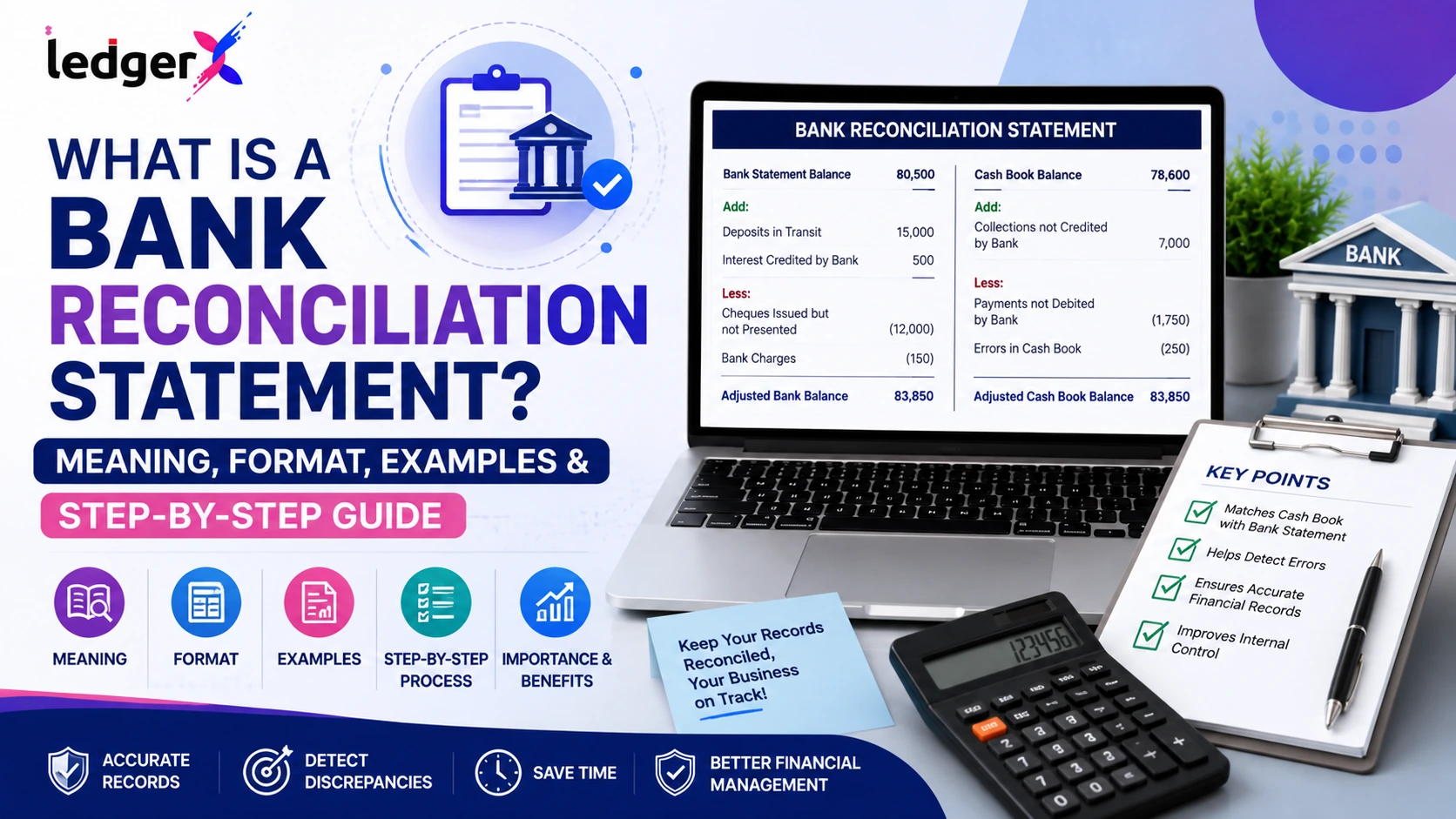
A Bank Reconciliation Statement (BRS) is a financial statement that compares the balance recorded in a company's Cash Book (Bank Column) with the balance shown in the Bank Statement issued by the bank.
The purpose of a Bank Reconciliation Statement is to identify the reasons for any differences and ensure that both records are accurate.
A BRS does not change the bank balance. Instead, it explains why the balances differ on a specific date.
Why is a Bank Reconciliation Statement Important?
Preparing a Bank Reconciliation Statement helps businesses:
- Verify the accuracy of accounting records
- Detect errors and omissions
- Identify unauthorized transactions
- Track uncleared cheques
- Detect duplicate entries
- Identify bank charges
- Monitor direct deposits
- Prevent fraud
- Improve cash flow management
- Prepare accurate financial statements
Regular bank reconciliation is considered one of the most important internal financial controls.
Objectives of Bank Reconciliation
The main objectives are:
- Match Cash Book and Bank Statement balances
- Identify timing differences
- Correct accounting mistakes
- Detect fraudulent transactions
- Improve financial accuracy
- Support auditing
- Maintain reliable bookkeeping
Why Do Differences Occur Between the Cash Book and Bank Statement?
Several reasons can cause differences between the two balances.
1. Outstanding Cheques
Cheques issued by the business may not yet have been presented to the bank for payment.
2. Deposits in Transit
Cash or cheques deposited into the bank may not yet have been credited by the bank.
3. Bank Charges
Banks may deduct:
- Account maintenance fees
- Transaction charges
- SMS charges
- Cheque collection charges
before the business records them in the Cash Book.
4. Interest Credited by the Bank
Banks may credit:
- Savings account interest
- Fixed deposit interest
before the business updates its accounting records.
5. Direct Customer Deposits
Customers may deposit money directly into the company's bank account without immediate notification.
6. Standing Instructions
Banks may automatically process:
- Loan EMI payments
- Insurance premiums
- Utility bills
- Subscription payments
before they are recorded in the books.
7. Dishonoured Cheques
A deposited cheque may bounce due to insufficient funds or other reasons.
8. Recording Errors
Common accounting mistakes include:
- Duplicate entries
- Incorrect amounts
- Wrong dates
- Omitted transactions
Bank Reconciliation Statement Format
A standard Bank Reconciliation Statement typically follows this format:
| Particulars | Amount (₹) |
|---|---|
| Balance as per Cash Book | 2,50,000 |
| Add: Cheques issued but not presented | 40,000 |
| Add: Bank interest credited | 2,000 |
| Less: Bank charges | (1,000) |
| Less: Cheques deposited but not cleared | (20,000) |
| Balance as per Bank Statement | 2,71,000 |
How to Prepare a Bank Reconciliation Statement
Step 1: Obtain the Cash Book and Bank Statement
Collect:
- Updated Cash Book
- Latest Bank Statement
Ensure both relate to the same accounting period.
Step 2: Compare Opening Balances
Verify whether the opening balances match.
If differences exist, investigate previous reconciliations before proceeding.
Step 3: Match Individual Transactions
Compare:
- Deposits
- Withdrawals
- Cheques
- Bank transfers
- Interest
- Charges
Tick each matching transaction.
Step 4: Identify Unmatched Transactions
Examples include:
- Outstanding cheques
- Deposits in transit
- Bank charges
- Interest received
- Direct deposits
- Standing instructions
- Recording mistakes
Step 5: Adjust for Timing Differences
Prepare the reconciliation by adding or subtracting unmatched items.
Step 6: Verify Final Balance
After adjustments, the reconciled balance should agree with the bank statement.
Bank Reconciliation Example
Suppose the following balances exist on 31 March:
Cash Book Balance
₹4,80,000
Bank Statement Balance
₹5,05,000
Differences:
- Outstanding Cheques: ₹30,000
- Bank Charges: ₹2,000
- Interest Received: ₹5,000
- Deposit in Transit: ₹8,000
The reconciliation statement would be:
| Particular | Amount (₹) |
| Cash Book Balance | 4,80,000 |
| Add: Outstanding Cheques | 30,000 |
| Add: Interest Credited | 5,000 |
| Less: Bank Charges | (2,000) |
| Less: Deposit in Transit | (8,000) |
| Adjusted Bank Balance | 5,05,000 |
Common Errors Identified During Bank Reconciliation
Businesses often discover:
- Duplicate payments
- Missing receipts
- Incorrect cheque amounts
- Wrong account postings
- Data entry mistakes
- Unrecorded bank charges
- Incorrect GST entries
- Unrecorded interest income
- Unauthorized withdrawals
Timely reconciliation helps correct these issues before they affect financial reports.
Benefits of Preparing a Bank Reconciliation Statement
Regular bank reconciliation provides several advantages:
- Improves accounting accuracy
- Detects fraud quickly
- Identifies banking errors
- Supports financial audits
- Strengthens internal controls
- Improves cash management
- Ensures accurate financial reporting
- Reduces bookkeeping errors
- Helps maintain tax compliance
Bank Reconciliation vs Cash Book
| Bank Reconciliation Statement | Cash Book |
| Compares Cash Book with Bank Statement | Records cash and bank transactions |
| Prepared periodically | Updated continuously |
| Identifies differences | Records daily transactions |
| Used for verification | Used for bookkeeping |
| Improves financial accuracy | Maintains transaction history |
Manual Bank Reconciliation vs LedgerX Accounting Software
| Manual Reconciliation | LedgerX Accounting Software |
| Spreadsheet-based | Digital reconciliation |
| Manual transaction matching | Faster transaction tracking |
| Time-consuming | Improved efficiency |
| Higher chance of errors | Greater accuracy |
| Difficult audit trail | Organized financial records |
| Delayed reconciliation | Real-time financial visibility |
How LedgerX Accounting Software Simplifies Bank Reconciliation
Reconciling bank accounts manually can become difficult as business transactions increase.
With LedgerX Accounting Software, businesses can:
- Record bank transactions accurately
- Maintain Cash Book automatically
- Track customer receipts
- Monitor supplier payments
- Generate Trial Balance reports
- Prepare Balance Sheets
- Generate Profit & Loss Statements
- Record journal entries automatically
- Maintain General Ledger accounts
- Access financial reports securely from anywhere
Using LedgerX Accounting Software, businesses can quickly identify discrepancies, maintain organized accounting records, and reduce the time spent on monthly bank reconciliation.
Best Practices for Bank Reconciliation
Follow these best practices:
- Reconcile bank accounts every month.
- Record transactions promptly.
- Verify cheque numbers.
- Review bank charges regularly.
- Match customer deposits daily.
- Investigate unmatched transactions immediately.
- Keep supporting documents safely.
- Reconcile multiple bank accounts separately.
- Use accounting software for automation.
Frequently Asked Questions (FAQs)
What is a Bank Reconciliation Statement?
A Bank Reconciliation Statement (BRS) compares the balance in the Cash Book with the balance shown in the Bank Statement and explains any differences between the two.
Why is a Bank Reconciliation Statement important?
It helps businesses identify errors, detect fraud, reconcile bank transactions, improve financial accuracy, and prepare reliable financial statements.
How often should a Bank Reconciliation Statement be prepared?
Most businesses prepare a Bank Reconciliation Statement monthly. Businesses with high transaction volumes may perform reconciliation weekly or even daily.
What causes differences between the Cash Book and Bank Statement?
Common causes include outstanding cheques, deposits in transit, bank charges, direct deposits, standing instructions, interest credited by the bank, and recording errors.
Can accounting software help with Bank Reconciliation?
Yes. LedgerX Accounting Software helps businesses maintain accurate bank records, record transactions efficiently, and simplify the reconciliation process by providing organized financial data and real-time reporting.
Conclusion
A Bank Reconciliation Statement (BRS) is an essential accounting tool that helps businesses verify the accuracy of their financial records by comparing the Cash Book with the Bank Statement. Regular reconciliation improves financial accuracy, detects errors and fraud, strengthens internal controls, and supports better cash flow management.
As businesses grow, manually reconciling bank transactions can become time-consuming and prone to errors. LedgerX Accounting Software simplifies this process by automatically recording transactions, maintaining Cash Books and Ledger Accounts, generating Trial Balances, Profit & Loss Statements, and Balance Sheets, and providing real-time financial insights.
Whether you're a startup, retailer, wholesaler, manufacturer, service provider, freelancer, or accountant, LedgerX Accounting Software helps streamline bookkeeping, simplify bank reconciliation, and keep your business finances accurate and organized.
Start using LedgerX Accounting Software today to automate accounting, simplify bank reconciliation, and gain complete control over your business finances.