What is a Cash Book? Types, Format, Examples & Complete Guide
Every business deals with cash transactions, whether it's receiving payments from customers, paying suppliers, withdrawing money from the bank, or covering daily operating expenses. Keeping an accurate record of these transactions is essential for maintaining healthy finances, avoiding errors, and making informed business decisions.
This is where a Cash Book becomes one of the most important accounting records. It helps businesses track every cash and bank transaction in chronological order while providing a clear picture of available funds.
Whether you're a small business owner, accountant, student, retailer, wholesaler, freelancer, or startup founder, understanding how a Cash Book works is a fundamental accounting skill.
Modern accounting software such as LedgerX Accounting Software automates Cash Book maintenance by recording transactions in real time, reducing manual work and improving financial accuracy.
What is a Cash Book?
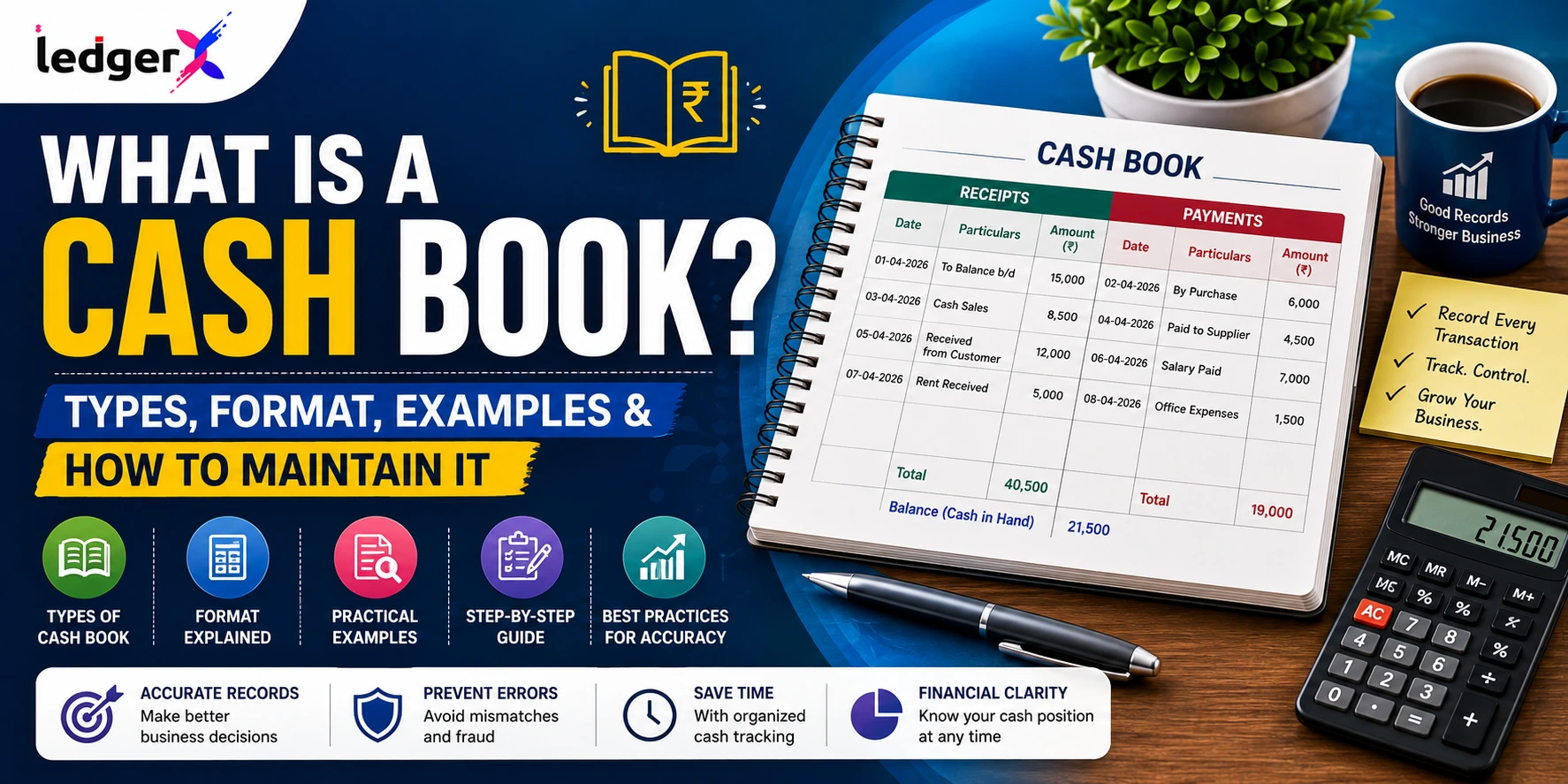
A Cash Book is a financial journal used to record all cash receipts and cash payments, including bank transactions, in chronological order. Unlike many accounting books, the Cash Book serves as both a book of original entry and a ledger account, making it one of the most frequently used records in bookkeeping.
Every transaction involving cash or bank accounts is entered into the Cash Book immediately after it occurs. This helps businesses monitor their available cash balance, manage liquidity, and ensure accurate financial reporting.
Why is a Cash Book Important?
Maintaining a Cash Book provides several benefits:
- Tracks all cash receipts and payments
- Records bank transactions accurately
- Helps monitor available cash balances
- Simplifies bank reconciliation
- Reduces accounting errors
- Supports financial reporting
- Improves cash flow management
- Provides audit-ready financial records
- Assists in preparing the Trial Balance and Balance Sheet
For businesses with frequent transactions, maintaining an updated Cash Book is essential for effective financial management.
Features of a Cash Book
A Cash Book has several key characteristics:
- Records cash and bank transactions only
- Updated in chronological order
- Shows opening and closing balances
- Acts as both a journal and ledger
- Provides real-time cash position
- Supports double-entry accounting
- Helps prepare financial statements
Types of Cash Book
There are several types of Cash Books used depending on the size and complexity of a business.
1. Single Column Cash Book
A Single Column Cash Book records cash transactions only.
It contains:
- Date
- Particulars
- Receipts
- Payments
- Balance
This type is commonly used by small businesses with limited cash transactions.
Example
| Date | Particulars | Receipts (₹) | Payments (₹) |
|---|---|---|---|
| 01 Apr | Opening Balance | 50,000 | |
| 03 Apr | Cash Sales | 20,000 | |
| 05 Apr | Office Rent | 10,000 | |
| 08 Apr | Electricity Bill | 3,500 |
2. Double Column Cash Book
A Double Column Cash Book records:
- Cash transactions
- Bank transactions
It usually contains separate columns for:
- Cash
- Bank
This format is suitable for businesses that regularly deposit or withdraw money from bank accounts.
Example
| Date | Particulars | Cash (₹) | Bank (₹) |
| Opening Balance | 30,000 | 2,50,000 | |
| Cash Deposited | -30,000 | +30,000 | |
| Customer Payment | +45,000 | ||
| Supplier Payment | -20,000 |
3. Triple Column Cash Book
A Triple Column Cash Book records:
- Cash
- Bank
- Discount Allowed/Received
It is widely used by medium and large businesses where discounts are frequently offered or received.
Example
| Date | Particulars | Discount (₹) | Cash (₹) | Bank (₹) |
| Customer Payment | 1,000 | 20,000 | ||
| Supplier Payment | 15,000 |
Cash Book Format
A standard Cash Book generally contains:
| Date | Particulars | Receipt (₹) | Payment (₹) | Balance (₹) |
| 01 Apr | Opening Balance | 75,000 | 75,000 | |
| 02 Apr | Cash Sales | 30,000 | 1,05,000 | |
| 03 Apr | Office Rent | 15,000 | 90,000 | |
| 04 Apr | Stationery | 2,500 | 87,500 |
How to Maintain a Cash Book
Step 1: Record Opening Balance
Begin with the cash available at the start of the accounting period.
Step 2: Record Cash Receipts
Enter all incoming cash transactions such as:
- Cash Sales
- Customer Payments
- Interest Received
- Capital Introduced
- Loan Received
Step 3: Record Cash Payments
Include all outgoing payments such as:
- Rent
- Salaries
- Purchases
- Utilities
- Office Expenses
- Loan Repayment
- GST Payment
Step 4: Update Running Balance
After each transaction, calculate the available cash balance.
This helps businesses monitor liquidity and identify cash shortages quickly.
Step 5: Reconcile with Bank Statements
If the Cash Book includes bank transactions, compare the balances regularly with bank statements to identify discrepancies.
Cash Book Example
Suppose a business has the following transactions during April.
| Date | Transaction | Receipt (₹) | Payment (₹) | Balance (₹) |
| 1 Apr | Opening Balance | 1,00,000 | 1,00,000 | |
| 3 Apr | Cash Sales | 40,000 | 1,40,000 | |
| 5 Apr | Rent Paid | 20,000 | 1,20,000 | |
| 7 Apr | Salary Paid | 30,000 | 90,000 | |
| 10 Apr | Customer Payment | 25,000 | 1,15,000 | |
| 12 Apr | Office Expenses | 10,000 | 1,05,000 |
The closing balance represents the available cash after all transactions.
Advantages of Maintaining a Cash Book
A properly maintained Cash Book offers several advantages:
- Improves financial accuracy
- Tracks daily cash movements
- Simplifies bookkeeping
- Supports bank reconciliation
- Reduces accounting errors
- Helps detect fraud
- Assists during audits
- Enables better cash flow planning
- Speeds up financial reporting
Common Mistakes While Maintaining a Cash Book
Businesses often make these mistakes:
- Forgetting to record cash transactions
- Duplicate entries
- Incorrect opening balance
- Wrong transaction dates
- Mixing personal and business expenses
- Not reconciling bank balances
- Recording bank transactions as cash transactions
- Ignoring supporting documents
Regular reviews and automation can prevent these issues.
Cash Book vs Cash Account
| Cash Book | Cash Account |
| Journal and Ledger | Ledger only |
| Records cash and bank transactions | Records only cash account postings |
| Updated immediately | Updated after journal posting |
| Shows daily cash position | Shows ledger balance |
| Used for bookkeeping | Used for accounting reports |
Manual Cash Book vs LedgerX Accounting Software
| Manual Cash Book | LedgerX Accounting Software |
| Manual data entry | Automatic transaction recording |
| Spreadsheet-based | Cloud-based accounting |
| Time-consuming | Instant updates |
| Prone to calculation errors | Accurate financial records |
| Manual reconciliation | Simplified bank reconciliation |
| Delayed reporting | Real-time cash reports |
Benefits of Using LedgerX Accounting Software
Managing cash manually becomes increasingly difficult as transaction volumes grow.
With LedgerX Accounting Software, businesses can:
- Automatically maintain Cash Books
- Record cash and bank transactions
- Track customer and supplier payments
- Generate Trial Balance reports
- Create Profit & Loss Statements
- Generate Balance Sheets
- Reconcile bank accounts
- Track cash flow in real time
- Manage GST accounting
- Access reports securely from anywhere
By automating bookkeeping, LedgerX eliminates repetitive manual tasks and gives business owners a real-time view of their financial position.
Best Practices for Maintaining a Cash Book
Follow these recommendations:
- Record transactions daily.
- Verify receipts and payments.
- Reconcile bank accounts regularly.
- Maintain supporting invoices.
- Separate business and personal expenses.
- Review balances weekly.
- Back up accounting records.
- Generate monthly financial reports.
- Use accounting software instead of spreadsheets.
Frequently Asked Questions (FAQs)
What is a Cash Book?
A Cash Book is an accounting record that documents all cash receipts, cash payments, and, in many cases, bank transactions. It functions as both a journal and a ledger.
What are the different types of Cash Books?
The three primary types are:
- Single Column Cash Book
- Double Column Cash Book
- Triple Column Cash Book
Why is a Cash Book important?
It helps businesses track cash flow, manage bank transactions, prepare financial statements, simplify reconciliation, and maintain accurate accounting records.
What is the difference between a Cash Book and a Cash Account?
A Cash Book records transactions directly as a journal and ledger, while a Cash Account is only a ledger account created from journal postings.
Can accounting software maintain a Cash Book automatically?
Yes. LedgerX Accounting Software automatically records cash and bank transactions, maintains an up-to-date Cash Book, and generates financial reports without manual calculations.
Conclusion
A Cash Book is one of the most essential accounting records for businesses of every size. It provides a clear, chronological record of all cash and bank transactions, helping businesses manage liquidity, monitor cash flow, prepare financial statements, and maintain accurate books of accounts.
While maintaining a Cash Book manually is possible, it becomes time-consuming and error-prone as your business grows. LedgerX Accounting Software simplifies this process by automatically recording transactions, maintaining an accurate Cash Book, generating Trial Balances, Profit & Loss Statements, and Balance Sheets, and providing real-time financial insights.
Whether you're a startup, retailer, wholesaler, service provider, freelancer, or accountant, LedgerX Accounting Software helps you streamline bookkeeping, improve financial accuracy, and make better business decisions.
Start using LedgerX Accounting Software today to automate your Cash Book, manage your finances efficiently, and keep your business accounting organized with ease.