What Is a General Ledger? Meaning, Format, Examples & How It Works
Every business records dozens, hundreds or even thousands of financial transactions.
Sales happen. Purchases are made. Customers make payments. Suppliers are paid. Expenses are incurred. Assets are purchased.
But recording transactions is only the beginning.
To understand the financial position of a business, these transactions need to be organized into individual accounts.
That's where the general ledger comes in.
A general ledger brings transactions together account by account — such as Cash, Sales, Purchases, Rent, Accounts Receivable and Accounts Payable.
In simple terms:
A general ledger is a collection of the accounts used to organize and summarize a business's financial transactions.
Let's understand how it works with practical examples.
What Is a General Ledger?
A general ledger is the main accounting record that contains the individual accounts used by a business to record and summarize its financial transactions.
Instead of looking at thousands of individual transactions separately, a business can use ledger accounts to see the activity and balance of specific accounts.
For example, a business might have ledger accounts for:
- Cash
- Bank
- Sales
- Purchases
- Rent
- Salaries
- Accounts Receivable
- Accounts Payable
- Inventory
- Capital
- Loans
Each account records the transactions affecting that particular account.
General Ledger Example
Imagine a small retail business makes these transactions during a week:
- Cash sales: ₹20,000
- Credit sales: ₹15,000
- Rent paid: ₹5,000
- Goods purchased: ₹12,000
- Customer payment: ₹8,000
Instead of keeping these as one long list, the transactions are classified into different accounts.
For example:
Sales Account
| Date | Particulars | Amount |
|---|---|---|
| 1 Sept | Cash Sales | ₹20,000 |
| 3 Sept | Credit Sales | ₹15,000 |
Rent Account
| Date | Particulars | Amount |
|---|---|---|
| 4 Sept | Rent Paid | ₹5,000 |
Purchases Account
| Date | Particulars | Amount |
|---|---|---|
| 5 Sept | Goods Purchased | ₹12,000 |
This organization is what makes the ledger useful.
Why Is the General Ledger Important?
Imagine trying to prepare a Balance Sheet using only hundreds of invoices and bank transactions.
It would be extremely difficult.
The general ledger helps organize those transactions into meaningful accounts.
It can help a business determine:
- Total sales
- Total purchases
- Customer balances
- Supplier balances
- Expenses
- Cash balance
- Bank balance
- Loans
- Capital
- Other account balances
These balances can then be used in preparing financial statements and other reports.
General Ledger vs Journal
The journal and general ledger are closely connected, but they serve different purposes.
Journal
Transactions are initially recorded in chronological order in the appropriate journal or accounting record.
For example:
1 September — Sold goods for ₹10,000
2 September — Paid rent ₹5,000
3 September — Purchased goods ₹8,000
General Ledger
Those transactions are then organized into the relevant accounts.
So:
Journal → Records transactions
Ledger → Organizes transactions by account
A simple way to remember it:
Journal = What happened and when
Ledger = What happened to each account
How Transactions Move Into the General Ledger
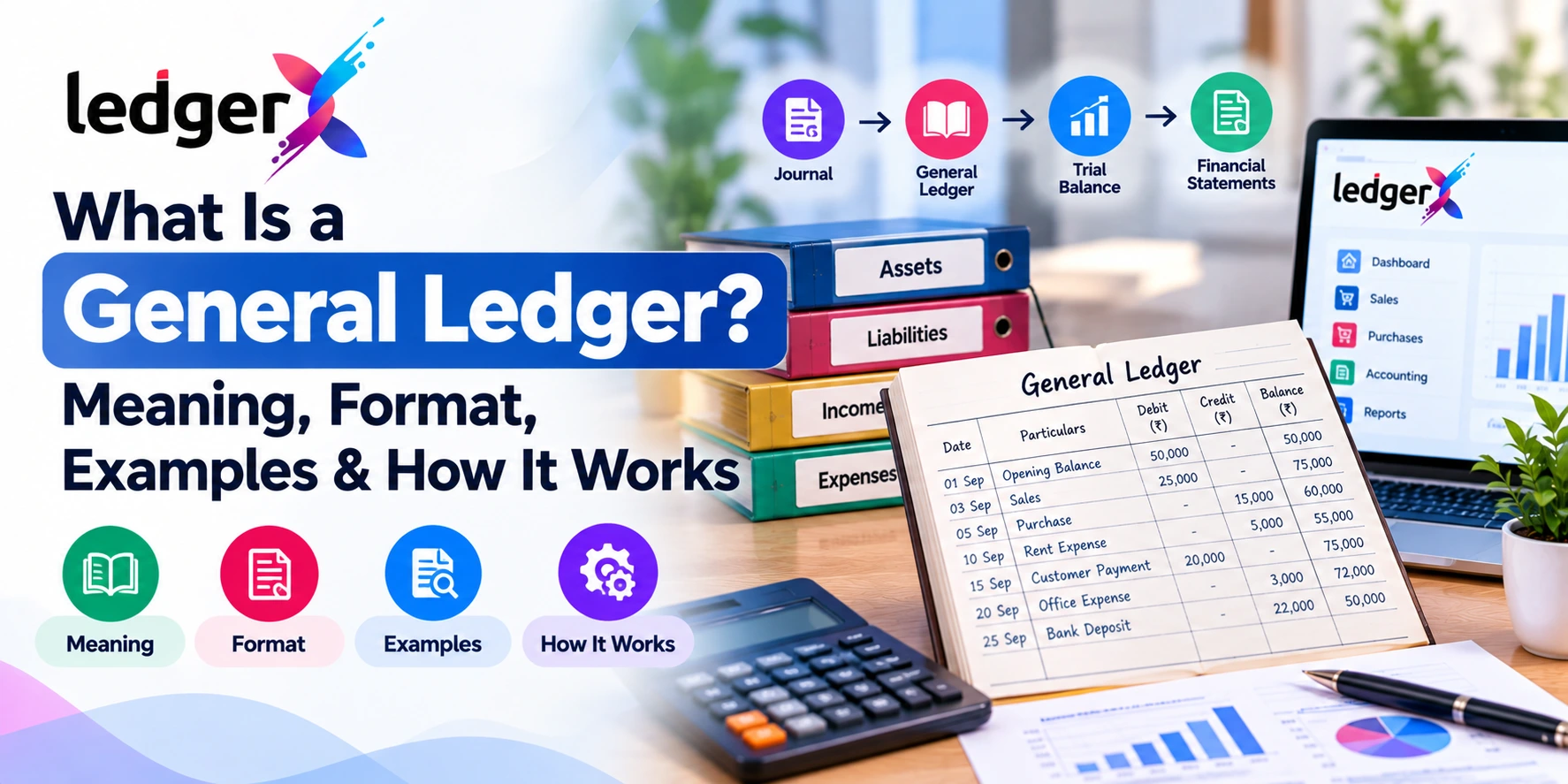
A simplified accounting flow looks like this:
Business Transaction
↓
Journal Entry
↓
Ledger Account
↓
Trial Balance
↓
Financial Statements
For example:
A business purchases office equipment for ₹50,000 in cash.
Journal entry
Office Equipment A/c Dr. ₹50,000 To Cash A/c ₹50,000
The transaction affects two ledger accounts:
Office Equipment Account
and
Cash Account
The respective balances are then included in the accounting records.
General Ledger Format
There isn't one single format used by every business or accounting system.
A traditional ledger account can be presented with debit and credit sides.
A simplified format is:
| Date | Particulars | Debit | Credit | Balance |
|---|---|---|---|---|
| 1 Sept | Capital introduced | — | ₹1,00,000 | ₹1,00,000 |
| 3 Sept | Purchase | ₹20,000 | — | ₹80,000 |
| 5 Sept | Expense | ₹5,000 | — | ₹75,000 |
Modern accounting software may present ledger reports differently, often including additional columns such as:
- Voucher number
- Reference
- Description
- Debit
- Credit
- Running balance
- Transaction type
The format can vary, but the purpose remains the same: show the transactions and balance associated with an account.
What Accounts Are Included in a General Ledger?
The accounts depend on the business.
A typical business may have ledger accounts for:
Assets
- Cash
- Bank
- Inventory
- Accounts Receivable
- Machinery
- Furniture
- Vehicles
Liabilities
- Accounts Payable
- Bills Payable
- Loans
- Taxes Payable
- Outstanding Expenses
Income
- Sales
- Service Revenue
- Other Income
Expenses
- Rent
- Salaries
- Electricity
- Advertising
- Transportation
- Office Expenses
Equity
- Capital
- Drawings
- Retained Earnings
- Other equity accounts
General Ledger Example: Cash Account
Suppose a business starts with ₹1,00,000 cash.
During the month:
- Sales received in cash: ₹30,000
- Rent paid: ₹10,000
- Office expense paid: ₹5,000
A simplified cash ledger could look like:
| Date | Particulars | Debit | Credit |
|---|---|---|---|
| 1 Sept | Opening Balance | ₹1,00,000 | — |
| 5 Sept | Cash Sales | ₹30,000 | — |
| 10 Sept | Rent | — | ₹10,000 |
| 15 Sept | Office Expense | — | ₹5,000 |
The closing balance would be:
₹1,00,000 + ₹30,000 − ₹10,000 − ₹5,000 = ₹1,15,000
So the business has a cash balance of ₹1,15,000 based on these transactions.
General Ledger Example: Sales Account
Now consider the Sales Account.
Suppose the business makes:
- Cash sales: ₹50,000
- Credit sales: ₹75,000
- Additional sales: ₹25,000
The Sales Account records the relevant sales transactions.
Total sales:
₹50,000 + ₹75,000 + ₹25,000 = ₹1,50,000
This balance can then be used when preparing the Profit & Loss statement, subject to the applicable accounting treatment and adjustments.
General Ledger and Debit & Credit
The general ledger uses the debit and credit system of accounting.
Every transaction affects accounts through debit and credit entries under the double-entry accounting system.
For example, if a business receives ₹20,000 from a customer:
Cash/Bank A/c Dr. ₹20,000 To Accounts Receivable A/c ₹20,000
Two accounts are affected:
- Cash/Bank increases
- Accounts Receivable decreases
The corresponding ledger accounts reflect those entries.
This is one of the reasons a general ledger is so important: it provides an organized view of the effect of transactions on individual accounts.
General Ledger vs Trial Balance
These two are often confused.
General Ledger
Contains the detailed transactions and balances for individual accounts.
Trial Balance
Summarizes the closing debit and credit balances of ledger accounts at a particular point in time.
For example:
| Account | Debit | Credit |
|---|---|---|
| Cash | ₹50,000 | — |
| Purchases | ₹1,00,000 | — |
| Rent | ₹20,000 | — |
| Sales | — | ₹1,50,000 |
| Capital | — | ₹20,000 |
The trial balance uses the balances from the ledger accounts.
So:
Transactions → Ledger → Trial Balance
The ledger contains the underlying account-level details; the trial balance provides a summarized list of balances.
General Ledger vs Subsidiary Ledger
A general ledger contains the main accounts of the business.
A subsidiary ledger provides more detailed information for a particular category of accounts.
For example, a business may have:
Accounts Receivable — General Ledger
Total customer receivables: ₹5,00,000
But the detailed customer records may show:
| Customer | Outstanding |
|---|---|
| Customer A | ₹1,50,000 |
| Customer B | ₹2,00,000 |
| Customer C | ₹1,50,000 |
| Total | ₹5,00,000 |
The detailed customer records provide supporting information for the overall receivable balance.
How to Prepare a General Ledger
A simplified process is:
Step 1: Record the transaction
Identify the business transaction.
Step 2: Prepare the journal entry
Determine the accounts affected and record the debit and credit.
Step 3: Post to the ledger
Transfer the relevant amounts to the corresponding ledger accounts.
Step 4: Update balances
Calculate the running balance of each account.
Step 5: Reconcile where necessary
Compare relevant ledger balances with supporting documents and external records.
Step 6: Prepare a trial balance
Use the closing balances of ledger accounts to prepare the trial balance.
Step 7: Prepare financial statements
The accounting information can then contribute to financial statements such as:
- Profit & Loss
- Balance Sheet
- Cash flow information
- Other management reports
Why Businesses Should Keep Accurate Ledger Records
A ledger is only useful when the underlying transactions are accurate.
Poor ledger maintenance can result in:
- Incorrect account balances
- Wrong financial reports
- Unidentified errors
- Incorrect customer balances
- Incorrect supplier balances
- Difficult reconciliations
- Problems during financial review
Regular reconciliation and review can therefore be important.
Common Ledger Mistakes
Posting to the wrong account
For example, recording an equipment purchase as an ordinary expense without considering the appropriate accounting treatment.
Duplicate entries
The same transaction may accidentally be recorded more than once.
Missing transactions
If transactions are not recorded, the ledger balance may not reflect reality.
Incorrect debit or credit
An incorrect entry can affect multiple reports.
Not reconciling balances
Differences between accounting records and bank or supporting records may remain unnoticed.
Using outdated records
A ledger that isn't updated regularly provides an incomplete picture.
General Ledger for Small Businesses
Small businesses sometimes maintain accounting records using spreadsheets or manual books.
This can work when transaction volumes are low.
But as the business grows, you may have:
- Hundreds of sales
- Multiple suppliers
- Numerous expenses
- Customer credit balances
- Inventory transactions
- GST transactions
- Multiple bank accounts
At that point, manually maintaining every ledger can become time-consuming.
This is where accounting software can make the process much easier.
General Ledger With Accounting Software
Modern accounting software can automatically update ledger accounts when transactions are recorded.
For example:
Create Sales Invoice
↓
Sales Account Updated
↓
Customer Receivable Updated
↓
GST Records Updated, Where Applicable
↓
Reports Updated
Similarly:
Record Purchase
↓
Purchase/Inventory Account Updated
↓
Supplier Payable Updated
↓
Financial Reports Updated
This reduces the need to manually post every transaction into separate ledger books.
Managing Ledgers With LedgerX
LedgerX brings billing, transactions and accounting reports into one platform.
Businesses can manage:
- Sales
- Purchases
- Expenses
- Customers
- Suppliers
- Inventory
- Receipts
- Payments
- Ledgers
- Trial Balance
- Profit & Loss
- Balance Sheet
- GST-related reports
- Other business reports
When a transaction is recorded, the relevant accounting information can flow into the corresponding records and reports.
This helps businesses move from individual transactions to a broader view of their financial position.
Explore LedgerX: https://ledgerx.biz/
General Ledger Example: From Sale to Financial Report
Let's follow one transaction through a simplified accounting system.
A business sells goods worth ₹25,000 on credit.
1. Sales Invoice
A ₹25,000 invoice is created.
2. Accounts Receivable
The customer now owes ₹25,000.
3. Sales Account
Sales revenue is recorded.
4. General Ledger
The relevant Sales and Accounts Receivable ledger accounts are updated.
5. Trial Balance
The closing account balances contribute to the trial balance.
6. Financial Statements
The transaction ultimately contributes to the relevant financial reports.
This illustrates why the general ledger acts as an important link between individual transactions and financial statements.
General Ledger Checklist
For accurate ledger maintenance, businesses should regularly check:
- All transactions are recorded
- Transactions are posted to the correct accounts
- Debit and credit entries are correct
- Customer balances are reviewed
- Supplier balances are reviewed
- Bank accounts are reconciled
- Cash balances are checked
- Inventory records are reviewed
- Ledger balances are updated
- Trial balance is reviewed
- Financial reports are checked
Frequently Asked Questions
What is a general ledger?
A general ledger is the main collection of accounting accounts used to record, organize and summarize a business's financial transactions.
What is the purpose of a general ledger?
It organizes transactions by account and provides account balances that can be used for preparing trial balances and financial statements.
What is the difference between a journal and a general ledger?
A journal records transactions, generally in chronological order. A general ledger organizes those transactions into individual accounts.
What is the difference between a general ledger and a trial balance?
The general ledger contains account-level transaction details and balances. A trial balance summarizes the debit and credit balances of ledger accounts at a particular point in time.
Is a general ledger an asset or liability?
A general ledger itself is not an asset or liability. It is an accounting record containing various accounts, which may include assets, liabilities, income, expenses and equity.
What are examples of general ledger accounts?
Examples include Cash, Bank, Sales, Purchases, Accounts Receivable, Accounts Payable, Rent, Salaries, Inventory, Capital and Loans.
Can accounting software maintain a general ledger?
Yes. Accounting software can automatically update relevant ledger accounts when transactions are recorded, depending on the system and configuration.
Why is the general ledger important?
It provides an organized view of account-level financial activity and helps businesses prepare financial reports and understand their financial position.
Final Takeaway
The general ledger is one of the foundations of accounting.
A business may generate thousands of transactions, but those transactions become much more useful when they're organized into accounts.
Think of the accounting flow as:
Transaction → Journal → General Ledger → Trial Balance → Financial Statements
The general ledger is the stage where individual transactions are grouped into meaningful accounts such as Sales, Cash, Purchases, Receivables, Payables and Expenses.
For small businesses, maintaining these records manually can become increasingly difficult as transaction volume grows.
Accounting software can automate much of this process, connecting invoices, purchases, expenses, customers, suppliers and payments with the underlying accounting records.
The general ledger doesn't just store accounting transactions. It organizes them into a structure that helps turn day-to-day business activity into financial information you can actually understand.