Balance Sheet vs Profit & Loss Statement: Key Differences, Format, Examples & Uses
Running a business is not just about knowing how much money came into your bank account.
You also need to know:
- How much your business owns
- How much it owes
- Whether the business is actually profitable
- How much you spent to generate revenue
- Whether your financial position is improving
- How much capital is available in the business
Two of the most important financial statements used to answer these questions are the Balance Sheet and the Profit & Loss Statement (P&L).
Although both reports are important, they serve different purposes.
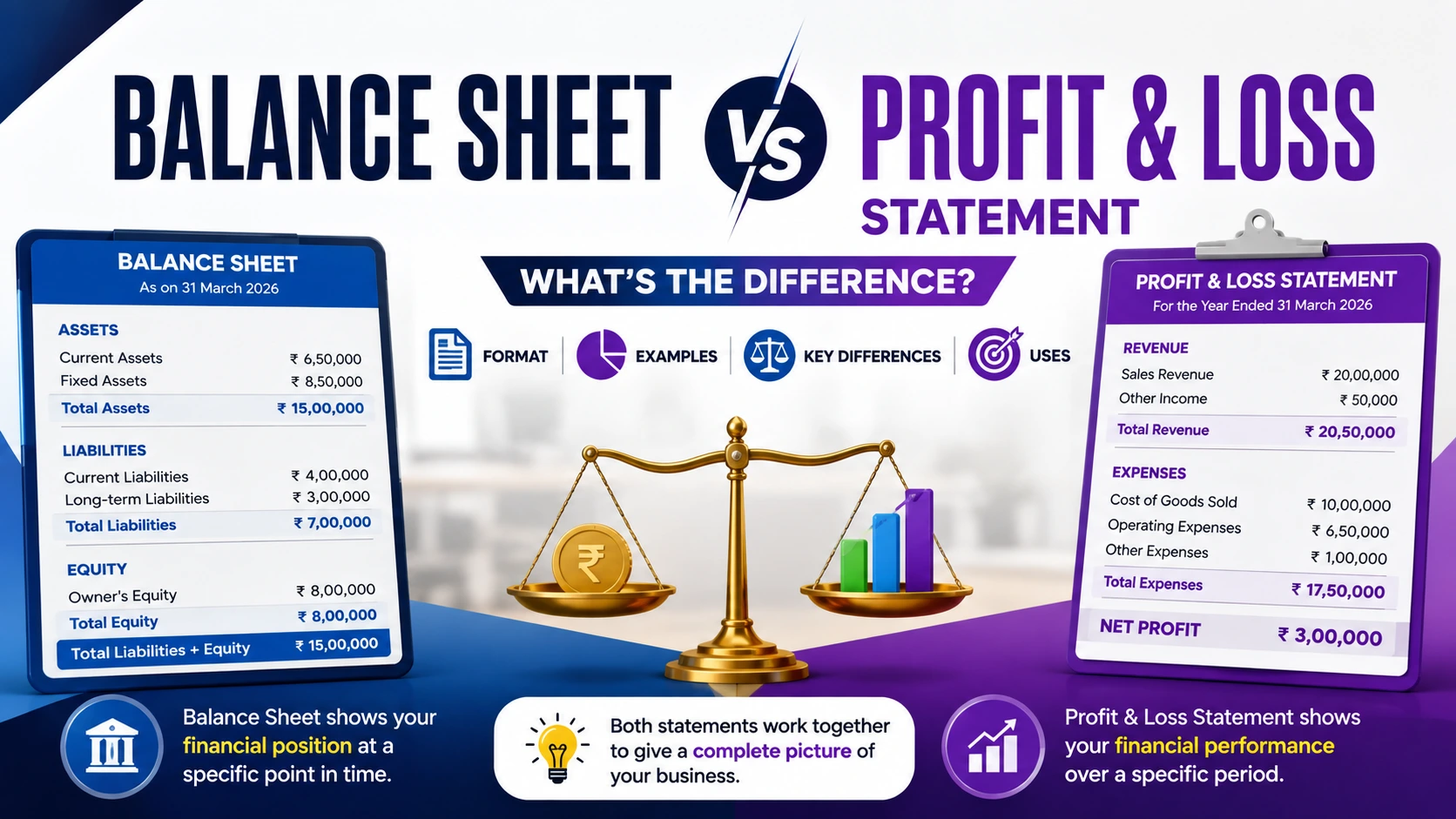
A Balance Sheet shows the financial position of a business at a specific point in time, while a Profit & Loss Statement shows the business's income, expenses and profit or loss over a specific period.
Understanding the difference between a Balance Sheet and a P&L statement is essential for business owners, accountants, managers and anyone responsible for financial decision-making.
In this guide, we will explain the Balance Sheet vs Profit & Loss Statement, their formats, examples, differences, relationship and how businesses can use both reports to make better decisions.
What Is a Balance Sheet?
A Balance Sheet is a financial statement that shows what a business owns, what it owes and the owner's or shareholders' equity at a specific date.
In simple terms, it provides a snapshot of the financial position of your business.
The three main components of a Balance Sheet are:
- Assets
- Liabilities
- Equity
The fundamental accounting equation is:
Assets = Liabilities + Equity
y=2x,y=x2
At x = 1, direct y = 2; y divided by x stays 2. Inverse y = 2; x times y stays 2.
xxx
xxx
Drag either highlighted point
0.511.522.5123456Direct: y = 2xInverse: y = 2/x
y=2x,y=x2
For example, suppose a business has:
- Assets: ₹10,00,000
- Liabilities: ₹4,00,000
- Owner's Equity: ₹6,00,000
The Balance Sheet will show:
₹10,00,000 = ₹4,00,000 + ₹6,00,000
This means the company's assets are financed through a combination of liabilities and owner's equity.
What Does a Balance Sheet Tell You?
A Balance Sheet can help you understand:
- How much the business owns
- How much the business owes
- Available cash and other current assets
- Outstanding loans
- Amount receivable from customers
- Inventory value
- Owner's capital
- Overall financial position
It is particularly useful when evaluating the financial health and stability of a business.
What Is a Profit & Loss Statement?
A Profit & Loss Statement, commonly called a P&L statement, shows the revenue earned and expenses incurred by a business during a particular period.
It helps answer one of the most important questions for any business:
Did the business make a profit or a loss?
Unlike a Balance Sheet, which represents a particular date, a P&L statement covers a period such as:
- One month
- One quarter
- Six months
- One financial year
The basic calculation is:
Profit = Revenue − Expenses
For example:
- Revenue: ₹15,00,000
- Expenses: ₹11,00,000
Therefore:
Profit = ₹15,00,000 − ₹11,00,000 = ₹4,00,000
The P&L statement helps business owners understand whether their operations are generating enough income to cover their costs.
Balance Sheet vs Profit & Loss Statement: Quick Comparison
| Difference | Balance Sheet | Profit & Loss Statement |
|---|---|---|
| Main purpose | Shows financial position | Shows financial performance |
| Measures | Assets, liabilities and equity | Revenue, expenses and profit/loss |
| Time | Specific date | Specific period |
| Main question | What does the business own and owe? | Is the business profitable? |
| Main components | Assets, liabilities, equity | Revenue, expenses, gains, losses |
| Accounting equation | Assets = Liabilities + Equity | Profit = Revenue − Expenses |
| Shows profit? | Indirectly through equity/retained earnings | Directly |
| Shows assets? | Yes | No |
| Shows liabilities? | Yes | Generally no |
| Used for | Financial position and stability | Profitability and performance |
Difference Between Balance Sheet and Profit & Loss Statement
Although both statements are part of financial reporting, there are several important differences.
1. Difference in Purpose
The biggest difference is their purpose.
A Balance Sheet tells you about the financial position of the business.
A P&L Statement tells you about the financial performance of the business.
For example:
If you want to know whether your business is profitable, look at the P&L.
If you want to know how much cash, inventory, debt and capital the business has, look at the Balance Sheet.
2. Difference in Time Period
A Balance Sheet represents the business at a specific point in time.
For example:
Balance Sheet as of March 31, 2026
It shows the financial position on that particular date.
A P&L statement covers a period of time.
For example:
Profit & Loss Statement for April 1, 2025 to March 31, 2026
It shows the revenue and expenses generated during the entire period.
Simple way to remember:
Balance Sheet = Snapshot
P&L = Movie
The Balance Sheet tells you what the business looks like at one moment, while the P&L shows what happened over a period.
3. Difference in Components
A Balance Sheet primarily contains:
Assets
Resources owned or controlled by the business.
Examples include:
- Cash
- Bank balance
- Inventory
- Accounts receivable
- Equipment
- Furniture
- Buildings
- Vehicles
Liabilities
Amounts the business owes to others.
Examples include:
- Business loans
- Accounts payable
- Outstanding expenses
- Tax liabilities
- Other borrowings
Equity
The owner's financial interest in the business.
Examples include:
- Owner's capital
- Retained earnings
- Other equity balances
A P&L statement primarily contains:
Revenue
Money earned from selling products or services.
Examples:
- Sales revenue
- Service income
- Other operating income
Expenses
Costs incurred to operate the business.
Examples include:
- Rent
- Salaries
- Electricity
- Advertising
- Transportation
- Software subscriptions
- Office expenses
- Interest expenses
The final result is the business's profit or loss.
4. Balance Sheet vs P&L: Assets and Expenses Are Not the Same
One common accounting mistake is confusing assets with expenses.
Suppose your business purchases a laptop for ₹80,000.
Depending on the accounting treatment, the laptop may be recorded as an asset, rather than treating the entire purchase price as an immediate operating expense.
On the other hand, if you pay ₹20,000 for monthly office rent, that is generally recorded as an expense.
Therefore:
Asset = Resource providing future economic benefit
Expense = Cost incurred in running the business
This distinction is important when preparing financial statements.
5. Profit Appears in the P&L, But It Also Affects the Balance Sheet
The two statements are not independent.
The profit or loss calculated through the P&L can ultimately affect the equity section of the Balance Sheet.
For example, suppose your business earns:
Revenue = ₹20,00,000
and incurs:
Expenses = ₹15,00,000
Therefore:
Net Profit = ₹5,00,000
If that profit is retained in the business, it can increase the business's equity or retained earnings.
This is one of the important connections between the two financial statements.
Balance Sheet Format
A simplified Balance Sheet can look like this:
Balance Sheet as of March 31, 2026
| Assets | Amount |
|---|---|
| Cash | ₹1,00,000 |
| Bank | ₹2,00,000 |
| Accounts Receivable | ₹2,50,000 |
| Inventory | ₹3,00,000 |
| Equipment | ₹1,50,000 |
| Total Assets | ₹10,00,000 |
| Liabilities & Equity | Amount |
|---|---|
| Business Loan | ₹2,50,000 |
| Accounts Payable | ₹1,50,000 |
| Owner's Capital | ₹6,00,000 |
| Total Liabilities + Equity | ₹10,00,000 |
The two sides must balance:
Total Assets = Total Liabilities + Equity
Profit & Loss Statement Format
A simplified P&L statement may look like this:
Profit & Loss Statement
For the Year Ended March 31, 2026
| Particulars | Amount |
|---|---|
| Sales Revenue | ₹20,00,000 |
| Less: Cost of Goods Sold | ₹10,00,000 |
| Gross Profit | ₹10,00,000 |
| Rent | ₹1,20,000 |
| Salaries | ₹2,00,000 |
| Marketing | ₹80,000 |
| Electricity | ₹40,000 |
| Other Expenses | ₹60,000 |
| Total Operating Expenses | ₹5,00,000 |
| Net Profit | ₹5,00,000 |
This statement helps the business owner understand where revenue is coming from and where money is being spent.
Example: Balance Sheet vs Profit & Loss Statement
Consider a small retail business.
During the year, the business generates:
Sales = ₹30,00,000
Its total expenses are:
₹24,00,000
Therefore:
Net Profit = ₹6,00,000
The P&L statement will show this ₹6,00,000 profit.
Now suppose that at the end of the financial year, the business has:
- Cash: ₹2,00,000
- Bank balance: ₹3,00,000
- Inventory: ₹5,00,000
- Receivables: ₹4,00,000
- Equipment: ₹6,00,000
The Balance Sheet will show these assets along with the business's liabilities and equity.
So, the two statements answer different questions:
P&L:
"How did my business perform during the year?"
Balance Sheet:
"What is my business's financial position at the end of the year?"
Why Is the Profit & Loss Statement Important?
A P&L statement helps business owners understand profitability.
It can help you identify:
1. Whether the business is profitable
You can compare revenue against expenses to determine whether the business generated a profit or loss.
2. Which expenses are increasing
If expenses increase faster than revenue, profitability can decline.
3. Gross and net profit
Businesses can analyze gross profit, operating expenses and net profit.
4. Pricing decisions
If profit margins are too low, the business may need to reconsider pricing or costs.
5. Business performance
Comparing P&L statements across different months or years can reveal trends.
Why Is the Balance Sheet Important?
A Balance Sheet provides a different perspective.
1. Understand assets
It shows the resources available to the business.
2. Monitor liabilities
Business owners can see outstanding loans, payables and other obligations.
3. Measure financial stability
A business with significant assets and manageable liabilities may have a stronger financial position.
4. Understand working capital
Current assets and current liabilities can help businesses evaluate short-term liquidity.
5. Support financial decisions
Banks, investors and business owners may use Balance Sheet information when evaluating financial strength.
Can a Business Have Profit but Still Have Cash Problems?
Yes.
This is an important reason why looking at only the P&L is not enough.
A business can report a profit but still face cash-flow difficulties.
For example, suppose you make ₹10,00,000 worth of sales, but customers have not yet paid the money.
The P&L may recognize the revenue according to the applicable accounting basis, but the business may not yet have received the cash.
At the same time, the business may have immediate payments such as:
- Salaries
- Rent
- Supplier payments
- Taxes
- Loan repayments
This is why business owners should examine both profitability and financial position rather than relying on a single report.
Balance Sheet vs P&L: Which One Is More Important?
Neither statement is more important in every situation.
They answer different questions.
If you want to know:
"Is my business making money?"
→ Check the P&L Statement.
If you want to know:
"What does my business own and owe?"
→ Check the Balance Sheet.
If you want a more complete understanding of your business's financial health:
→ Review both.
How Often Should Businesses Prepare These Statements?
The frequency depends on the business and its accounting requirements.
Many businesses review financial reports:
- Monthly
- Quarterly
- Half-yearly
- Annually
For small businesses, monthly financial reporting can be particularly useful because it allows owners to identify problems earlier.
For example, if operating expenses suddenly increase for three consecutive months, the business owner can investigate the reason before the problem becomes larger.
Balance Sheet vs Profit & Loss Statement for Small Businesses
Small businesses often focus heavily on sales and bank balances.
However, these alone do not provide a complete picture.
A business owner should ideally monitor:
- Revenue
- Gross profit
- Net profit
- Cash
- Bank balance
- Accounts receivable
- Accounts payable
- Inventory
- Loans
- Working capital
- Owner's equity
The P&L helps monitor performance, while the Balance Sheet helps monitor financial position.
Together, they provide a much clearer picture.
How Accounting Software Can Help
Preparing financial statements manually can become difficult as the number of transactions increases.
Accounting software can automatically organize transactions such as:
- Sales
- Purchases
- Expenses
- Payments
- Receipts
- Customer balances
- Supplier balances
- Inventory transactions
This makes it easier to generate financial reports and monitor business performance.
With LedgerX, businesses can manage accounting records online and use financial reports to better understand their business performance.
Explore LedgerX Free Online Accounting Software
Balance Sheet vs P&L: Common Mistakes
Mistake 1: Treating the Balance Sheet as a Profit Report
A Balance Sheet does not primarily show how much profit was generated during a period.
For profitability, use the P&L.
Mistake 2: Looking Only at Revenue
High revenue does not automatically mean high profit.
A business with ₹1 crore in revenue and ₹99 lakh in expenses may have a much smaller profit than expected.
Mistake 3: Ignoring Liabilities
A business may have substantial assets but also significant loans and outstanding payments.
Always consider both assets and liabilities.
Mistake 4: Confusing Profit With Cash
Profit and cash are not necessarily the same.
Outstanding customer payments, inventory purchases, loans and other transactions can affect cash differently from accounting profit.
Mistake 5: Reviewing Reports Only Once a Year
Waiting until the end of the year can make it harder to identify problems early.
Regular reporting provides better visibility.
Frequently Asked Questions
Is a Balance Sheet the same as a Profit & Loss Statement?
No.
A Balance Sheet shows the assets, liabilities and equity of a business at a specific date. A P&L Statement shows revenue, expenses and profit or loss over a specific period.
What is the main difference between Balance Sheet and P&L?
The Balance Sheet measures financial position, while the P&L measures financial performance.
Which statement shows profit?
The Profit & Loss Statement directly shows the business's profit or loss.
Which statement shows assets and liabilities?
The Balance Sheet shows assets, liabilities and equity.
Does the Balance Sheet show revenue?
Revenue is primarily reported through the P&L Statement rather than the Balance Sheet.
Can a business have a profit but negative cash flow?
Yes. Profit and cash flow are different concepts. Timing of customer collections, supplier payments, inventory purchases, loan transactions and other factors can cause differences.
How are the Balance Sheet and P&L connected?
The profit or loss generated by the P&L can affect equity or retained earnings on the Balance Sheet.
Should small businesses prepare both statements?
Yes. Reviewing both provides a more complete understanding of profitability and financial position.
Balance Sheet vs Profit & Loss Statement: Final Takeaway
The Balance Sheet and Profit & Loss Statement serve different but complementary purposes.
The Balance Sheet tells you:
What does my business own and owe?
The P&L tells you:
Did my business make a profit or a loss?
A healthy business should not evaluate its performance based on revenue alone.
By regularly reviewing both statements, business owners can better understand:
- Profitability
- Assets
- Liabilities
- Equity
- Expenses
- Working capital
- Financial stability
- Business performance
For small businesses, maintaining accurate accounting records makes this process much easier.
With the right accounting system, transactions can be recorded consistently and financial reports can be generated with less manual work.
Understand your numbers. Track your performance. Make better business decisions.
Manage Your Business Accounts More Easily
Track sales, expenses, purchases and financial reports in one place with LedgerX.
Start using LedgerX for free → LedgerX