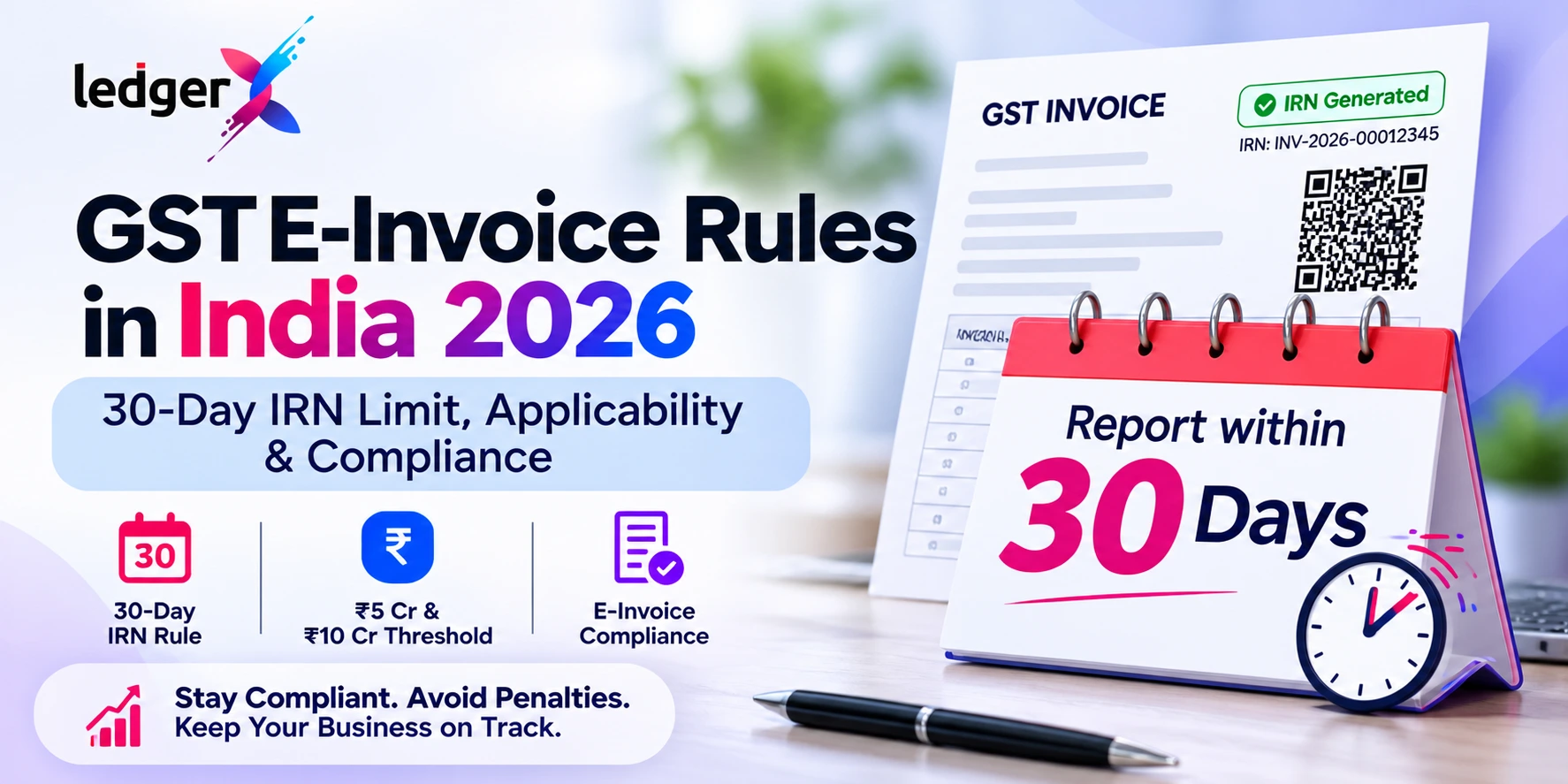
GST E-Invoice Rules in India 2026: 30-Day IRN Limit, Applicability & Compliance
GST e-invoicing is an important part of tax compliance for eligible businesses in India. It standardises how specified GST invoices and related documents are reported to the government-notified Invoice Registration Portal (IRP), helping businesses maintain consistent records and reducing manual data entry.
One important requirement businesses should understand is the 30-day e-invoice reporting restriction introduced for taxpayers with an Aggregate Annual Turnover (AATO) of ₹10 crore or more from 1 April 2025. Eligible businesses in this category cannot report covered documents to the IRP once they are more than 30 days old.
However, this is not the same as the threshold for mandatory e-invoicing. Understanding both requirements helps businesses establish appropriate invoicing processes and avoid reporting delays.
In this guide, we explain GST e-invoice rules in India for 2026, the applicability threshold, the 30-day IRN reporting limit, important exemptions, and practical steps businesses can take to maintain compliance.
What Is GST E-Invoicing?
GST e-invoicing is a system in which eligible registered taxpayers report specified invoice details to an Invoice Registration Portal and obtain an Invoice Reference Number (IRN).
An e-invoice is not simply a PDF invoice or an invoice created online. Businesses continue to create their invoices using accounting software, billing software or an ERP system. The required invoice data is then reported to the IRP.
Once the IRP successfully processes the document, it returns the applicable IRN and a digitally signed invoice containing a QR code.
According to the Goods and Services Tax Network (GSTN), this process supports standardisation and can facilitate the auto-population of invoice information into GST returns and other related documents.
Businesses can refer to the official GSTN e-invoicing overview for more information.
GST E-Invoice Rules in India for 2026
Businesses should distinguish between the rules determining whether e-invoicing applies and the rules governing when an eligible invoice must be reported.
1. Mandatory E-Invoicing Applicability
Under the notified framework, e-invoicing applies to specified registered persons whose aggregate turnover exceeds ₹5 crore in a financial year from 2017–18 onwards, subject to the applicable rules and exemptions.
This means eligibility is not determined only by the turnover in the current financial year. Businesses must consider the relevant preceding financial years as prescribed.
The applicable threshold and exemptions should be checked against the latest notifications and the business's circumstances.
2. The 30-Day IRN Reporting Restriction
From 1 April 2025, the IRP reporting restriction applies to taxpayers with an AATO of ₹10 crore or more. Such taxpayers cannot report covered invoices, debit notes or credit notes more than 30 days after the document date.
For example, an invoice dated 1 April must be reported within the permitted 30-day window. The IRP will reject a document reported after the applicable window.
This restriction is a portal validation requirement. It should not be confused with the GST return filing deadline or treated as a separate statutory penalty in itself.
The GST Council's published advisory explains the reporting restriction and its effective date. See the GST Council e-invoice reporting advisory.
3. Which Documents Are Covered?
For taxpayers required to comply with e-invoicing, the system generally covers specified documents such as:
- GST invoices for applicable business-to-business supplies.
- Invoices for applicable export transactions.
- Credit notes.
- Debit notes.
The exact applicability depends on the notified provisions and the nature of the transaction.
Ordinary B2C invoices are not generally reported through the e-invoice system under the current framework.
Difference Between the ₹5 Crore Threshold and the ₹10 Crore Rule
These two thresholds serve different purposes.
| Requirement | Threshold | What it means |
|---|---|---|
| Mandatory e-invoicing | Aggregate turnover exceeding ₹5 crore in a relevant financial year, subject to rules and exemptions | Determines whether a registered taxpayer falls within the notified e-invoicing framework |
| 30-day IRP reporting restriction | AATO of ₹10 crore or more | Restricts how late covered documents can be reported to the IRP |
Example: A business with an applicable turnover of ₹7 crore may fall under mandatory e-invoicing but not under the specific 30-day restriction for taxpayers with AATO of ₹10 crore or more.
A business with an AATO of ₹12 crore that is subject to e-invoicing must account for both requirements.
This distinction is important when businesses configure their accounting processes. The absence of the 30-day restriction does not automatically exempt a taxpayer from e-invoicing.
What Is an IRN in GST?
IRN stands for Invoice Reference Number. It is a unique reference generated through the e-invoice registration process for a successfully reported document.
The IRN helps identify the registered invoice and is associated with the digitally signed e-invoice and its QR code.
An invoice number and an IRN are not the same:
- Invoice number: Assigned by the supplier using its invoice numbering system.
- IRN: Generated through the Invoice Registration Portal after successful reporting.
A business should maintain both references where applicable so that invoices can be retrieved and verified correctly.
How Does the GST E-Invoice Process Work?
The typical process for an eligible business is as follows.
Step 1: Create the Invoice
Prepare the invoice using accounting software, billing software or an ERP system. Include the required invoice details and tax information.
Step 2: Validate the Invoice Data
Check customer information, GSTINs, invoice dates, taxable values, tax amounts and other applicable fields.
Errors in the source data can cause reporting failures or require corrective action.
Step 3: Report the Invoice to the IRP
Submit the required invoice data through an enabled software integration or the applicable portal process.
Step 4: Receive the IRN and Signed QR Code
After successful registration, the IRP returns the IRN and digitally signed e-invoice information, including the applicable QR code.
Step 5: Issue and Maintain the Invoice
Provide the invoice to the recipient as required and preserve the corresponding records.
Step 6: Reconcile Accounting and GST Records
Verify that the reported invoice is correctly reflected in the business's accounting records and relevant GST reporting processes.
How Can Businesses Avoid Missing the 30-Day Reporting Window?
Businesses covered by the restriction should make invoice reporting part of their regular workflow rather than leaving it until the end of the month.
1. Generate Invoices Promptly
Create invoices as soon as the relevant transaction and documentation requirements are met. Delays in invoice preparation can reduce the time available for reporting.
2. Monitor Unreported Documents
Maintain a process for identifying invoices, debit notes and credit notes that still require IRN generation.
For businesses with high invoice volumes, a daily review can help identify pending documents before they approach the deadline.
3. Use Software That Supports E-Invoicing
Accounting or billing software with appropriate e-invoice integration can help businesses submit invoice data and maintain related records.
Before selecting or configuring a solution, verify its supported IRP integration, reporting workflow, error handling and current capabilities.
4. Assign Responsibility
Define who is responsible for preparing invoices, submitting them to the IRP, resolving errors and checking successful registration.
A clear workflow is particularly important when several employees or branches issue invoices.
5. Review Failed Reports
A submitted invoice is not necessarily a successfully registered e-invoice. Check the response from the IRP and resolve validation errors promptly.
6. Reconcile Invoice and IRN Records
Maintain a reliable relationship between the internal invoice number, IRN, document date and reporting status.
This helps the accounting team identify documents that are still pending or need further attention.
What Happens If an Invoice Is Reported After 30 Days?
For taxpayers covered by the restriction, the IRP rejects a covered document submitted after the permitted 30-day window.
This can disrupt the normal invoicing workflow and may require the business to investigate the document's status and seek appropriate professional guidance on the available corrective steps.
Do not assume that changing the invoice date or generating a different invoice number will resolve the issue. Any correction or reissuance must follow the applicable GST and accounting requirements.
Businesses should also distinguish between an IRP reporting restriction and the consequences of a separate GST compliance failure. The circumstances and applicable provisions determine what further action may be necessary.
If a deadline has been missed, consult a qualified GST professional and check the latest official guidance before taking corrective action.
Who Is Exempt from GST E-Invoicing?
The e-invoicing framework includes specified exclusions and exemptions. GSTN's published overview identifies categories such as:
- Special Economic Zone units.
- Insurance companies.
- Banking companies and specified financial institutions, including NBFCs.
- Goods Transport Agencies providing the specified transport services.
- Passenger transport service providers.
- Multiplex cinema admission service providers.
The exact scope depends on the relevant notification and the category of taxpayer. Some descriptions of exempt categories are subject to specific legal wording, so businesses should not rely solely on a simplified list.
Review the current GSTN e-invoicing guidance and the relevant CBIC notifications to determine whether an exemption applies.
Common GST E-Invoicing Mistakes
Confusing the Two Turnover Thresholds
The ₹5 crore applicability threshold and the ₹10 crore reporting restriction are different. A business may be subject to mandatory e-invoicing without being subject to the specific 30-day restriction.
Reporting Invoices Too Late
Eligible businesses subject to the restriction should not wait until the end of the month to report documents created earlier.
Assuming a PDF Is an E-Invoice
A PDF invoice alone does not satisfy the e-invoicing process where an IRN is required. The applicable invoice data must be successfully registered through the IRP.
Ignoring Failed IRP Responses
Businesses should verify successful registration rather than assuming that every submitted document has received an IRN.
Using Incorrect Invoice Data
Incorrect GSTINs, dates, tax values or other required details can create validation problems. Review the source data before submission.
Failing to Reconcile Records
Invoice registers, accounting entries and GST records should be reviewed for inconsistencies and missing documents.
How Accounting Software Helps with GST Invoicing
Businesses subject to GST e-invoicing often manage large volumes of invoices, customer records, tax values and accounting entries.
Accounting software can help centralise invoice creation, maintain sales records, track expenses and organise financial reports. Where e-invoice integration is available, it can also support the reporting workflow.
When evaluating accounting software, businesses should check:
- GST invoice creation and tax calculations.
- Support for the applicable e-invoice reporting process.
- IRN and QR-code handling, where supported.
- Invoice status tracking and error visibility.
- Customer and supplier record management.
- Sales reports and accounting reconciliation.
- Access controls and reliable record retention.
LedgerX provides GST billing and accounting features for Indian businesses, including invoice management, sales and purchase records, expense tracking, inventory management and financial reporting.
Businesses considering LedgerX should verify the current availability and scope of any e-invoice or IRP integration before relying on it for mandatory e-invoice reporting.
Explore LedgerX accounting software to learn more about its features.
Frequently Asked Questions
Is GST e-invoicing mandatory for businesses with turnover above ₹5 crore?
E-invoicing applies to specified registered persons whose aggregate turnover exceeds the notified threshold of ₹5 crore in a relevant financial year, subject to applicable exemptions and conditions.
What is the 30-day IRN rule?
From 1 April 2025, taxpayers with an AATO of ₹10 crore or more cannot report covered invoices, debit notes or credit notes to the IRP more than 30 days after the document date.
Does the 30-day rule apply to every GST-registered business?
No. The specific 30-day reporting restriction applies to taxpayers with an AATO of ₹10 crore or more. Other eligible taxpayers may still be required to comply with mandatory e-invoicing but are not subject to this particular restriction under the published advisory.
Is an invoice number the same as an IRN?
No. The supplier assigns the invoice number, while the IRN is generated through the Invoice Registration Portal after successful registration.
Are B2C invoices covered by GST e-invoicing?
Ordinary B2C invoices are not generally covered by the current e-invoice reporting process. Businesses should check the applicable rules for their specific transactions.
Can a business report an invoice after the 30-day window?
For taxpayers covered by the restriction, the IRP rejects covered documents reported after the permitted window. Businesses should seek qualified advice on the appropriate next steps rather than altering invoice details without a valid basis.
Does using accounting software automatically ensure GST compliance?
No. Software can support invoice creation and reporting workflows, but businesses must configure it correctly, maintain accurate records, monitor reporting status and follow the applicable rules.
Conclusion
GST e-invoicing requires eligible businesses to report specified documents through the Invoice Registration Portal and obtain the applicable IRN.
For 2026, businesses should pay particular attention to two separate requirements: the ₹5 crore threshold governing mandatory e-invoicing applicability and the 30-day IRP reporting restriction for taxpayers with an AATO of ₹10 crore or more.
A structured invoicing process, accurate transaction data and regular monitoring of reporting status can help businesses reduce errors and avoid preventable delays.
Simplify your business accounting with LedgerX. Explore GST billing, sales and purchase management, expense tracking, inventory and financial reporting at ledgerx.biz.
Disclaimer: This article is for general informational purposes and is not legal or tax advice. GST provisions, notifications and portal requirements may change. Verify the latest official guidance and consult a qualified tax professional for advice specific to your business.