How to Calculate Closing Balance in Accounting (2026 Guide for Small Businesses)
Every business needs to know how much money it has at the end of the day, month, or financial year. This value is known as the closing balance.
Whether you're managing a small business, retail shop, manufacturing unit, or startup, calculating the correct closing balance helps you monitor cash flow, prepare financial statements, and make informed business decisions.
This guide explains everything you need to know about calculating closing balances in accounting.
What is a Closing Balance?
A closing balance is the final balance remaining in an account after recording all transactions during a specific accounting period.
It becomes the opening balance for the next accounting period.
Examples include:
- Cash Closing Balance
- Bank Closing Balance
- Customer Closing Balance
- Supplier Closing Balance
- Inventory Closing Balance
- Ledger Closing Balance
Closing Balance Formula
The standard formula is:
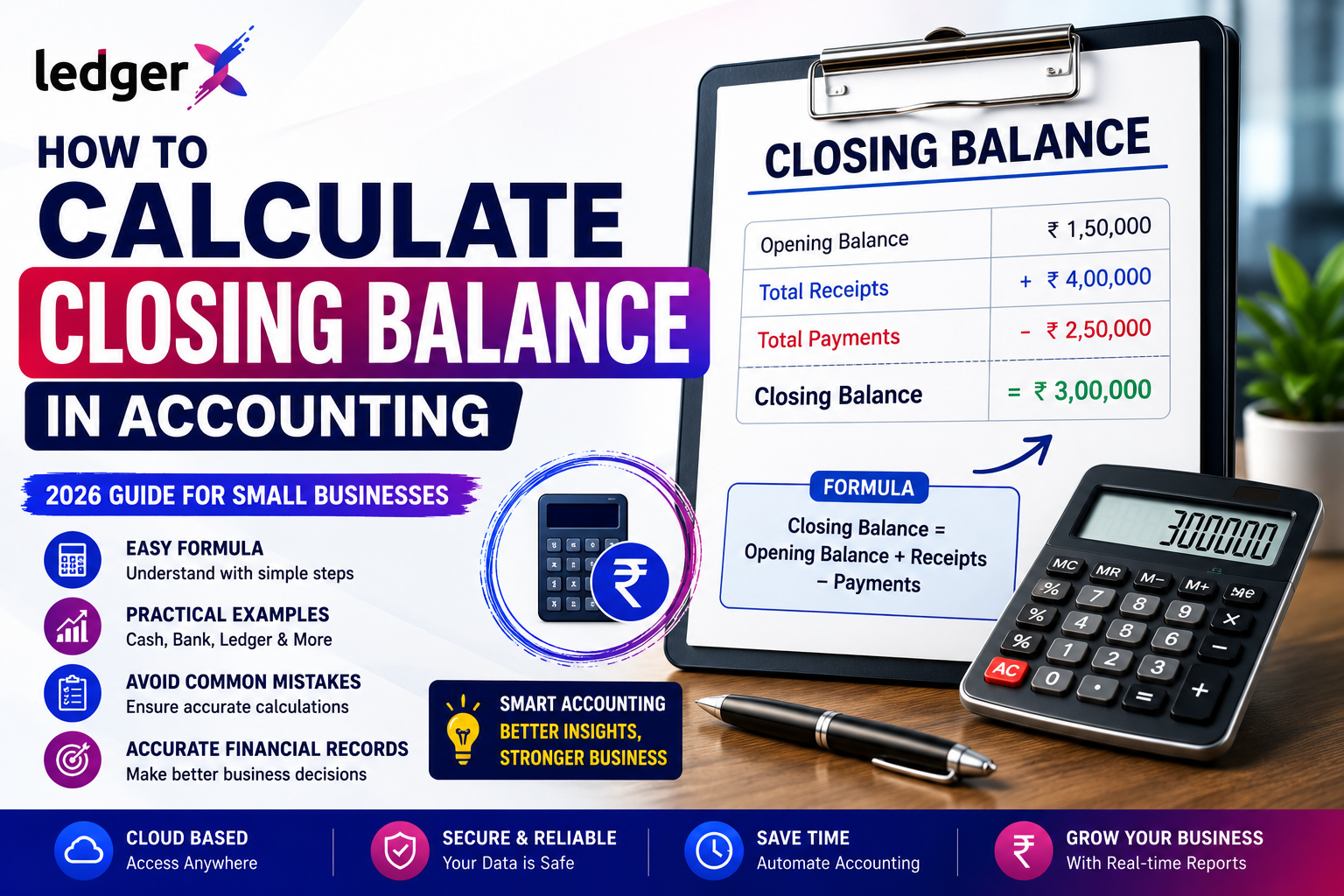
Closing Balance = Opening Balance + Total Receipts – Total Payments
or
Closing Balance = Opening Balance + Debit Entries – Credit Entries
The formula varies slightly depending on the type of account.
Example of Closing Balance Calculation
Suppose your business has:
| Particular | Amount |
|---|---|
| Opening Cash Balance | ₹1,50,000 |
| Sales Received | ₹3,20,000 |
| Customer Collections | ₹80,000 |
| Business Expenses | ₹1,10,000 |
| Supplier Payments | ₹1,40,000 |
Calculation
Opening Balance ₹1,50,000 + Total Receipts ₹4,00,000 − Total Payments ₹2,50,000 = Closing Balance ₹3,00,000
Your cash closing balance is ₹3,00,000.
Types of Closing Balances
Cash Closing Balance
Shows the amount of cash available in hand after all daily transactions.
Useful for:
- Daily cash reconciliation
- Retail businesses
- Cash sales
- Expense tracking
Bank Closing Balance
Represents the final balance in your business bank account.
It helps businesses:
- Match bank statements
- Reconcile payments
- Detect banking errors
- Track available funds
Customer Closing Balance
Shows the amount receivable from customers after invoices and payments are recorded.
Useful for:
- Outstanding collections
- Credit sales
- Customer ageing reports
Supplier Closing Balance
Displays the amount payable to vendors and suppliers.
This helps businesses:
- Plan payments
- Avoid overdue bills
- Maintain supplier relationships
Inventory Closing Balance
Represents the value of unsold stock at the end of the accounting period.
Inventory closing balances are essential for:
- Profit calculation
- GST reporting
- Balance Sheet preparation
Why is Closing Balance Important?
Accurate closing balances help businesses:
- Prepare Profit & Loss Statements
- Generate Balance Sheets
- File GST Returns
- Monitor business cash flow
- Track profitability
- Reconcile bank accounts
- Detect accounting errors early
Without accurate closing balances, financial reports become unreliable.
Common Mistakes While Calculating Closing Balance
Many businesses make these common mistakes:
❌ Missing expense entries
❌ Duplicate receipts
❌ Ignoring bank charges
❌ Not recording GST adjustments
❌ Incorrect opening balance
❌ Inventory valuation errors
Review your transactions regularly to avoid reporting mistakes.
How LedgerX Automatically Calculates Closing Balance
With LedgerX Cloud Accounting Software, you don't have to calculate balances manually.
LedgerX automatically updates closing balances whenever you:
- Create invoices
- Record expenses
- Add receipts
- Make payments
- Purchase inventory
- Record journal entries
- Reconcile bank transactions
Real-time balances are instantly reflected across all financial reports.
Benefits of Using LedgerX
LedgerX helps Indian businesses simplify accounting with features like:
- GST-ready accounting
- Real-time cash and bank balances
- Automatic ledger updates
- Customer and supplier management
- Inventory tracking
- Financial reporting
- Profit & Loss Statement
- Balance Sheet
- AI-powered business insights
Whether you're a retailer, wholesaler, startup, manufacturer, or service provider, LedgerX keeps your financial records accurate and up to date.
Closing Balance vs Opening Balance
| Opening Balance | Closing Balance |
|---|---|
| Starting amount of an accounting period | Final amount after all transactions |
| Entered once at the beginning | Calculated automatically after transactions |
| Comes from previous period | Becomes the next opening balance |
Frequently Asked Questions
What is the closing balance?
Closing balance is the final amount remaining in an account after recording all transactions during an accounting period.
Is closing balance carried forward?
Yes. The closing balance becomes the opening balance for the next accounting period.
What is the formula for calculating closing balance?
Closing Balance = Opening Balance + Receipts − Payments
Can LedgerX calculate closing balances automatically?
Yes. LedgerX automatically calculates cash, bank, customer, supplier, inventory, and ledger balances in real time.
Conclusion
Calculating an accurate closing balance is essential for maintaining healthy business finances. It ensures your reports, GST filings, cash flow, and profitability calculations remain accurate.
Instead of manually maintaining ledgers, businesses can automate the entire process using LedgerX Accounting Software, saving time while reducing accounting errors.
.png)