How to Calculate Profit and Loss Statement?
A Profit and Loss Statement (P&L) is one of the most important financial reports for a business. It shows how much revenue a business generated, what it spent and whether it made a profit or loss during a specific period.
For small business owners, a P&L statement can answer a simple but important question:
Is my business actually making money?
A properly prepared P&L can also help business owners understand which expenses are increasing, whether margins are improving and where the business may need to reduce costs.
In this guide, we'll explain the Profit and Loss Statement formula, format, components, calculation and a practical example.
What Is a Profit and Loss Statement?
A Profit and Loss Statement, also called an income statement, summarizes a business's income and expenses for a particular accounting period.
It generally includes:
- Revenue from operations
- Other income
- Cost of goods sold
- Gross profit
- Operating expenses
- Finance costs
- Depreciation
- Taxes
- Net profit or net loss
The final result tells you whether the business generated a profit or incurred a loss during that period.
For Indian companies, the presentation of financial statements can also be governed by the applicable Schedule III requirements of the Companies Act, 2013.
Profit and Loss Formula
At its simplest:
Profit = Total Revenue − Total Expenses
If revenue is greater than expenses, the result is a profit.
If expenses are greater than revenue, the result is a loss.
However, preparing a complete P&L involves several stages, including calculating gross profit, operating profit and finally net profit.
Main Components of a Profit and Loss Statement
1. Revenue
Revenue is the income generated from the business's primary activities.
For example:
- Product sales
- Service income
- Trading income
- Professional fees
For a trading business, revenue may primarily come from the sale of goods.
2. Cost of Goods Sold
Cost of Goods Sold (COGS) represents the direct cost associated with the goods sold during the period.
A commonly used formula is:
COGS = Opening Stock + Purchases + Direct Expenses − Closing Stock
For example:
Opening Stock = ₹2,00,000
Purchases = ₹5,00,000
Direct Expenses = ₹50,000
Closing Stock = ₹1,50,000
COGS = ₹2,00,000 + ₹5,00,000 + ₹50,000 − ₹1,50,000
COGS = ₹6,00,000
3. Gross Profit
Gross profit shows how much remains after deducting the direct cost of goods sold from net sales.
Gross Profit = Net Sales − COGS
For example:
Net Sales = ₹10,00,000
COGS = ₹6,00,000
Gross Profit = ₹4,00,000
Gross profit is useful for understanding the profitability of the products or services before considering operating expenses.
4. Operating Expenses
Operating expenses are the costs required to run the business.
Examples include:
- Salaries
- Rent
- Electricity
- Internet
- Advertising
- Office expenses
- Transportation
- Professional fees
- Repairs and maintenance
- Software expenses
These expenses are generally deducted after calculating gross profit.
5. Operating Profit
Operating profit shows the profit generated from the core operations of the business before certain non-operating costs and taxes.
A simplified formula is:
Operating Profit = Gross Profit − Operating Expenses
For example:
Gross Profit = ₹4,00,000
Operating Expenses = ₹2,50,000
Operating Profit = ₹1,50,000
6. Other Income and Expenses
A business may have income or expenses outside its main operating activities.
Examples include:
- Interest income
- Investment income
- Interest expenses
- Certain financial costs
These may need to be considered before arriving at the final profit.
7. Net Profit
Net profit represents the final profit after accounting for the relevant expenses and applicable items.
A simplified calculation is:
Net Profit = Total Income − Total Expenses
If the result is negative, the business has incurred a net loss.
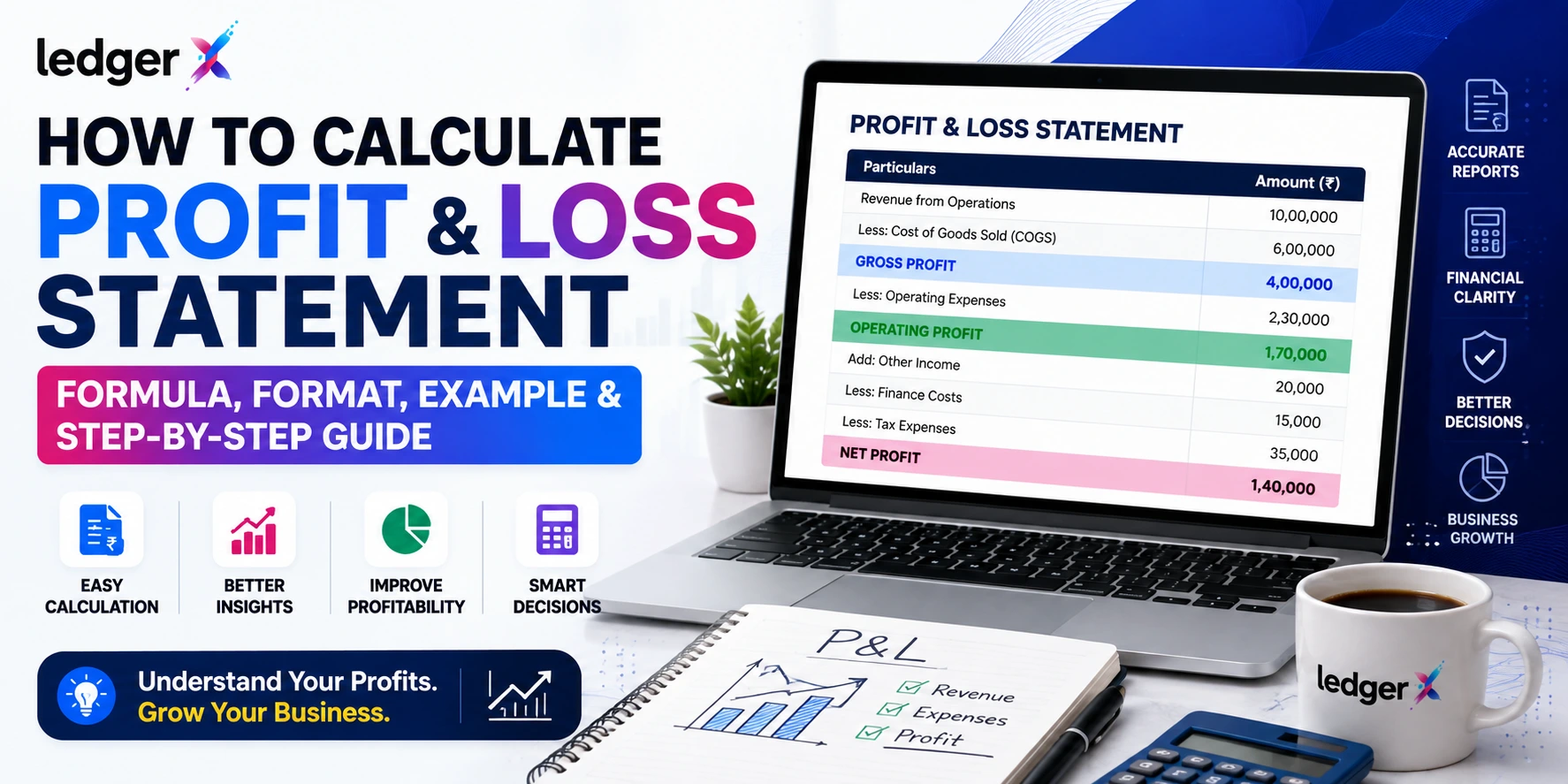
Profit and Loss Statement Example
Let's consider a simple example of a small trading business.
| Particulars | Amount |
|---|---|
| Sales | ₹10,00,000 |
| Cost of Goods Sold | ₹6,00,000 |
| Gross Profit | ₹4,00,000 |
| Rent | ₹60,000 |
| Salaries | ₹1,00,000 |
| Electricity | ₹20,000 |
| Marketing | ₹30,000 |
| Other Expenses | ₹20,000 |
| Total Operating Expenses | ₹2,30,000 |
| Operating Profit | ₹1,70,000 |
This simplified example shows how revenue flows through the P&L to arrive at operating profit.
A complete financial statement may include additional items such as finance costs, depreciation and tax expenses depending on the business and applicable accounting requirements.
How to Prepare a Profit and Loss Statement Step by Step
Step 1: Determine the accounting period
Decide whether you are preparing the P&L for:
- One month
- One quarter
- Six months
- Financial year
- Another reporting period
Step 2: Calculate total revenue
Collect all relevant sales and operating income for the period.
Make sure sales returns, discounts and other relevant adjustments are properly accounted for.
Step 3: Calculate COGS
For businesses dealing with inventory, calculate the cost of goods sold using the relevant stock, purchase and direct-expense information.
Step 4: Calculate gross profit
Subtract COGS from net sales.
Gross Profit = Net Sales − COGS
Step 5: Add operating expenses
Record expenses such as:
- Salaries
- Rent
- Utilities
- Advertising
- Transportation
- Office expenses
- Repairs
- Professional fees
Step 6: Calculate operating profit
Subtract operating expenses from gross profit.
Step 7: Account for other income and expenses
Include relevant non-operating income, finance costs and other applicable items.
Step 8: Calculate the final profit or loss
After accounting for the relevant expenses and applicable taxes, determine the final net profit or loss.
Gross Profit vs Net Profit
These two terms are often confused.
Gross Profit
Gross profit focuses primarily on revenue and the direct cost of goods or services.
Gross Profit = Net Sales − COGS
Net Profit
Net profit takes the broader business expenses and other relevant items into consideration.
Therefore:
Gross profit tells you about direct profitability.
Net profit tells you about the overall profitability of the business.
What Does a Profit and Loss Statement Tell a Business Owner?
A P&L isn't just an accounting document.
It can help answer practical business questions such as:
Are sales increasing?
Compare revenue across different months or financial years.
Are expenses increasing faster than sales?
A business can have increasing revenue while becoming less profitable if expenses rise faster.
Are margins improving?
Gross and net profit margins can help you evaluate profitability.
Which expenses are consuming the most money?
A detailed P&L can reveal areas where costs may need attention.
Is the business actually profitable?
Revenue alone does not mean the business is profitable.
A business can generate ₹1 crore in sales and still have a very small profit if its expenses are high.
Profit Is Not the Same as Cash
This is an important concept for business owners.
A business can show a profit on its P&L while still experiencing cash-flow problems.
For example, suppose a business makes a large credit sale. The sale may contribute to revenue, but the customer may not have paid yet.
Therefore:
Profitability and cash flow are related, but they are not the same thing.
This is why businesses should monitor their P&L alongside cash, receivables, payables and other financial reports.
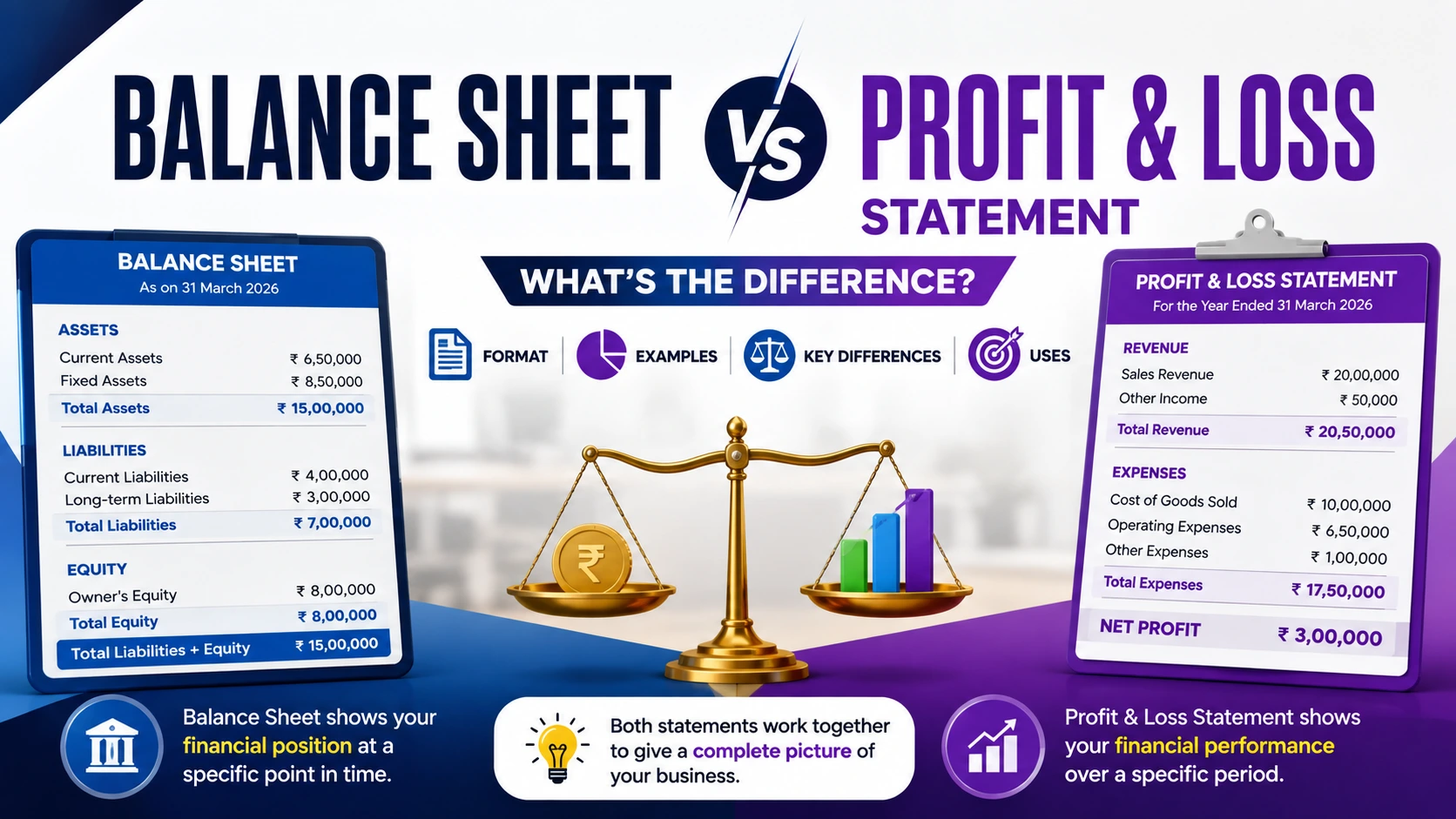
Profit and Loss Statement vs Balance Sheet
A P&L and a Balance Sheet provide different information.
| Profit & Loss Statement | Balance Sheet |
| Shows income and expenses | Shows assets and liabilities |
| Covers a period | Shows financial position at a point in time |
| Determines profit or loss | Shows business net worth/financial position |
| Helps analyze profitability | Helps analyze financial strength |
Both reports are important for understanding the financial health of a business.
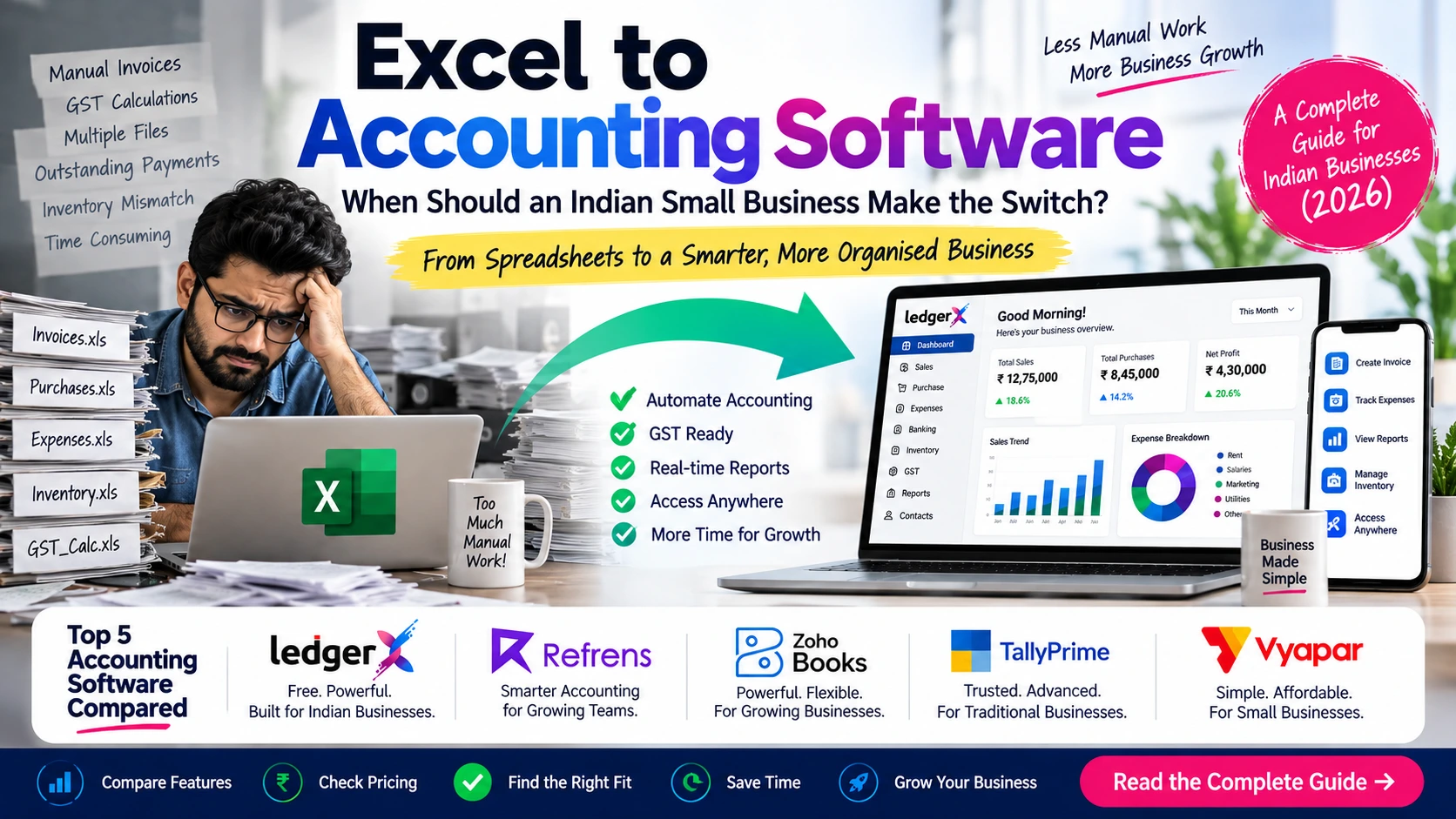
How Accounting Software Makes P&L Reporting Easier
Preparing a P&L manually using spreadsheets can become difficult as transaction volume increases.
Accounting software can automatically organize information from:
- Sales
- Purchases
- Expenses
- Payments
- Receipts
- Inventory
- Customers
- Suppliers
This can make financial reporting faster and reduce repetitive manual calculations.
With cloud-based accounting software, business owners and accountants can also access financial information online, depending on the platform.
How LedgerX Helps With Profit & Loss Reporting
LedgerX is a cloud-based accounting platform designed to bring day-to-day business accounting into one system.
Business transactions such as sales, purchases, expenses, receipts and payments can be recorded and organized within the accounting system, helping businesses generate financial reports more efficiently.
LedgerX provides features including:
- Sales management
- Purchase management
- Expense management
- Customer management
- Supplier management
- Inventory management
- Receipts and payments
- Financial reports
- GST-related accounting features
- Cloud-based access
- AI-powered insights
For a small business owner, this can reduce dependence on manually maintaining multiple spreadsheets for everyday accounting.
How Often Should You Check Your P&L?
You don't necessarily need to wait until the end of the financial year.
Businesses can review their financial performance:
- Monthly
- Quarterly
- Half-yearly
- Annually
For actively managed small businesses, a monthly P&L review can provide earlier visibility into changing revenue, expenses and profitability.
Common Mistakes When Preparing a P&L
Avoid these common mistakes:
1. Mixing personal and business expenses
Keep personal and business transactions properly separated.
2. Ignoring purchase and inventory adjustments
Inventory businesses need accurate stock information to calculate COGS correctly.
3. Recording GST incorrectly
GST collected and other tax-related amounts should be handled according to the applicable accounting and tax treatment rather than simply treating all invoice amounts as business revenue.
4. Forgetting expenses
Small recurring expenses can accumulate significantly over time.
5. Using outdated data
A P&L is only useful when the underlying accounting records are reasonably complete and accurate.
6. Looking only at revenue
High sales do not automatically mean high profitability.
Key Profitability Ratios to Monitor
Once your P&L is prepared, you can calculate useful ratios.
Gross Profit Margin
Gross Profit Margin = (Gross Profit ÷ Net Sales) × 100
This shows how much gross profit the business retains from its sales after direct costs.
Net Profit Margin
Net Profit Margin = (Net Profit ÷ Net Sales) × 100
This shows the percentage of sales that remains as net profit after the relevant expenses.
Tracking these ratios over time can provide more insight than looking at profit amounts alone.
Frequently Asked Questions
What is a Profit and Loss Statement?
A Profit and Loss Statement summarizes a business's income, costs and expenses for a particular period and shows whether the business generated a profit or loss.
What is the basic P&L formula?
The basic formula is:
Profit = Revenue − Expenses
A detailed P&L involves additional calculations such as COGS, gross profit, operating expenses and other applicable items.
How do you calculate gross profit?
Gross Profit = Net Sales − Cost of Goods Sold
How do you calculate net profit?
In simplified terms:
Net Profit = Total Income − Total Expenses
The exact presentation depends on the accounting framework and the business's financial transactions.
Is GST included in profit?
GST treatment depends on the nature of the transaction and the business's tax position. GST collected from customers is generally not treated as ordinary business revenue for a regular registered taxpayer; accounting treatment should follow applicable rules.
Can accounting software generate a P&L?
Yes. Many accounting platforms can generate P&L reports from recorded business transactions.
How often should a small business prepare a P&L?
A small business can review its P&L monthly or quarterly, while annual financial statements may be prepared for the financial year and applicable reporting requirements.
Conclusion
A Profit and Loss Statement is one of the most useful reports for understanding business performance.
It helps you move beyond simply asking:
"How much did I sell?"
and start asking:
"How much did I actually earn?"
By tracking revenue, COGS, expenses, gross profit and net profit regularly, business owners can identify cost problems, monitor margins and make better financial decisions.
Using accounting software can make this process significantly easier by keeping transactions organized and generating reports from the accounting data.
Want to simplify your business accounting?
Explore LedgerX and manage your business accounting, invoicing, expenses, purchases and financial reports in one platform.
Start with LedgerX today.